LA PAZ, Bolivia: Bolivia’s President Evo Morales claimed on Sunday his political rivals were preparing to overthrow him next week as strike action and protests against his controversial re-election continued.
It was the second time in five days that the leader has warned of a coup, and it comes after Bolivia’s electoral court declared him the winner of last Sunday’s poll over his nearest challenger, Carlos Mesa.
The court said Morales had won with 47.1 percent compared to 36.5 percent for Mesa — narrowly giving him the 10-point margin he needed to win outright without a runoff.
But a sudden and unexplained change in the ballot count Monday had boosted his advantage, leading the election court’s own vice president to resign in protest.
Speaking from the rural village of Vila Vila, Morales warned that “various sectors of society... are preparing for a coup d’etat next week.”
Mesa called for a strike on Monday to protest what he said was a fraudulent election.
“All of us have to be determined, without any hesitation, to go out into the street to show that we don’t accept fraud,” Mesa said to a crowd of about 500, speaking in a church in San Miguel, an affluent neighborhood in southern La Paz.
Meanwhile, a powerful farmers’ union announced plans to block roads on Monday “in defense of the indigenous vote” to support Morales.
Foreign powers including the European Union and the United States have called for a second round of voting, while the Organization of American States (OAS) expressed its “surprise” and “concern” over the sudden vote shift.
The Washington-based OAS is planning an audit of the results.
Mesa, a former president backed by a collective of centrist and right-wing parties, has rejected the official tally, calling it “a breach of the popular will.”
The poll triggered a week of violent protests, with rival supporters clashing with security forces and each other in La Paz and elsewhere.
Mesa has called on his supporters to maintain their street protests.
Thousands of demonstrators blocked streets in major cities around the country on Saturday, erecting barricades and waving the red, yellow and green Bolivian flag.
Morales urged those who accuse him of fraud to provide evidence.
“We aren’t hiding anything, we aren’t lying,” he said on Saturday.
Morales had said earlier that he would be happy to contest a second round — and do so “the next day” — if anyone provided evidence of fraud.
His candidacy was itself a scandal. The Bolivian constitution limits a president to two successive terms, but this was Morales’s fourth election victory.
Bolivia’s first indigenous president, Morales lost a referendum in 2016 in which he tried to remove term limits from the constitution, but a year later the Constitutional Court authorized him to stand for a fourth term.
The court, like the election tribunal, is made up of members appointed by Morales’s Movement for Socialism party.
As things stand, Morales — already the longest-serving leader in Latin America, will continue to lead his country until 2025.


![]()

Bolivia president Morales says rivals preparing ‘coup’
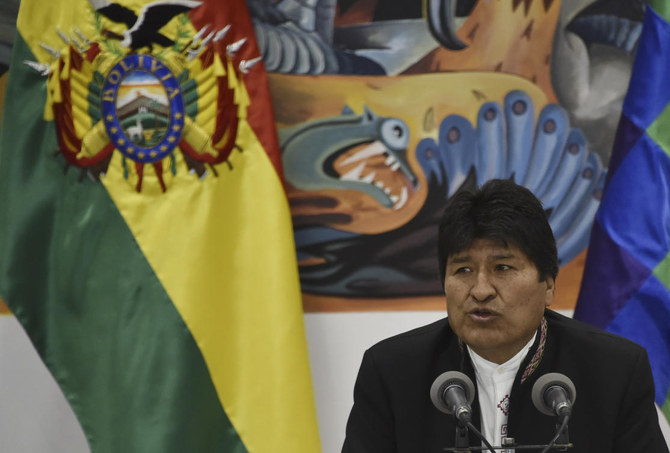
Bolivia president Morales says rivals preparing ‘coup’
- The court said Morales had won with 47.1 percent compared to 36.5 percent for Mesa
- Mesa called for a strike on Monday to protest what he said was a fraudulent election
Latest updates


Recommended


© 2026 SAUDI RESEARCH & PUBLISHING COMPANY, All Rights Reserved And subject to Terms of Use Agreement.