

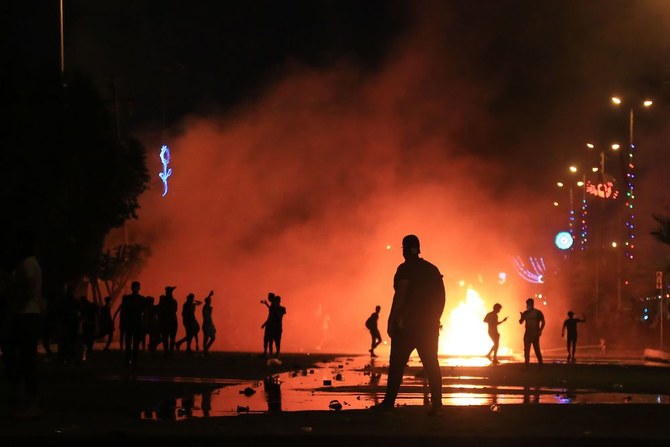

BAGHDAD: Iraqi Prime Minister Adel Abdul-Mahdi will not resign in response to the demands of demonstrators and refuses to allow his country to slide into civil war, his spokesman said Sunday.
Baghdad and seven other Shiite-dominated southern provinces have witnessed mass demonstrations since the beginning of the month. The protests have been against corruption, unemployment and a lack of basic services.
Demonstrations stalled after the first week when at least 147 people, including security personnel, were killed and more than 7,000 injured in a bloody crackdown by the Iraqi government and its allies.
But the protests resumed on Friday after Iraqi forces vowed not to use live ammunition against demonstrators.
Despite the pledge, at least 74 people have been killed and more than 3,600 wounded in the past three days, according to the Independent High Commission for Human Rights in Iraq.
Protesters have responded to the violence by increasing their demands, which now include the resignation of Abdul-Mahdi and his government, changing the election law, and holding fresh elections.
The prime minister’s insistence on not resigning, means the cycle of violence is expected to continue and increases the possibility of clashes erupting between the different Shiite factions.
“Abdel-Mahdi will not resign in this critical and difficult circumstance,” Sa’ad Al-Hadaithi, the prime minister’s spokesman, told a local Iraqi TV station on Sunday evening. “The resignation of the government could lead the country into a dangerous situation. We warn of the loss of civil peace and the collapse of the country into chaos.
“The prime minister continues to respond to the legitimate demands of the demonstrators and will not allow the loss of control of the situation.”
Most of the casualties in Baghdad have been from tear gas, while in the provinces they have mainly been caused by clashes when demonstrators attempted to attack the headquarters of Iranian-backed political parties, security officials and witnesses told Arab News.
Abdul-Mahdi attempted to quell the protests with a promise to secure hundreds of thousands of jobs, speeding up corruption trials, and increased welfare for poor families.
But after a two week pause, the incentives appear to have failed with large numbers of demonstrators, returning to the streets with increased popular support, especially in the Shiite communities.
His refusal to resign is linked to the positions of his local and regional allies. Several Iraqi political leaders allied with Abdul-Mahdi told Arab News that an agreement overseen by Gen, Qassem Soleimani, the powerful Iranian military commander, was made to keep Abdul-Mahdi in his post until the end of the crisis.
Soleimani, who commands the Quds Force of the Islamic Revolutionary Guard Corps, is accused of leading the crackdown on demonstrators in Baghdad when they first erupted.
“All the Iraqi political parties involved in the government were clearly informed that they are not allowed to take any step to resign Abdul-Mahdi now,” a prominent Shiite governmental advisor closed to Abdul-Mahdi told Arab News.
“At the first days of the crisis (demonstrations), we suggested to ask the prime minister to resign to calm the demonstrators and gain some time, but Haj (Soleimani) rejected this.
“He (Soleimani) said in front of most of the prominent political leaders that he is committed to protecting Abdel-Mahdi to the end and would not allow him to fall because of the protests.
“He said he would agree on the resignation of Abdul-Mahdi just after the end of the crisis. Maybe after two months and Abdul-Mahdi knew and agreed on this.”


