



Islamabad — A Pakistani graphic artist whose popular artwork depicts a league of superheroes from different regions and ethnicities in the country, announced on social media on Saturday that his first comic book series was slated for release on digital and limited print editions in December.
Umair Najeeb Khan, 25, is originally from the southern city of Karachi and has recently moved across the country to the capital, Islamabad, where he works in digital media. Initially, he had hoped to study architecture, but when he was unable to make it into his program of choice, he settled for media science with an animation major, which he now says, worked out for the best.
Last month, Khan began sharing the characters for his upcoming comic book series titled ‘Pasbaan Legion’ online, with their visible likeness to different Pakistani cultures drawing people to his Twitter and Instagram pages. The powerful multi-character cover for the comic book was finally revealed on social media on Sunday, and reads “A Pakistani Superhero Comic Book.”
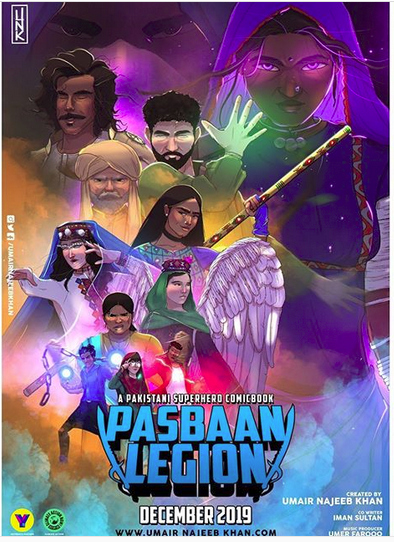
The cover for Pakistan's first multi-character crime-fighting superhero comic book series, "Pasbaan Legion" was released on social media on Sunday by creator Umair Najeeb Khan. Oct. 27, 2019 (Photo: Umair Najeeb Instagram)
“While I was displaying my thesis, a short animated film, at university, one of the judges pointed out that I could’ve made the characters actual local, desi-looking kids too,” Khan told Arab News.
“That stayed with me. Since then, I have been wanting to create material for us and about us. That inspired me to come up with this.”
Khan, who is mainly self-taught in illustration, said his idea for the series is all about representation and inclusion, and he has made the conscious decision to emphasize the country’s many ethnicities in his work.
From Hunza in Pakistan’s northern most areas, to Sindh in the south, superheroes from Khan’s imagination represent the entire country, and work together as a team.
“And this inclusion doesn’t stop at the celebration of cultures or heritage only. It’s about body positivity as well,” Khan said. “You won’t just see tall, muscular, perfectly sized bodies...as you’d normally expect from hero depictions (in Pakistan).”
In the worlds of global animated superhero giants, Marvel and DC, there is only one Pakistani superhero and a handful of middle-eastern ones. In 2013, a Pakistani superhero series in Urdu called Burka Avenger, which featured a woman superhero disguised in a burka fighting villains, won international acclaim and was translated into a number of languages.
But Khan’s multi-character series features 12 characters with unique powers.
“We have a Sindhi character, Marvi from Sukkur. She is a vigilante and a teacher. Then there is Sofiyan from Bahawalpur, he is a nawab (nobleman) and a time-traveler with sand manipulation powers,” Khan said.
“There is a Pakhtun hacker girl, Bazira with foresight from Swat. And Raad (thunder) twin brothers from Islamabad and Rawalpindi who have electrokinesis abilities,” he said.
Khan plans for his series to be released with an English and Urdu script so it reaches more comic book fans around the world.
“Everything about the series and characters is currently being processed through three layers. First, is the representation and celebration of culture. Second is the inclusion of people of all shapes and sizes from all races of life. And third, it will be about Pakistan, but not just for Pakistan,” he said.
“I want it to reach an even larger audience and give us a positive face in front of the world.”


