ISLAMABAD: Representatives of China, Russia and Pakistan, who met in Moscow to discuss the situation in Afghanistan, called for the resumption of peace process between the United States and the Afghan Taliban on Friday, hoping that the negotiations between the two sides would also pave the way for intra-Afghan talks.
US Special Representative for Afghanistan Reconciliation Zalmay Khalilzad joined officials of the three countries to explore ways to restore peace in the war-torn country.
Last month, US President Donald Trump halted the talks with the Taliban after the insurgent group carried out a bomb attack in Kabul that killed 12 people, including an American soldier.
The representatives of the four countries reiterated their commitment to work with the Afghan government and the Taliban to reach a comprehensive and sustainable peace agreement that would end the war and contribute to regional stability and global security.
A joint statement issued at the conclusion of the daylong meeting urged all sides in the Afghan war to immediately reduce violence in order to create conducive environment for result-oriented negotiations.
The participants said they expected all sides to observe a cease-fire for the duration of intra-Afghan negotiations to enable different stakeholders in the war-torn country to reach an agreement that is beneficial for Afghanistan’s future.
“Russia, China and Pakistan expressed their support for the earliest resumption of negotiation process and reaching an agreement between the United States of America and the Taliban movement, which will pave the way for launching intra-Afghan talks,” said the statement.
They called on the Afghan government and the Taliban to release significant number of prisoners at the beginning of the intra-Afghan negotiations.
The meeting called on all Afghans, including the government and the Taliban, to ensure that Al-Qaeda, Daesh, the Chinese East Turkistan Islamic Movement (ETIM) and other international terrorists do not use the Afghan soil to threaten the security of any other country, according to the statement.
The participants reviewed the current situation in Afghanistan and their joint efforts to reach a sustainable settlement in that country by political and diplomatic means. They agreed that sustainable peace could only be achieved through negotiated political settlement.
They welcomed the Chinese proposal to host the next intra-Afghan meeting in Beijing that will ensure the participation of a number of high-profile Afghan political personalities, including the representatives of the administration in Kabul, other Afghan leaders and the Taliban.
US representative for Afghan reconciliation, Zalmay Khalilzad, Chinese special envoy for Afghanistan, Deng Xijun, and Russian special envoy, Zamir Kabulov, attended the meeting.
Additional secretary of Pakistan’s foreign office, Muhammed Aejaz, who led his country’s delegation in the 4-party talks, tweeted that all sides were “hopeful about and agreed to expedite the earliest peaceful resolution of the issue through an Afghan-owned and Afghan-led peace process.”
The delegates reaffirmed that any peace agreement must protect the rights of all Afghans, including women, men, children and minorities, and should respond to the strong desire of Afghans for economic, social and political development.


![]()

Four-party talks in Moscow seek resumption of US-Taliban negotiations
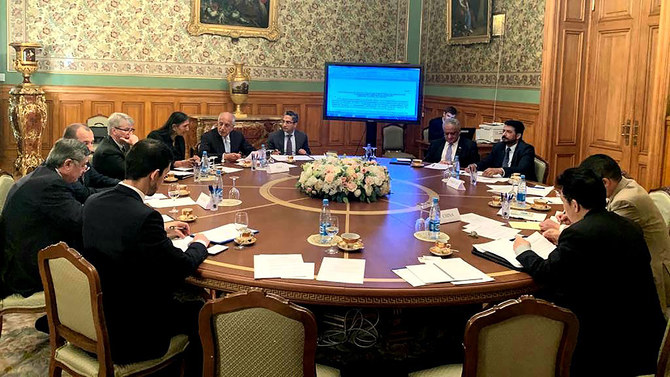
Four-party talks in Moscow seek resumption of US-Taliban negotiations
- A joint statement hopes all warring sides will declare cease-fire during the intra-Afghan consultations
- China proposed to host an intra-Afghan meeting in Beijing that will bring together a number of Afghan political personalities
Latest updates


© 2026 SAUDI RESEARCH & PUBLISHING COMPANY, All Rights Reserved And subject to Terms of Use Agreement.