Hezbollah leader Nasrallah claims ‘specific, known parties’ are behind Lebanon’s protests

1 / 2
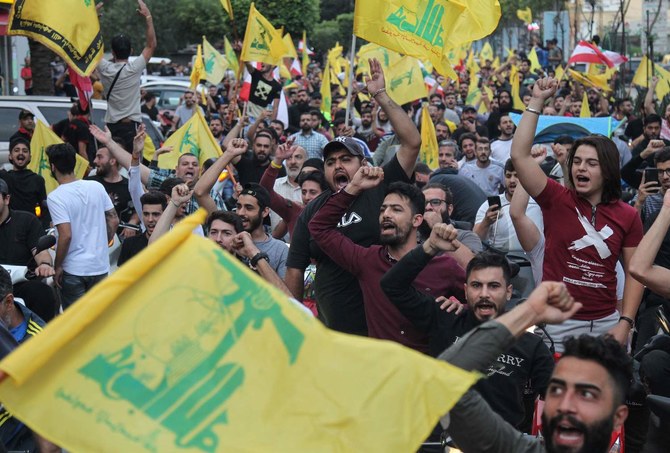
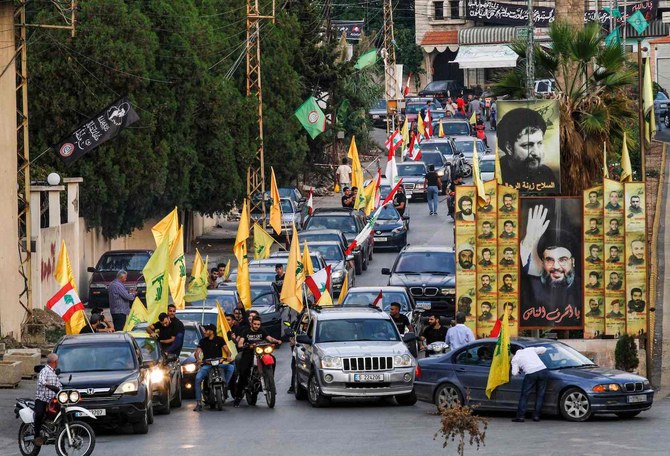
Supporters of the Shiite Hezbollah movement drive in a convoy in support of its leader Hassan Nasrallah's speech, in the southern suburbs of Beirut on October 25, 2019. (AFP)
2 / 2
Supporters of Lebanon's Shiite movement Hezbollah drive in a convoy with the group's yellow flags in the town of Ghazieh, south of the southern city of Sidon on October 25, 2019. (AFP)
Updated 03 November 2019
Follow

Hezbollah leader Nasrallah claims ‘specific, known parties’ are behind Lebanon’s protests

  • Hezbollah supporters went to Riad Al-Solh Square where they threatened and intimidated protesters in an attempt to quash any criticism of Nasrallah
  • Riot police intervened and clashed with Hezbollah’s supporters

BEIRUT: As protests in Lebanon against institutional corruption and taxes entered their ninth day on Friday, both Hezbollah and the Free Patriotic Movement (FPM), founded by President Michel Aoun, increased their presence on the streets.

Supporters of the FPM gathered outside the Palace of Justice in defense of Aoun, and attempted to convince protesters that they shared the same goals, holding banners with slogans including “Your demands are the same as the FPM’s,” “Fighting corruption is done through the judiciary,” “Why don’t you protest the presence of 1.5 million Syrian refugees?” and “President Aoun is not corrupt. Focus on others.”

Hezbollah’s Secretary-General Hassan Nasrallah claimed that the protests were being orchestrated by “specific, known political parties, powers, communities and institutions.”

Hezbollah supporters went to Riad Al-Solh Square — the center of the uprising in Beirut — where they threatened and intimidated protesters in an attempt to quash any criticism of Nasrallah, and led chants calling the head of the Lebanese Forces, Samir Geagea, a “terrorist.” They arrived overnight on Thursday, dressed in black shirts, and erected a tent in the square.

Arab News spoke to several protesters who called Nasrallah’s supporters “thugs.” One of them asked: “What brought Hezbollah here? This is not its place.”

Protesters then began chanting “All of them means all of them” — a chant signifying their intention to hold everyone in power accountable for Lebanon’s problems. One protester told Arab News, “Instead of standing by the people, Hezbollah is standing against them. It is a shame.” Another addressed Nasrallah directly, saying: “We love you. Why do you make us hate you and your supporters?”

One also said, “Without the people, neither Nasrallah nor anyone else would be here. This attack is unacceptable.” Another stressed: “The revolution will continue. They want it to fail, but this is not going to happen.”

Riot police intervened and clashed with Hezbollah’s supporters. Stones were thrown and batons were used. Several police were injured.

Hezbollah’s supporters eventually took control of the square, as one protester announced through a loudspeaker: “Whoever wants to cause trouble is not welcome among us. This square is open to everyone, but with respect.”

In a televised speech, Nasrallah said that the uprising may have started as a “spontaneous” movement, but that was no longer the case.

“It is now being managed, coordinated and funded,” he claimed. “The movement has entered the scope of regional political conflicts and is no longer limited to popular protests. This pushes us to question it. We fear that someone is targeting the country in order to lead us to civil war and lure the resistance. We have information and doubts.”

He called on the leadership of the movement to “reassure demonstrators and reassure us as well. Identify your representatives because there is a hidden leadership and the people have the right to know who they are following.”

Nasrallah asked his supporters to leave the areas of the protests because “we have no interests there,” and told protesters, “Rejecting dialogue means that there is a major political targeting of all elements of power in the country.”

Convoys supporting Nasrallah were organized in the southern suburbs of Beirut and in Tyre. Security forces blocked all roads leading to Beirut to prevent them from reaching the city center.

Hani Fayyad, a member of the revolution’s coordination committee, responded to Nasrallah, saying, “The movement’s representatives will meet tonight and come up with a unified decision.”


First responders enter devastated Aleppo neighborhood after days of deadly fighting

Updated 12 January 2026
Follow

First responders enter devastated Aleppo neighborhood after days of deadly fighting

  • The US-backed SDF, which have played a key role in combating the Daesh group in large swaths of eastern Syria, are the largest force yet to be absorbed into Syria’s national army

ALEPPO, Syria: First responders on Sunday entered a contested neighborhood in Syria’ s northern city of Aleppo after days of deadly clashes between government forces and Kurdish-led forces. Syrian state media said the military was deployed in large numbers.
The clashes broke out Tuesday in the predominantly Kurdish neighborhoods of Sheikh Maqsoud, Achrafieh and Bani Zaid after the government and the Syrian Democratic Forces, the main Kurdish-led force in the country, failed to make progress on how to merge the SDF into the national army. Security forces captured Achrafieh and Bani Zaid.
The fighting between the two sides was the most intense since the fall of then-President Bashar Assad to insurgents in December 2024. At least 23 people were killed in five days of clashes and more than 140,000 were displaced amid shelling and drone strikes.
The US-backed SDF, which have played a key role in combating the Daesh group in large swaths of eastern Syria, are the largest force yet to be absorbed into Syria’s national army. Some of the factions that make up the army, however, were previously Turkish-backed insurgent groups that have a long history of clashing with Kurdish forces.
The Kurdish fighters have now evacuated from the Sheikh Maqsoud neighborhood to northeastern Syria, which is under the control of the SDF. However, they said in a statement they will continue to fight now that the wounded and civilians have been evacuated, in what they called a “partial ceasefire.”
The neighborhood appeared calm Sunday. The United Nations said it was trying to dispatch more convoys to the neighborhoods with food, fuel, blankets and other urgent supplies.
Government security forces brought journalists to tour the devastated area, showing them the damaged Khalid Al-Fajer Hospital and a military position belonging to the SDF’s security forces that government forces had targeted.
The SDF statement accused the government of targeting the hospital “dozens of times” before patients were evacuated. Damascus accused the Kurdish-led group of using the hospital and other civilian facilities as military positions.
On one street, Syrian Red Crescent first responders spoke to a resident surrounded by charred cars and badly damaged residential buildings.
Some residents told The Associated Press that SDF forces did not allow their cars through checkpoints to leave.
“We lived a night of horror. I still cannot believe that I am right here standing on my own two feet,” said Ahmad Shaikho. “So far the situation has been calm. There hasn’t been any gunfire.”
Syrian Civil Defense first responders have been disarming improvised mines that they say were left by the Kurdish forces as booby traps.
Residents who fled are not being allowed back into the neighborhood until all the mines are cleared. Some were reminded of the displacement during Syria’s long civil war.
“I want to go back to my home, I beg you,” said Hoda Alnasiri.