

NEOM project draws interest at  Japan-Saudi conference in Tokyo

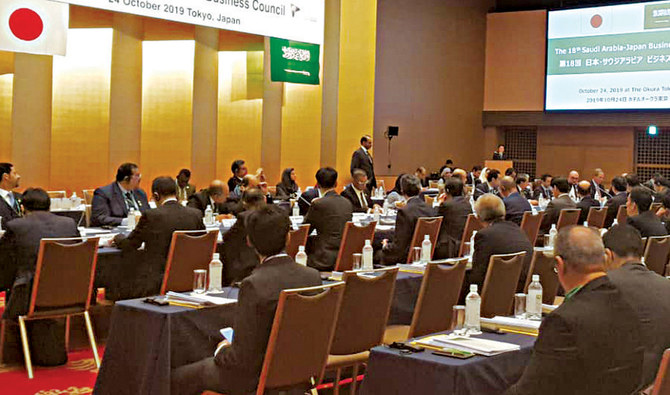
The Japan-Saudi Arabia Business Council meeting in Tokyo provided an excellent platform for investors from both countries to exchange ideas. (Photo/Supplied)
Updated 24 October 2019
Follow

NEOM project draws interest at  Japan-Saudi conference in Tokyo

  • Kingdom’s medical devices manufacturer eyes advanced Japanese technology

TOKYO: Dozens of Saudi and Japanese businessmen met at the 18th Japan-Saudi Arabia Business Council in Tokyo on Thursday to discuss standing and new investment opportunities.

The conference, attended by representatives from the Japanese External Exchange Organization, Ministry of Trade and several top businesses, as well as the Saudi Arabian General Investment Authority, saw presentations promoting various sectors including real estate, medicine, entertainment, education and agriculture.

Projects like NEOM, the ambitious city project which Saudi Arabia is building in the Tabuk Province in the Kingdom’s northwest, grabbed a lot of attention.

The city, which the Kingdom will share with Egypt and Jordan near the Red Sea, will incorporate smart city technologies and function as a tourist destination.

“Saudi Arabia is a very important partner, both politically and economically, and we have to keep close contact with the Kingdom,” said Yasuhiro Sato, co-chairman of the Japanese side of the council. 

“Based on today’s meeting there are a lot of business opportunities that can be invested in.”

He revealed that Japanese business representatives “will soon be visiting Saudi Arabia” this November to further inspect projects.

The Kingdom’s Ambassador to Japan, Naif bin Marzouq Al-Fahadi, praised the excellent relations between the two nations, and built on Wednesday’s meeting between Saudi and Japanese ministers to highlight the increasing number of economic agreements signed between them.

“Today, we have many business opportunities because there is change in the economic infrastructure, and times have been changing as well,” Sato said.

“They (Japanese businesses) appreciate the efforts of Saudi business representatives in bringing leaders together to discuss how they can improve their businesses via mutual agreements,” Dr. Maha Al-Ateeki told Arab News on the sidelines of the conference.

Al-Ateeki, who is the first Saudi woman to invest in the manufacturing of medical devices in the Kingdom, said that she was looking at bringing Japanese technology back home.

“They have more advanced technology than us, and we are interested in taking it back to Saudi Arabia because, under Vision 2030, the Saudi leadership wants to localize technology,” she said, adding that she had set up a number of interviews while in Japan to help make this possible.


IsDB announces $2.41bn in new financing for strategic development sectors

Updated 15 sec ago
Follow

IsDB announces $2.41bn in new financing for strategic development sectors

JEDDAH: The Islamic Development Bank has approved $2.41 billion in new financing for a series of transformative projects during its 364th Executive Board meeting, chaired by IsDB President Mohammed Al-Jasser.

The approvals underscore the bank’s ongoing commitment to regional cooperation, economic development, and climate- and environment-friendly investments that advance the UN Sustainable Development Goals across its member countries.

The new financing includes an additional $40 million for the Central Asia–South Asia Electricity Transmission and Trade Project (CASA-1000) in Tajikistan, aimed at boosting regional energy trade, improving electricity access and reliability, and mitigating climate change through the export of clean and renewable energy.

The bank also approved €116 million ($135 million) to upgrade Senegal’s Dakar Expressway Project.

The initiative is designed to improve health, education, and economic services for local populations, reduce traffic congestion and peak travel times, and enhance road safety measures to halve traffic-related deaths and injuries, with a particular focus on women and young pedestrians.

A $1.307 billion allocation was approved for Kazakhstan’s Economic and Industrial Zones Project to foster sustainable industrial development.

The initiative is expected to promote economic diversification, attract investment, create jobs, and boost global competitiveness through infrastructure upgrades and operational efficiency in special economic zones, industrial zones, and specialized industrial zones.

Bahrain will receive $330.07 million to expand its industrial capacity and strengthen economic competitiveness. The funding will support the development of modern industrial land with resilient infrastructure, advanced export-oriented manufacturing, effective internal connectivity, and reclaimed land facilities.

The project aims to stimulate private investment, generate employment, and reinforce Bahrain’s position as a regional industrial and logistics hub.

The IsDB approved $160 million to enhance utilities, water, and urban development sectors in Jordan.

The financing will secure future drinking water supply for Aqaba, Amman, and northern regions, support climate adaptation and mitigation, foster economic growth, and promote private sector participation in sustainable, long-term water solutions to alleviate severe water stress.

Azerbaijan was granted $436.67 million to improve agricultural productivity by reducing irrigation water losses and supporting sustainable rural development, in line with Azerbaijan’s 2030 vision.

The project will also promote green growth, strengthen climate resilience, and ensure long-term food security.

The approved projects reflect the IsDB’s strategic focus on fostering sustainable and inclusive growth across member countries by addressing critical infrastructure, energy, water, transport, and industrial development challenges.

These initiatives are expected to deliver lasting impact and contribute effectively to achieving the Sustainable Development Goals.