Replicas of Assyrian statues smashed by Daesh unveiled in Iraq’s Mosul

1 / 4
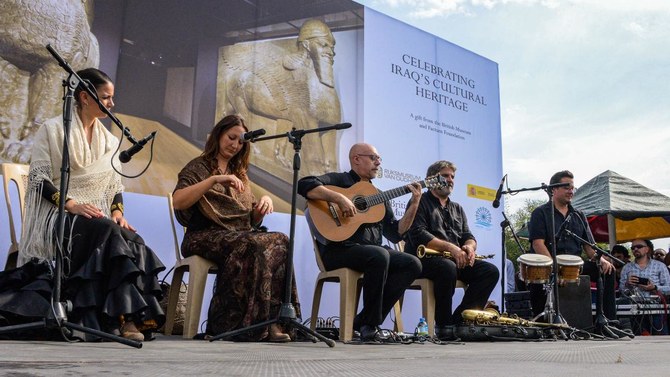
Members of a Spanish flamenco music group perform during a ceremony for the unveiling of replicas of "lamassu", an Assyrian protective deity depicted with a human head, the body of a lion, and bird wings, at the University of Mosul in the northern Iraqi city on October 24, 2019. (AFP)
2 / 4
This picture taken on October 24, 2019 shows two replicas of "lamassu", an Assyrian protective deity depicted with a human head, the body of a lion, and bird wings, on display on the day of their unveiling at the University of Mosul in the northern Iraqi city. (AFP)
3 / 4
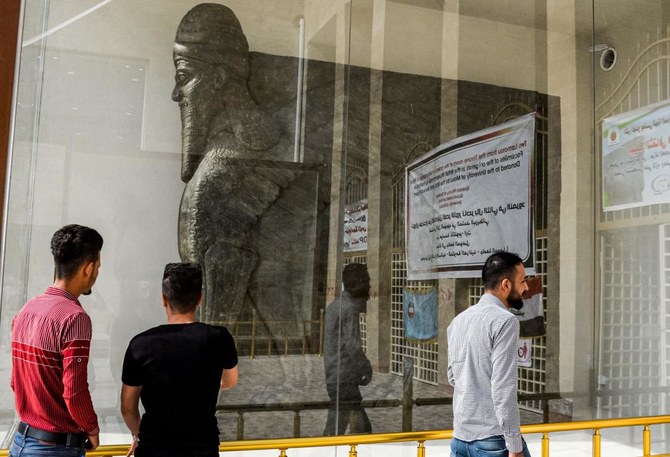
Men look at a replica of a "lamassu", an Assyrian protective deity depicted with a human head, the body of a lion, and bird wings, on the day of its unveiling at the University of Mosul in the northern Iraqi city on October 24, 2019. (AFP)
4 / 4
A man poses for a picture with a replica of a "lamassu", an Assyrian protective deity depicted with a human head, the body of a lion, and bird wings, on the day of its unveiling at the University of Mosul in the northern Iraqi city on October 24, 2019. (AFP)
Updated 24 October 2019
Follow

Replicas of Assyrian statues smashed by Daesh unveiled in Iraq’s Mosul

  • Extremists destroyed the originals after they swept across northern Iraq in 2014
  • Iraqi troops recaptured Mosul in mid-2017, but the museum has remained shuttered and the lamassu in ruins

MOSUL: Two high-tech replicas of iconic Assyrian statues destroyed by the Daesh group in northern Iraq were unveiled on Thursday at the University of Mosul.
The real “lamassu” — massive statues of winged bulls with human faces — had adorned a royal throne room in the ancient city of Nimrud for centuries, and one was later exhibited in the Mosul Museum.
But extremists destroyed the originals after they swept across northern Iraq in 2014, blowing up Nimrud and filming themselves taking hammers to pre-Islamic artefacts they deemed heretical.
Iraqi troops recaptured Mosul in mid-2017, but the museum has remained shuttered and the lamassu in ruins.
Using 3D recordings of lamassu fragments, the Spanish Factum Foundation created copies, erected this week outside the student library at the University of Mosul.
“This gift is a message of hope that Mosul has returned to normal and its people must build their city,” Spanish Ambassador Juan Jose Escobar said at the statues’ unveiling.
Ahmad Qassem, a professor of history at the University of Mosul, said the lamassu’s hybrid figure is highly symbolic.
“The head symbolizes wisdom, the wings speed, and the body — a mix of a bull and a lion — represent strength,” he told AFP.
And Factum founder Adam Lowe told AFP the replicas now had their own meaning.
“We want them to be here as a symbol, a demonstration of what’s possible with technology when people work together to share cultural heritage, share understanding, and share our historical culture that links us all together,” he said.
“Now they’re sitting in front of the entrance to the student building and I hope they’ll guard everyone for many years to come,” said Lowe.
University student Ilaf Muhannad said she was elated to see her university house them.
“I’m so happy today to see the lamassu statues placed here, because it represents the civilization and heritage of Mosul. We demand the Iraqi government work on returning everything stolen from Mosul,” she said.


US makes plans to reopen embassy in Syria after 14 years

Updated 21 February 2026
Follow

US makes plans to reopen embassy in Syria after 14 years

  • The administration has been considering re-opening the embassy since last year
  • Trump told reporters on Friday that Al-Sharaa was “doing a phenomenal job” as president

WASHINGTON: The Trump administration has informed Congress that it intends to proceed with planning for a potential re-opening of the US Embassy in Damascus, Syria, which was shuttered in 2012 during the country’s civil war.
A notice to congressional committees earlier this month, which was obtained by The Associated Press, informed lawmakers of the State Department’s “intent to implement a phased approach to potentially resume embassy operations in Syria.”
The Feb. 10 notification said that spending on the plans would begin in 15 days, or next week, although there was no timeline offered for when they would be complete or when US personnel might return to Damascus on a full-time basis.
The administration has been considering re-opening the embassy since last year, shortly after longtime strongman Bashar Assad was ousted in December 2024, and it has been a priority for President Donald Trump’s ambassador to Turkiye and special envoy for Syria, Tom Barrack.
Barrack has pushed for a deep rapprochement with Syria and its new leadership under former rebel Ahmad Al-Sharaa and has successfully advocated for the lifting of US sanctions and a reintegration of Syria into the regional and international communities.
Trump told reporters on Friday that Al-Sharaa was “doing a phenomenal job” as president. “He’s a rough guy. He’s not a choir boy. A choir boy couldn’t do it,” Trump said. “But Syria’s coming together.”
Last May, Barrack visited Damascus and raised the US flag at the embassy compound, although the embassy was not yet re-opened.
The same day the congressional notification was sent, Barrack lauded Syria’s decision to participate in the coalition that is combating the Daesh militant group, even as the US military has withdrawn from a small, but important, base in the southeast and there remain significant issues between the government and the Kurdish minority.
“Regional solutions, shared responsibility. Syria’s participation in the D-Daesh Coalition meeting in Riyadh marks a new chapter in collective security,” Barrack said.
The embassy re-opening plans are classified and the State Department declined to comment on details beyond confirming that the congressional notification was sent.
However, the department has taken a similar “phased” approach in its plans to re-open the US Embassy in Caracas, Venezuela, following the US military operation that ousted former President Nicolás Maduro in January, with the deployment of temporary staffers who would live in and work out of interim facilities.