

Pakistan, India sign ‘historic’ Kartarpur corridor deal

1 / 3
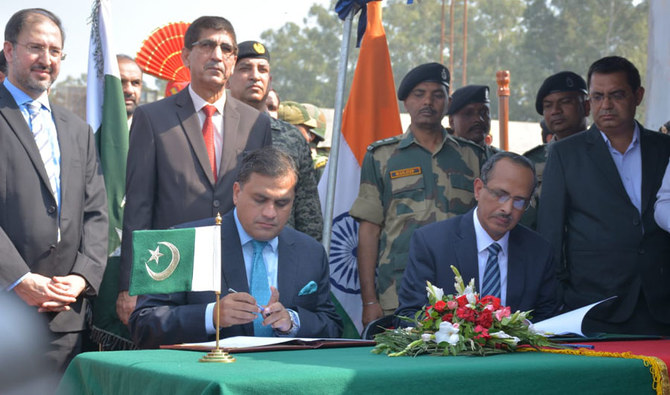
Pakistan and India signed the historic Kartarpur corridor agreement on October 24, 2019 at Zero Point. (Photo Courtesy: Foreign Office of Pakistan)
2 / 3
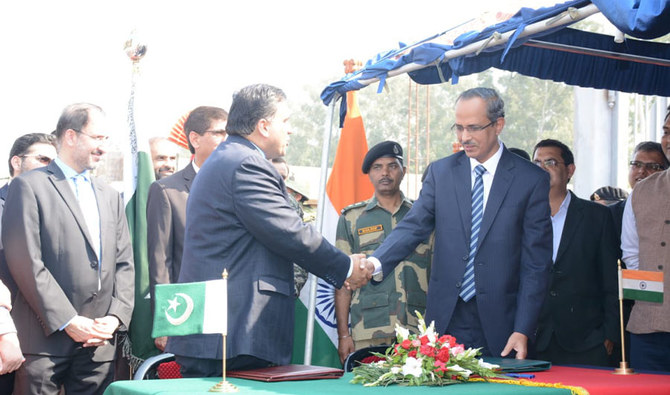
Pakistan and India signed the historic Kartarpur corridor agreement on October 24, 2019 at Zero Point. (Photo Courtesy: Foreign Office of Pakistan)
3 / 3
Pakistan and India signed the historic Kartarpur corridor agreement on October 24, 2019 at Zero Point. (Photo Courtesy: Foreign Office of Pakistan)
Updated 24 October 2019
Follow

Pakistan, India sign ‘historic’ Kartarpur corridor deal

  • Border crossing will provide visa-free access to Indian Sikh pilgrims to a holy shrine in Pakistan
  • Prime Minister Imran Khan will formally inaugurate the corridor on November 9, says foreign office

LAHORE: Pakistan and India signed the historic Kartarpur corridor agreement on Thursday, Pakistan’s foreign ministry spokesman, Dr. Mohammad Faisal, told reporters after signing the deal on Pakistan’s behalf. 

The agreement was signed by officials from the two sides at the Pakistan-India border in Narowal.

Faisal said the agreement will provide a visa-free corridor for the Indian Sikh pilgrims to visit a holy shrine in Pakistan. 

Kartarpur Corridor connects the Sikh shrines of Dera Baba Nanak Sahib, in India’s Punjab region to the Gurdwara Darbar Sahib in Kartarpur, Pakistan.
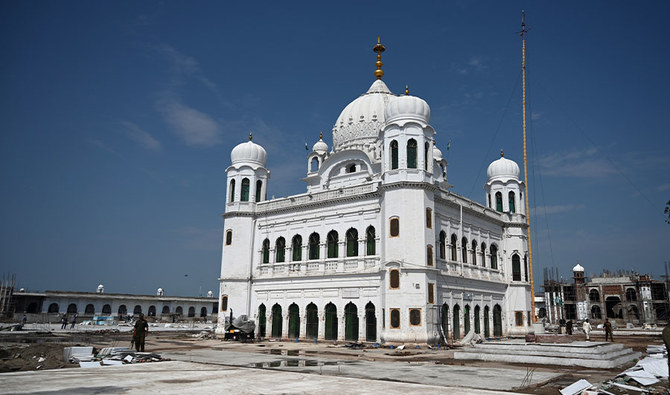


In this picture taken on September 16, 2019 a Pakistani policeman stands guard on the construction site at the Sikh religious site Gurdwara Darbar Sahib, in the Pakistani town of Kartarpur near the Indian border. Pakistan on September 16 announced that the Kartarpur corridor will be opened for Indian Sikh pilgrims early this November. (AFP)

The visa-free border crossing will be inaugurated on November 9, days ahead of one of Sikhism’s most sacred festivals and the 550th birth anniversary of the religion’s founder.

“PM Khan will inaugurate the Kartarpur Sahib corridor in Narowal, Pakistan on 9 November insha Allah,” tweeted Dr. Faisal before setting off for the signing of the deal. “Reaching Kartarpur Sahib for the signing of historic Pakistan India Agreement on the opening of the corridor,” he earlier said. 

The corridor is a rare example of cooperation and diplomacy between the two South Asian rivals, who came to the brink of war in February following a suicide attack in Indian-administered Kashmir.

Ties nose-dived further in August when India flooded its portion of the disputed valley with troops, imposed a communications lockdown and revoked the special legal status of the territory.

The connecting bridge at the border was also a significant issue. India favored an elevated bridge but Pakistan was only willing to build an embankment, fearing a possible breach in security.

The sikh community has long sought easier access to Kartarpur, a village just four kilometers over the border in Pakistan, as it used to demand a lengthy visa and travel process.

Pilgrims will get special permits to access the shrine. Up to 5,000 pilgrims will be allowed to access the corridor daily.

Indian Prime Minister Narendra Modi will inaugurate the Indian side of the corridor, but it is unclear if he will cross into Pakistan afterward.


Pakistan launches first skills impact bond to fund training with private capital

Updated 8 sec ago
Follow

Pakistan launches first skills impact bond to fund training with private capital

  • New $3.57 million pilot ties investor returns to job placement and retention outcomes
  • The program aims to upskill youth at scale, with 40 percent of trainees targeted to be women

KARACHI: Pakistan on Tuesday launched its first-ever Pakistan Skills Impact Bond (PSIB), a private-capital-funded instrument aimed at financing technical training by linking investor repayments to measurable employment outcomes, as the government seeks new ways to upskill its rapidly growing workforce without relying solely on public spending.

The Rs 1 billion ($3.57 million) pilot tranche, backed by a government guarantee, is part of a three-year program designed to fund skills training through an outcome-based model, under which investors are repaid only if trainees achieve results such as certification, job placement and at least six months of employment retention.

Social impact bonds are a form of results-based financing in which private investors provide upfront capital for social programs, while governments or donors repay them only if agreed performance targets are met. Pakistan’s skills bond is intended to shift training finance away from traditional input-based budgets toward a market-oriented approach that rewards verified outcomes and crowds in private investment.

“Speaking at the event, Senator Muhammad Aurangzeb, Federal Minister for Finance and Revenue, underscored the transformational importance of the PSIB in Pakistan’s broader economic reform agenda and human capital strategy,” the finance division said in a statement. “He described the day as ‘an important moment focused on education and training,’ reiterating that Pakistan’s demographic dividend can only be realized if the country succeeds in upskilling and reskilling its youth at scale.”

The program is anchored in collaboration with the National Vocational and Technical Training Commission (NAVTTC) and is expected to evolve over time, with later tranches potentially linking repayments to a small share of trainees’ future earnings, a move officials say could help make the model financially self-sustaining.

The bond forms part of a broader government push to adopt social impact financing across priority areas including education, gender equality, health, climate resilience and poverty reduction, the statement said.

“Highlighting gender inclusion as central to the program design, the Finance Minister welcomed the recommendation led by the British Asian Trust that 40 percent of trainees under the PSIB be women, acknowledging that women’s participation and leadership in the workforce will play a decisive role in shaping Pakistan’s economic trajectory,” it added.

The Ministry of Finance has provided the initial guarantee to help establish credibility and attract investors, but has stressed the support is limited to the pilot phase.

The government has noted the model is intended to support Pakistan’s large youth population by aligning training with labor market demand, including high-value digital skills, while reducing long-term pressure on public finances.

The launch ceremony was attended by senior government officials, development partners, private sector representatives and international organizations involved in structuring and financing the bond.