WASHINGTON: Facebook CEO Mark Zuckerberg is again appearing before Congress to face questions about his company’s massive market power, privacy lapses and tolerance of speech deemed false or hateful.
Zuckerberg has been summoned to testify at a hearing Wednesday by the House Financial Services Committee on Facebook’s plan to create a global digital currency, which has stirred opposition from lawmakers and regulators in the US and Europe. But the full range of policies and conduct of the social media giant with nearly 2.5 billion users will be under the public glare.
It’s the Facebook chief’s first testimony to Congress since April 2018.
The company seems to spark public and official anger at every turn these days, from its shift into messaging services that allow encrypted conversations to its alleged anticompetitive behavior to its refusal to take down phony political ads or doctored videos.
Lawmakers from both parties and top regulators — including Treasury Secretary Steven Mnuchin and Federal Reserve Chairman Jerome Powell — have criticized Facebook’s plan for the new currency, to be called Libra. They warn that it could be used for illicit activity such as money laundering or drug trafficking.
Rep. Maxine Waters, the California Democrat who heads the Financial Services panel, this summer asked Facebook to not move forward with the currency and a digital wallet called Calibra that would be used with it. Waters has called Libra “a new Swiss-based financial system” that potentially is too big to fail and could require a taxpayer bailout.
Several high-profile companies that had signed on as partners in Facebook’s governing association for Libra have recently bailed, spelling a potentially rough road for the project. But many experts don’t believe it’s doomed.
Zuckerberg, in written testimony prepared for the hearing, aimed to reassure lawmakers that his company won’t try to evade financial regulators as it readies Libra.
Facebook “will not be a part of launching the Libra payments system anywhere in the world unless all US regulators approve it,” he said. That’s a stronger statement than Facebook official David Marcus made to Congress in July, when he said the company will not activate Libra until it has “fully addressed regulatory concerns and received appropriate approvals.” Marcus leads the Libra project.
Zuckerberg is striving to defend Libra and alleviate concerns that the currency could sidestep regulators. Analysts say Libra could avoid regulation and launch in countries where it’s not getting pushback, but this doesn’t appear to be Facebook’s intention.
Instead, Zuckerberg is pushing an optimistic vision of Libra and what it could mean for people around the world who don’t have access to bank accounts.
While some critics see the recent exodus of some Libra partners as evidence of the plan’s likely failure, US regulators appear to view it as enough of a threat that they are considering the possibility of the Fed launching its own competitor currency.
“At the Federal Reserve, we will continue to analyze the potential benefits and costs of central bank digital currencies, and look forward to learning from other central banks,” Lael Brainard, a member of the Fed’s board of governors, said in a speech last week.
There is concern among regulators that the massive reserve created with money used to buy the new currency could supplant the Fed and destabilize the financial system, and that consumers could be hurt by Libra losses.
Zuckerberg also played the China card in his remarks, urging regulators to act quickly “While we debate these issues, the rest of the world isn’t waiting. China is moving quickly to launch similar ideas in the coming months,” he said.
The Facebook CEO also has cited competition from China as a compelling reason against breaking up the company.
The Justice Department, the Federal Trade Commission and the House Judiciary antitrust subcommittee are all conducting investigations of Facebook and the other huge tech companies amid accusations of abuse of their market power to crush competition.
Sen. Elizabeth Warren, a leading Democratic presidential candidate, has advocated breaking up Facebook and other tech behemoths. She recently ran a fake political ad on Facebook taking aim at Zuckerberg to protest the company’s policy of not fact-checking politicians’ speech or ads in the same way it enlists outside parties to fact-check news stories and other posts.
In a major speech last week at Georgetown University, Zuckerberg defended the company’s refusal to take down content from its platform it considers newsworthy “even if it goes against our standards.”
Facebook, Google and Twitter are trying to oversee Internet content while also avoiding infringing on First Amendment rights. The pendulum has swung recently toward restricting hateful speech that could spawn violence.


Zuckerberg appears in Congress as Facebook faces scrutiny
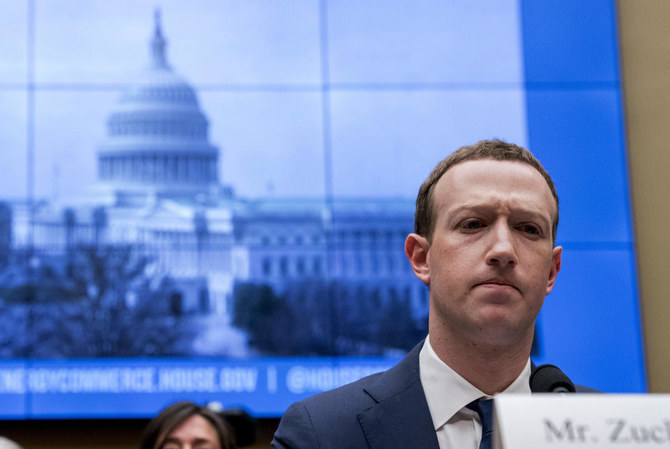
Zuckerberg appears in Congress as Facebook faces scrutiny

- The company seems to spark public and official anger at every turn these days
- Lawmakers from both parties and top regulators have criticized Facebook’s plan for the new currency


Israel arrests 2 Turkish CNN journalists over live broadcast outside IDF HQ
- Police said reporter Emrah Cakmak and cameraman Halil Kahraman were detained on suspicion of filming a sensitive security facility
- Since the Gaza war began, restrictions have expanded significantly, including tighter limits on filming soldiers on duty and sensitive or strategic sites
LONDON: Israeli police have arrested two Turkish CNN journalists who were broadcasting live outside the Israel Defense Forces’ headquarters in Tel Aviv.
Police said the pair were detained on suspicion of filming a sensitive security facility, according to the Israel Police Spokesperson’s Unit.
Reporter Emrah Cakmak and cameraman Halil Kahraman, from the network’s Turkish-language channel, had been reporting near the IDF’s Kirya military headquarters on Tuesday after Iran launched another missile barrage at Tel Aviv and other parts of central Israel.
During the live broadcast, two men believed to be soldiers approached the crew and seized the reporter’s phone, according to initial reports and a video circulating online that could not be independently verified.
Police said officers were dispatched after receiving reports of two people carrying cameras and allegedly broadcasting in real time for a foreign outlet.
עיתונאים של CNN טורקיה נעצרו לאחר שצילמו את בסיס הקרייה@NoamIhmels pic.twitter.com/t8a5P9yXfw
— גלצ (@GLZRadio) March 3, 2026
Israel’s long-standing military censorship system, overseen by the IDF Military Censor, has long barred journalists and civilians from publishing material deemed harmful to national security.
Since the Gaza war began, restrictions have expanded significantly, including tighter limits on filming soldiers on duty and sensitive or strategic sites.
After a series of similar incidents involving foreign media — most of them Palestinian citizens of Israel working for Arab-language and international media, along with foreign journalists — during the 12-Day War, Israeli police halted live international broadcasts from missile impact sites, citing concerns that exact locations were being revealed.
The Government Press Office later imposed a blanket ban on live coverage from crash and impact areas.
Communications Minister Shlomo Karhi and National Security Minister Itamar Ben-Gvir subsequently ordered that all foreign journalists obtain prior written approval from the military censor before broadcasting — live or recorded — from combat zones or missile strike locations.
Police said that when officers asked the CNN Turk crew to identify themselves, they presented expired press cards and were taken in for questioning.
Burhanettin Duran, head of Turkiye’s Directorate of Communications, condemned the arrests as an attack on the press and said Ankara is working to secure the journalists’ release.


