


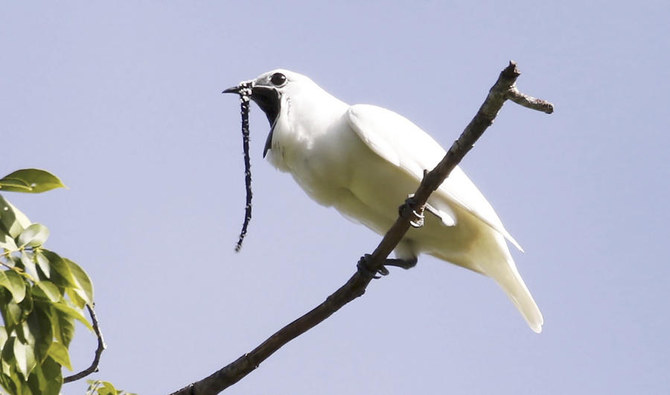

WASHINGTON: In the mountainous northern Amazon, a tiny white-plumed suitor turns to face his would-be paramour and belts out a deafening, klaxon-like call, reaching decibel levels equal to a pile driver.
Meet the white bellbird, which has just beaten out its rainforest neighbor, the screaming piha, for the title of the world’s loudest bird.
Biologist Jeff Podos at the University of Massachusetts Amherst and Mario Cohn-Haft of Brazil’s Instituto Nacional de Pesquisas da Amazonia described the record-breaking finding in a paper published in the journal Current Biology on Monday.
The researchers wrote that its calls are so loud, they wondered how white bellbird females listen at close range without damaging their hearing.
The feat is all the more impressive given the species’ diminutive size: they’re about as big as doves, weighing around half a pound (a quarter of a kilogram).
The males are distinguished by a fleshy black wattle adorned with white specks that falls from the beak, while the females are green with dark streaks and wattle-less.
Podos told AFP he was lucky enough to witness females join males on their perches as they sang.
“He sings the first note facing away, and then he does this dramatic, almost theatrical swivel, where he swings around with his feet wide open and his wattle is kind of flailing around,” he said.
“And he blasts that second note right where the female would have been, except the female knows what’s coming and she’s not going to sit there and accept that so she flies backwards” by around four meters (13 feet).
It’s not clear why the females voluntarily expose themselves to the noise at such proximity, which reaches peak levels of 113 decibels — above the human pain threshold and equivalent to a loud rock concert or a turbo-prop plane 200 feet (60 meters) away achieving liftoff power.
“Maybe they are trying to assess males up close, though at the risk of some damage to their hearing systems,” Podos added.
Still, since the scientists didn’t actually observe the birds ever mating, “We don’t know if the males we saw were accomplished males or dorks,” said Podos.
The pair used high-quality sound recorders and high-speed video to slow the action enough to study how the bird uses its anatomy to achieve such levels of noise — louder than much larger howler monkeys or bison, but probably not as loud as lions, elephants or whales.
“We don’t know how small animals manage to get so loud. We are truly at the early stages of understanding this biodiversity,” said Podos.
They also found that as the bird’s call gets louder, it also gets shorter, and theorized the trade-off may be occurring because the birds’ respiratory systems have a finite ability to control airflow and generate sound.
This, they said, would place a natural anatomical limit on how loud the bird could evolve to become through sexual selection, or selection for traits that are advantageous for reproduction.


