

Pilot hailed as hero for emergency landing after bird strike in engines disables Russian jet

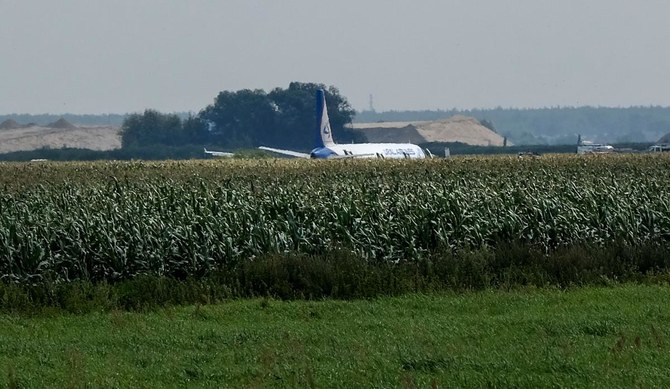
A view shows the Ural Airlines A321 plane after a hard landing on a corn field near Moscow's Zhukovsky airport on August 15, 2019. A Russian pilot was being hailed as a hero on August 15, 2019 for landing an Airbus carrying more than 230 people in a Moscow corn field after a bird strike. / AFP / Yuri KADOBNOV
Updated 15 August 2019
Follow

Pilot hailed as hero for emergency landing after bird strike in engines disables Russian jet

  • Russian television stations showed passengers standing in head-high corn next to the plane

MOSCOW: A Russian pilot was hailed as a hero Thursday for safely landing his passenger jet in a cornfield after a collision with a flock of gulls seconds after takeoff crippled both engines. While dozens of people on the plane sought medical assistance, only one was hospitalized.

The quick thinking of the captain, 41-year old Damir Yusupov, drew comparisons to the 2009 “miracle on the Hudson,” when Capt. Chesley Sullenberger safely ditched his plane in New York’s Hudson River after a bird strike disabled its engines.

Russian television stations showed passengers standing in head-high corn next to the plane, hugging Yusupov and thanking him for saving their lives.

“It was quite a feat to keep the plane from stalling and quickly find a place to land,” Viktor Zabolotsky, a former test pilot, said in televised remarks.

The Ural Airlines A321 was carrying 226 passengers and a crew of seven as it took off Thursday from Moscow’s Zhukovsky Airport en route to Simferopol in Crimea.

Russia’s Rosaviatsiya state aviation agency chief, Alexander Neradko, told reporters that the crew “made the only right decision” to immediately land the fully loaded plane with its wheels up after both of its engines malfunctioned.

“The crew has shown courage and professionalism and deserve the highest state awards,” he said, adding that the plane was fully loaded with 16 tons of fuel. “Just imagine what the consequences would be if the crew didn’t make the correct decision.”

The airline said Yusupov, the son of a helicopter pilot, is an experienced pilot who has logged over 3,000 flight hours. Yusupov worked as a lawyer before he changed course and joined a flight school when he was 32. A father of four, he has flown with Ural Airlines since his graduation in 2013. He became a captain last year.

Yusupov’s wife told Rossiya state television from their home in Yekaterinburg that he called her after landing, before she had heard about the emergency.

“He called me and said: ‘Everything is fine, everyone is alive,’” she said. “I asked what was it, and he said that birds hit the engine and we landed in a field. I was horrified and in panic and burst into tears.”

Russian officials immediately rushed to shower the pilot and crew with praise. Russian President Vladimir Putin’s spokesman, Dmitry Peskov, hailed the pilots as “heroes” and said they will receive state awards. Prime Minister Dmitry Medvedev opened a session of Cabinet by praising the crew and asking the transport minister to explain what happened.

The Emergencies Ministry said that 74 people asked for medical assistance after the incident. Health authorities said 23 people, including five children, were taken to the hospital, but all but one were released following check-ups.

Bird strikes on planes occur regularly around the world even though airports use bird distress signals, air cannons and other means to chase birds away from runways. Plane engines are designed to withstand occasional bird strikes but a collision with a flock of birds can result in serious trouble.

It’s rare for bird strikes to knock out both engines but pilots do prepare for this, said John Hansman, an aeronautics professor at the Massachusetts Institute of Technology.

He said the Ural Airlines pilot probably knew in advance that a farm field was near the airport.

With both engines down, the pilot is flying what essentially is a glider but still has control of the airplane, Hansman said. His toughest decision is where to try to land.

“When you’re in a glider, you’ve got a certain amount of altitude,” he said. “You have to make the judgment what’s the best place I can fly with the amount of energy I have left because I’m not getting any more from the engine.”

Some Russian media reports suggested the birds could have been drawn to Zhukovsky Airport by an unauthorized garbage dump nearby, but there was no immediate confirmation of the claim.

On Jan. 15, 2009, a US Airways Airbus A320 hit a flock of geese after taking off from New York City’s LaGuardia Airport and both of its engines shut down. The crew made an emergency landing in the Hudson River along midtown Manhattan and all 155 people aboard survived despite landing in very cold water.

The so-called “miracle on the Hudson” was immortalized in the Hollywood movie “Sully,” based on the autobiography of Sullenberger and starring Tom Hanks.


Japan prepares to restart world’s biggest nuclear plant, 15 years after Fukushima

Updated 7 sec ago
Follow

Japan prepares to restart world’s biggest nuclear plant, 15 years after Fukushima

NIIGATA: Japan took the final step to allow the world’s largest nuclear power plant to ​resume operations with a regional vote on Monday, a watershed moment in the country’s return to nuclear energy nearly 15 years after the Fukushima disaster. Kashiwazaki-Kariwa, located about 220 km (136 miles) northwest of Tokyo, was among 54 reactors shut after the 2011 earthquake and tsunami crippled the Fukushima Daiichi plant in the worst nuclear disaster since Chernobyl.
Since then, Japan has restarted 14 of the 33 that remain operable, as it tries to wean itself off imported fossil fuels. Kashiwazaki-Kariwa will be the first operated by Tokyo Electric Power Co. (TEPCO), which ran the doomed Fukushima plant. On Monday, Niigata prefecture’s assembly passed a vote of confidence on Niigata Governor Hideyo Hanazumi, who backed the restart last month, effectively allowing for the plant to begin operations again.
“This is a milestone, but this is not the end,” Hanazumi told reporters after the vote. “There is no end in terms of ensuring the safety of Niigata residents.”
While lawmakers voted in support of Hanazumi, the assembly session, the ‌last for the year, ‌exposed the community’s divisions over the restart, despite new jobs and potentially lower electricity bills.
“This is nothing ‌other ⁠than ​a political settlement ‌that does not take into account the will of the Niigata residents,” an assembly member opposed to the restart told fellow lawmakers as the vote was about to begin.
Outside, around 300 protesters stood in the cold holding banners reading ‘No Nukes’, ‘We oppose the restart of Kashiwazaki-Kariwa’ and ‘Support Fukushima’. “I am truly angry from the bottom of my heart,” Kenichiro Ishiyama, a 77-year-old protester from Niigata city, told Reuters after the vote. “If something was to happen at the plant, we would be the ones to suffer the consequences.”
TEPCO is considering reactivating the first of seven reactors at the plant on January 20, public broadcaster NHK reported.
Kashiwazaki-Kariwa’s total capacity is 8.2 GW, enough to power a few million homes. The pending restart would bring one 1.36 GW unit online next year and start another one with the same capacity around 2030.
“We remain firmly committed to never ⁠repeating such an accident and ensuring Niigata residents never experience anything similar,” said TEPCO spokesperson Masakatsu Takata. Takata declined to comment on timing. TEPCO shares closed up 2 percent in afternoon trade in Tokyo, higher than the wider ‌Nikkei index, which was up 1.8 percent.

RELUCTANT RESIDENTS WARY OF RESTART
TEPCO earlier this year pledged to ‍inject 100 billion yen ($641 million) into the prefecture over the next ‍10 years as it sought to win the support of Niigata residents.
But a survey published by the prefecture in October found 60 percent of residents did ‍not think conditions for the restart had been met. Nearly 70 percent were worried about TEPCO operating the plant.
Ayako Oga, 52, settled in Niigata after fleeing the area around the Fukushima plant in 2011 with 160,000 other evacuees. Her old home was inside the 20 km irradiated exclusion zone.
The farmer and anti-nuclear activist has joined the Niigata protests.
“We know firsthand the risk of a nuclear accident and cannot dismiss it,” said Oga, adding that she still struggles with post-traumatic stress-like symptoms from what happened at Fukushima.
Even Niigata Governor Hanazumi ​hopes that Japan will eventually be able to reduce its reliance on nuclear power. “I want to see an era where we don’t have to rely on energy sources that cause anxiety,” he said last month.

STRENGTHENING ENERGY SECURITY
The Monday vote was seen as the ⁠final hurdle before TEPCO restarts the first reactor, which alone could boost electricity supply to the Tokyo area by 2 percent, Japan’s trade ministry has estimated. Prime Minister Sanae Takaichi, who took office two months ago, has backed nuclear restarts to strengthen energy security and to counter the cost of imported fossil fuels, which account for 60 percent to 70 percent of Japan’s electricity generation.
Japan spent 10.7 trillion yen ($68 billion) last year on imported liquefied natural gas and coal, a tenth of its total import costs.
Despite its shrinking population, Japan expects energy demand to rise over the coming decade due to a boom in power-hungry AI data centers. To meet those needs, and its decarbonization commitments, it has set a target of doubling the share of nuclear power in its electricity mix to 20 percent by 2040.
Joshua Ngu, vice chairman for Asia Pacific at consultancy Wood Mackenzie, said public acceptance of the restart of Kashiwazaki-Kariwa would represent “a critical milestone” toward reaching those goals. In July, Kansai Electric Power, Japan’s top nuclear power operator, said it would begin conducting surveys for a reactor in western Japan, the first new unit since the Fukushima disaster.
But for Oga, who was in the crowd outside the assembly on Monday chanting ‘Never forget Fukushima’s lessons!’, the nuclear revival is a terrifying reminder of the potential risks. “At the time (2011), I never thought that TEPCO would operate a nuclear power ‌plant again,” she said.
“As a victim of the Fukushima nuclear accident, I wish that no one, whether in Japan or anywhere in the world, ever again suffers the damage of a nuclear accident.”