Hong Kong descends into chaos again as protesters defy ban

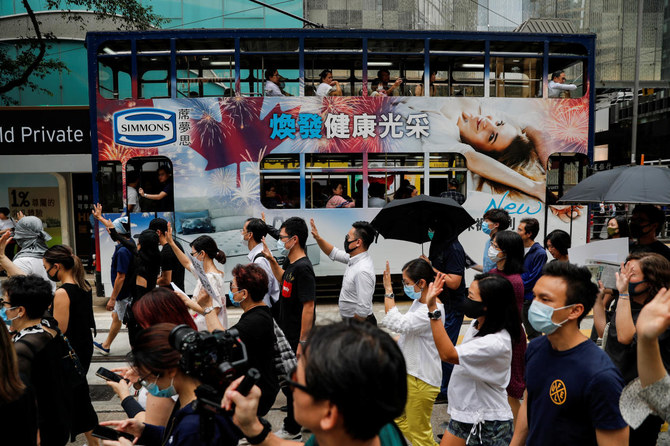
People march past a tram as they protest against what they say is the abuse of pro-democracy protesters by Hong Kong police, in Central district, Hong Kong, China October 18, 2019. (Reuters/Ammar Awad)
Updated 20 October 2019
Follow

Hong Kong descends into chaos again as protesters defy ban

  • Protesters tossed firebombs and took their anger out on shops with mainland Chinese ties as they skirmished late into the evening with riot police
  • Police had beefed up security measures ahead of the rally, for which they refused to give permission

HONG KONG: Hong Kong streets descended into chaotic scenes following an unauthorized pro-democracy rally Sunday as protesters set up roadblocks and torched businesses and police responded with tear gas and a water cannon.
Protesters tossed firebombs and took their anger out on shops with mainland Chinese ties as they skirmished late into the evening with riot police, who unleashed numerous tear gas rounds on short notice, angering residents and passers-by.
Police had beefed up security measures ahead of the rally, for which they refused to give permission, the latest chapter in the unrest that has disrupted life in the financial hub since early June.
Some 24 people were hurt and treated at hospitals, including six with serious injuries, the Hospital Authority said.
Police did not give an arrest figure. One person was seen being handcuffed and taken away to a police van.
As the rally march set off, protest leaders carried a black banner that read, “Five main demands, not one less,” as they pressed their calls for police accountability and political rights in the semi-autonomous Chinese territory.
Supporters sang the protest movement’s anthem, waved colonial and US flags, and held up placards depicting the Chinese flag as a Nazi swastika.
Many protesters wore masks in defiance of a recently introduced ban on face coverings at public gatherings, and volunteers handed more out to the crowd.
Matthew Lee, a university student, said he was determined to keep protesting even after more than four months.
“I can see some people want to give up, but I don’t want to do this because Hong Kong is my home, we want to protect this place, protect Hong Kong,” he said. “You can’t give up because Hong Kong is your home.”
Some front-line protesters barricaded streets at multiple locations in Kowloon, where the city’s subway operator restricted passenger access.
They tore up stones from the sidewalk and scattered them on the road, commandeered plastic safety barriers and unscrewed metal railings to form makeshift roadblocks.
A water cannon truck and armored car led a column of dozens of police vans up and down Nathan Road, a major artery lined with shops, to spray a stinging blue-dyed liquid as police moved to clear the road of protesters and barricades.
At one point, the water cannon sprayed a handful of people standing outside a mosque. Local broadcaster RTHK reported that the people hit were guarding the mosque and few protesters were nearby. The Hong Kong police force said it was an “unintended impact” of its operation to disperse protesters and later sent a representative to meet the mosque’s imam.
As night fell, protesters returned to the streets, setting trash on fire at intersections.
Residents jeered at riot police, cursing at them and telling them to leave. The officers, in turn, warned people that they were part of an illegal assembly and told them to leave, and unleashed tear gas to disperse the crowds.
Along the way, protesters trashed discount grocery shops and a restaurant chain because of what they say is the pro-Beijing ownership of the companies. They also set fire to ATMs and branches of mainland Chinese banks, setting off sprinklers in at least two, as well as a shop selling products from Chinese smartphone maker Xiaomi.
The police used a bomb disposal robot to blow up a cardboard box with protruding wires that they suspected was a bomb.
Organizers said ahead of the march that they wanted to use their right to protest as guaranteed by Hong Kong’s constitution despite the risk of arrest.
“We’re using peaceful, rational, nonviolent ways to voice our demands,” Figo Chan, vice convener of the Civil Human Rights Front, told reporters. “We’re not afraid of being arrested. What I’m most scared of is everyone giving up on our principles.”
The group has organized some of the movement’s biggest protest marches. One of its leaders, Jimmy Sham, was attacked on Wednesday by assailants wielding hammers.
On Saturday, Hong Kong police arrested a 22-year-old man on suspicion of stabbing a teenage activist who was distributing leaflets near a wall plastered with pro-democracy messages. A witness told RTHK that the assailant shouted afterward that Hong Kong is “a part of China” and other pro-Beijing messages.
The protest movement sprang out of opposition to a government proposal for an extradition bill that would have sent suspects to mainland China to stand trial, and then ballooned into broader demands for full democracy and an inquiry into alleged police brutality.


Uganda’s presidential election experiences hours of delays at some polling stations

Updated 7 sec ago
Follow

Uganda’s presidential election experiences hours of delays at some polling stations

  • Some polling stations remained closed for up to four hours after the scheduled 7 a.m. start time due to “technical challenges“
  • The East African country of roughly 45 million people has 21.6 million registered voters

KAMPALA, Uganda: Uganda’s presidential election was plagued by widespread delays Thursday in addition to a days-long Internet shutdown that has been criticized as an anti-democratic tactic in a country where the president has held office since 1986.
Some polling stations remained closed for up to four hours after the scheduled 7 a.m. start time due to “technical challenges,” according to the nation’s electoral commission, which asked polling officers to use paper registration records to ensure the difficulties did not “disenfranchise any voter.”
President Yoweri Museveni, 81, faces seven other candidates, including Robert Kyagulanyi, a musician-turned-politician best known as Bobi Wine, who is calling for political change.
The East African country of roughly 45 million people has 21.6 million registered voters. Polls are expected to close at 4 p.m. Thursday, according to the electoral commission. Results are constitutionally required to be announced in 48 hours.
Impatient crowds gathered outside polling stations expressing concerns over the delays Thursday morning. Umaru Mutyaba, a polling agent for a parliamentary candidate, said it was “frustrating” to be waiting outside a station in the capital Kampala.
“We can’t be standing here waiting to vote as if we have nothing else to do,” he said.
Wine alleged there was electoral fraud occurring, noting that biometric voter identification machines were not working at polling places and claiming there was “ballot stuffing.”
“Our leaders, including Deputy President for Western Region, arrested. Many of our polling agents and supervisors abducted, and others chased off polling stations,” Wine wrote in a post on social media platform X.
Museveni told journalists he was notfied biometric machines were inoperable at some stations and he supported the electoral body’s decision to revert to paper registration records. He did not comment on the allegation of fraud.
Ssemujju Nganda, a prominent opposition figure and lawmaker seeking reelection in Kira municipality, told The Associated Press he had been waiting in line to vote for three hours.
Nganda also noted biometric machines were malfunctioning, in addition to the late arrival of balloting materials, and predicted the delays likely would lead to apathy and low turnout in urban areas where the opposition has substantial support.
“It’s going to be chaos,” he said Thursday morning.
Nicholas Sengoba, an independent analyst and newspaper columnist, said delays to the start of voting in urban, opposition areas favored the ruling party.
Museveni serving Africa’s third-longest presidential term
Uganda has not witnessed a peaceful transfer of presidential power since independence from British colonial rule six decades ago.
Museveni has served the third-longest term of any African leader and is seeking to extend his rule into a fifth decade. Some critics say removing him through elections remains difficult, but the aging president’s authority has become increasingly dependent on the military led by his son, Muhoozi Kainerugaba.
Museveni and Wine are reprising their rivalry from the previous election in 2021, when Wine appealed to mostly young people in urban areas. With voter turnout of 59 percent, Wine secured 35 percent of the ballots against Museveni’s 58 percent, the president’s smallest vote share since his first electoral campaign three decades ago.
The lead-up to Thursday’s election produced concerns about transparency, the possibility of hereditary rule, military interference and opposition strategies to prevent vote tampering at polling stations.
Uganda’s Internet was shut down Tuesday by the government communications agency, which cited misinformation, electoral fraud and incitement of violence. The shutdown has affected the public and disrupted critical sectors such as banking.
Heavy security deployed
There has been heavy security leading up to voting, including military units deployed on the streets this week.
Amnesty International said security forces are engaging in a “brutal campaign of repression,” citing a Nov. 28 opposition rally in eastern Uganda where the military blocked exits and opened fire on supporters, killing one person.
Museveni urged voters to come out in large numbers during his final rally Tuesday.
“You go and vote, anybody who tries to interfere with your freedom will be crushed. I am telling you this. We are ready to put an end to this indiscipline,” he said.
The national electoral commission chairperson, Simon Byabakama, urged tolerance among Ugandans as they vote.
“Let us keep the peace that we have,” Byabakama said late Wednesday. “Let us be civil. Let us be courteous. Let’s be tolerant. Even if you know that this person does not support (your) candidate, please give him or her room or opportunity to go and exercise his or her constitutional right.”
Authorities also suspended the activities of several civic groups during the campaign season. That Group, a prominent media watchdog, closed its office Wednesday after the interior ministry alleged in a letter that the group was involved in activities “prejudicial to the security and laws of Uganda.”
Veteran opposition figure Kizza Besigye, a four-time presidential candidate, remains in prison after he was charged with treason in February 2025.