HONG KONG: No tiresome wait for hugs and kisses from Mickey and Minnie Mouse. No queue at all for Hyperspace Mountain, where thrill-seekers are so scarce that Star Wars’ Admiral Ackbar speaks to himself in the dark.
Tinker Bell gazes out over rows of empty seats on the train to Hong Kong Disneyland that was far busier before tourists were scared off by anti-government protests shaking this international hub for business and fun.
That’s tough for local business but great for Disney fans like Yunice Tsui and her 7 and 4-year-old daughters, adorable in Minnie headbands. With an annual pass to the park she’s already toured nine times, Tsui is better placed than most to size up the body-blow to Hong Kong visitor numbers from the often violent demonstrations, now in their fifth month.
“Before June, you’d generally queue for more than 30 minutes for each ride. For the last few times since July, we’ve been here about two-to-three times, every time it’s about a five-to-six minute wait to queue up for a ride. There are certainly less people, I would say 60% less. Kids are very happy because after a ride, they can go queue up for another one and play again.”
The impact of the protests on tourism is verging on catastrophic for Hong Kong, one of the world’s great destinations and geared up to receive 65 million visitors a year.
On Victoria Peak, restaurants with knock-out nighttime views of the city’s neon-lit skyscrapers stand empty. The snaking lines of tourists for the clicketty-clacketty 19th-century tram to the top are now just a memory.
The Dragon Boat Carnival in June, when protests started: canceled. A Wine & Dine Festival scheduled for the end of this month: scrapped, too. Hong Kong received 2.3 million fewer visitors in August compared with a year earlier, largely trips that people from elsewhere in China are no longer making to the semi-autonomous Chinese territory. September visitor numbers, due Oct. 31, are unlikely to be any better, given recent protest-related violence and chaos.
“It’s deserted,” said Dyutimoy Chakraborty, who runs the Gordon Ramsay Bread Street Kitchen & Bar opposite the Peak Tram. The tram now closes at 10 p.m. instead of midnight, because of “potential demonstrations and protests in the nearby area.”
“Normally, there would be a huge queue,” Chakraborty said on a recent weeknight. “Since the protests started, it has been like this.”
The eatery has lost almost half of its weekday business, he added.
“You think of what you could have made and what you are making at the moment,” he said. “That difference, yes, it hurts.”
Protester leaflets advise, “You’ve arrived in a broken, torn-apart city,” and the protests have at times caused monumental disruptions of traffic and public transport.
But even when the protests have involved hundreds of thousands of people, they’ve generally been confined to only a few areas in this semi-tropical former British colony of 7 million.
And the tourists who come anyway are finding bargain-basement hotel rates, two-for-one deals, easy late checkouts and other sweeteners.
Visiting this month from Taiwan, where he works as a teacher, South African traveler Winand Koch paid the equivalent of just $65 per night for a room in a comfy hotel that was charging nearly quadruple that rate when he first checked a few months back. Of all his trips to Hong Kong, the two-day stay with his sister, Betro, was “one of the best,” he said.
“I’ve never seen Hong Kong this quiet before,” he said. “We didn’t have to queue anywhere. We could get in everywhere.”
Trundling along with suitcases through crowds of demonstrators, hoping to catch a train to the airport a day after protest violence shut down the entire rail network, Koch said he’d enjoyed being “part of history.”
“By accident ran into the protest today,” he said. “But it was fun, actually, the people were all friendly, helping us through ... they even gave us masks.”
Aside from the risk of stumbling unawares into street battles and clouds of police tear gas — as some tourists have to their coughing, spluttering dismay — Hong Kong remains a pleasant city. Visitors of either sex needn’t think twice about venturing out late at night or while wearing valuables. For the moment, the US State Department still only recommends that visitors exercise extra caution. A similarly worded travel advisory from the British government says, “most visits are trouble free.”
Edgar Ruiz said he flew from Mexico “just to see the protests.”
“I wanted to experience it firsthand. This is big!” he said. “I want to be telling people that I was here when this happened, because it is going to be major in history.”
Even some Hong Kong residents are enjoying a respite from the usual floods of visitors, mainly from mainland China. The number of total arrivals has almost doubled over the past decade, from 36 million in 2010 to 65 million last year.
Up on the Peak, Hong Kong-born Isaac Mercado, a 26-year-old banking analyst, was luxuriating in the unusual emptiness.
“We used to have a quiet city,” he said. Now, with fewer visitors, “I get the chance to explore more a bit on my own, and not be crammed with loads of tourists. So, it’s getting more like my home, rather than a tourist city.”


In protest clouds, Hong Kong tourists see silver lining
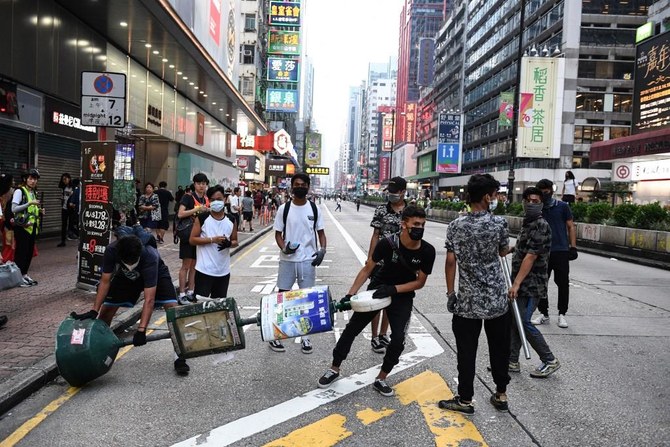
In protest clouds, Hong Kong tourists see silver lining

- The demonstrations have made it tough for local businesses
- Tourists are enjoying emptier ques at places like Disney


Justice Department sees no basis for civil rights probe in Minnesota ICE shooting, official says
- And on Tuesday, Deputy Attorney General Todd Blanche said in a statement that “there is currently no basis for a criminal civil rights investigation”
WASHINGTON: The Justice Department does not believe there is currently any basis to open a criminal civil rights investigation into the killing of a woman by a US Immigration and Customs Enforcement officer in Minneapolis, a top department official said Tuesday.
The decision to keep the Justice Department’s Civil Rights Division out of the investigation into the fatal shooting of Renee Good marks a sharp departure from past administrations, which have moved quickly to probe shootings of civilians by law enforcement officials for potential civil rights offenses.
While an FBI probe is ongoing, lawyers in the Civil Rights Division were informed last week that they would not play a role in the investigation at this time, according to two people familiar with the matter who spoke on the condition of anonymity to discuss internal department deliberations.
And on Tuesday, Deputy Attorney General Todd Blanche said in a statement that “there is currently no basis for a criminal civil rights investigation.” The statement, first reported by CNN, did not elaborate on how the department had reached a conclusion that no investigation was warranted.
Federal officials have said that the officer acted in self-defense and that the driver of the Honda was engaging in “an act of domestic terrorism” when she pulled forward toward him.
The quick pronouncement by administration officials before any meaningful investigation could be completed has raised concerns about the federal government’s determination to conduct a thorough review of the chain of events precipitating the shooting. Minnesota officials have also raised alarm after federal officials blocked state investigators from accessing evidence and declared that Minnesota has no jurisdiction to investigate the killing.
Also this week, roughly half a dozen federal prosecutors in Minnesota resigned and several supervisors in the criminal section of the Civil Rights Division in Washington gave notice of their departures amid turmoil over the federal probe, according to people familiar with the matter.
Among the departures in Minnesota is First Assistant US Attorney Joseph Thompson, who had been leading the sprawling investigation and prosecution of fraud schemes in the state, two other people said. At least four other prosecutors in the Minnesota US attorney’s office joined Thompson in resigning amid a period of tension in the office, the people said. The people spoke on the condition of anonymity to discuss personnel matters.
They are the latest in an exodus of career Justice Department attorneys who have resigned or been forced out over concerns over political pressure or shifting priorities under the Trump administration. Hundreds of Justice Department lawyers have been fired or have left voluntarily over the last year.
Minnesota Democratic lawmakers criticized the departures, with Sen. Amy Klobuchar, a member of the Senate Judiciary Committee, calling the resignations “a loss for our state and for public safety” and warning that prosecutions should not be driven by politics. Gov. Tim Walz said the departures raised concerns about political pressure on career Justice Department officials.
The resignations of the lawyers in the Civil Rights Division’s criminal section, including its chief, were announced to staff on Monday, days after lawyers were told the section would not be involved in the probe. The Justice Department on Tuesday said those prosecutors had requested to participate in an early retirement program “well before the events in Minnesota,” and added that “any suggestion to the contrary is false.”
Founded nearly 70 years ago, the Civil Rights Division has a long history of investigating shootings by law enforcement even though prosecutors typically need to clear a high bar to mount a criminal prosecution.
In prior administrations, the division has moved quickly to open and publicly announce such investigations, not only to reflect federal jurisdiction over potential civil rights violations but also in hopes of soothing community angst that sometimes accompanies shootings involving law enforcement.
“The level of grief, tension and anxiety on the ground in Minnesota is not surprising,” said Kristen Clarke, who led the Civil Rights Division under the Biden administration. “And historically the federal government has played an important role by being a neutral and impartial agency committing its resources to conducting a full and fair investigation, and the public loses out when that doesn’t happen,” she said.
In Minneapolis, for instance, the Justice Department during the first Trump administration opened a civil rights investigation into the 2020 death of George Floyd at the hands of city police officers that resulted in criminal charges. The Minneapolis Police Department was separately scrutinized by the Biden administration for potential systemic civil rights violations through what’s known as a “pattern or practice” investigation, a type of police reform inquiry that is out of favor in the current Trump administration Justice Department.


