Prince William and wife Kate land in Pakistan capital after aborted flight

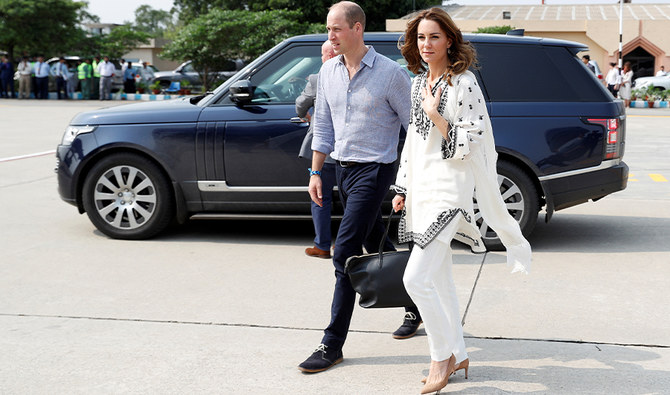
Britain's Prince William and Catherine, Duchess of Cambridge, depart from Lahore airport, Pakistan October 18, 2019. (REUTERS)
Updated 18 October 2019
Follow

Prince William and wife Kate land in Pakistan capital after aborted flight

  • Bad weather made the couple to stay overnight in Lahore that changed their tightly-choreographed itinerary
  • Planned visit to a Pakistan military post in the country's west on Friday morning was cancelled

ISLAMABAD: Britain’s Prince William and his wife Kate landed in Pakistan’s capital Islamabad on Friday, after turbulence forced the couple to stay overnight in Lahore in a change to their tightly-choreographed itinerary.
On Thursday an RAF Voyager carrying the royals, who are on a four-day official visit to Pakistan, aborted landings in Islamabad and nearby Rawalpindi due to severe turbulence.
The couple stayed at Lahore’s Pearl Continental Hotel on Thursday evening, along with journalists, Kensington Palace staff and foreign ministry officials.
Thursday’s aborted flight was described by a Reuters photographer on board as one of the most turbulent he had experienced in 25 years of regular flying, although the couple told reporters after returning to Lahore they were “fine.” Friday’s flight passed off without incident.
A planned visit to a Pakistan military post in the west of the country on Friday morning was canceled, but the couple will visit an army canine training school in Islamabad before departing from the country later in the day.


Islamabad steps up vehicle checks to boost security as 166,000 cars get electronic tags

Updated 4 sec ago
Follow

Islamabad steps up vehicle checks to boost security as 166,000 cars get electronic tags

  • Authorities say over 3,000 vehicles registered in past 24 hours as enforcement intensifies
  • Extended service hours introduced to push full compliance with digital monitoring system

ISLAMABAD: Authorities in the Pakistani capital have intensified enforcement against vehicles without mandatory electronic tags with more than 166,000 cars now registered, according to data released on Sunday evening, as Islamabad moves to strengthen security and digital monitoring at key entry and exit points.

The Islamabad Capital Territory (ICT) administration introduced the electronic tagging system late last year as part of a broader effort to regulate traffic, improve record-keeping and enhance surveillance in a city that hosts the country’s main government institutions, foreign missions and diplomatic enclaves.

Under the system, vehicles are fitted with electronic tags that can be read automatically by scanners installed at checkpoints across the capital, allowing authorities to identify unregistered vehicles without manual inspections. Vehicles already equipped with a motorway tag, or m-tag, are exempt from the requirement.

“A total of 166,888 vehicles have successfully been issued M-Tags so far, including 3,130 vehicles in the last 24 hours,” the ICT administration said, according to the Excise Department.

Officials said readers installed at checkpoints across Islamabad are fully operational and are being used to stop vehicles still without tags, as enforcement teams carry out checks across the city.

To facilitate compliance, authorities have expanded installation facilities and extended operating hours. The Excise Department said m-tag installation is currently available at 17 booth locations, while select centers have begun operating beyond normal working hours.

According to Director General Excise Irfan Memon, m-tag centers at 26 Number Chungi and 18 Meel are providing services round the clock, while counters at Kachnar Park and F-9 Park remain open until midnight to accommodate motorists unable to visit during daytime hours.

Officials said the combination of enforcement and facilitation was aimed at achieving full compliance with minimal disruption, adding that operations would continue until all vehicles operating in the capital are brought into the system.

The enforcement drive builds on a wider push by the federal government to integrate traffic management, emergency response and security monitoring through technology-driven “safe city” initiatives. Last month, Interior Minister Mohsin Naqvi reviewed Islamabad’s surveillance infrastructure and said reforms in monitoring systems and the effective use of technology were the “need of the hour.”

Authorities have urged motorists to obtain electronic tags promptly to avoid delays and penalties at checkpoints as enforcement continues across the capital.