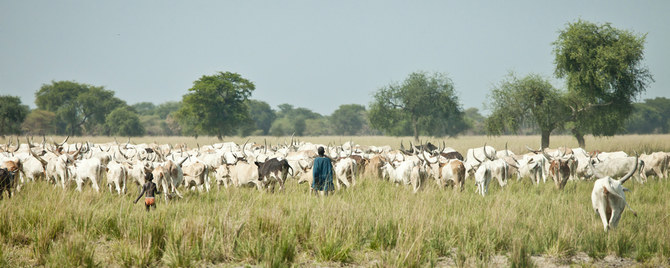

JEDDAH: The Ministry of Environment, Water and Agriculture has announced a ban on importing livestock from Sudan and Djibouti.
The ministry said the ban is a response to the announcement of World Organization for Animal Health (OIE) concerning documented cases of Rift Valley fever (RVF) in Sudan.
In addition, a sample from one livestock shipment arriving from Djibouti was positive and thus was not cleared.
According to the ministry, Saudi Arabia imported 5 million heads of cattle from Sudan and 700,000 from Djibouti during the last Hijri year, prior to the ban.
The spokesman for the ministry, Abdullah Abalkhail, said that alternative sources include GCC, Jordan, Uruguay, Eritrea, Ethiopia, Australia, New Zealand, Pakistan, Georgia, Portugal, Hungary, Kazakhstan and Romania, as well as Chinese Mongolia, Argentine, Brazil and the US.
These countries can hardly compete with African states, said Al-Jadani, due to prices, different weather and customer demand.
HIGHLIGHTS
- Humaid Al-Jadani, a livestock merchant and a former member of the Jeddah Chamber of Commerce livestock committee, said 5 ships were about to arrive carrying up to 50,000 heads of cattle when the ban was announced, but were turned back.
- He said that the Saudi market depends heavily on imports from Africa, specifically Sudan and Djibouti.
- Prices have risen during the past two days by 30 percent and further rises are expected, said Al-Jadani.
- Official reports from Sudan say that at least 135 cases of rift valley fever were documented in Sudan, in Kassala, Red Sea and northern Darfur.
The domestic livestock, he added, covers the demand of a very low percentage of the market and the price of local sheep are very high.
All shipments are examined at their point of arrival and only healthy animals are allowed into the local market.
Regulations
The ministry has already banned livestock imports from Somalia.
“The ministry studies each country individually to put health regulations in line with the OIE and we follow up daily reports from the OIE to reduce the spread of the diseases among animals and people,” Abalkhail said.
Humaid Al-Jadani, a livestock merchant and a former member of the Jeddah Chamber of Commerce livestock committee, said five ships were about to arrive carrying up to 50,000 heads of cattle when the ban was announced, but were turned back.
He said that the Saudi market depends heavily on imports from Africa, specifically Sudan and Djibouti.
According Al-Jadani, prices have risen during the past two days by 30 percent and further rises are expected in the coming period.
The ministry has called on those working in the sector to contact officials on the hotline 8002470000 if they find any suspicious cases.
A fine up to SR1 million ($267,000) will be imposed on any company contravening the ban.
Official reports from Sudan say that at least 135 cases of RVF were documented in Sudan, in Kassala, Red Sea and Northern Darfur. According to the World Health Organization Sudan witnessed a huge RVF outbreak in 2007, while in Saudi Arabia RVF spread back in 2000.
The World Bank noted previously that six zoonotic diseases between 1997 and 2009 have led to a loss of $80 billion.
Officials believe that only through collaboration between various authorities in the health, biology and environment sectors the disease can be controlled.