

Storm forces William and Kate’s royal plane to abandon Islamabad landing

1 / 2
The RAF Voyager aircraft that the The Duke and Duchess of Cambridge travelled is seen, in Lahore, Pakistan. (Reuters)
2 / 2
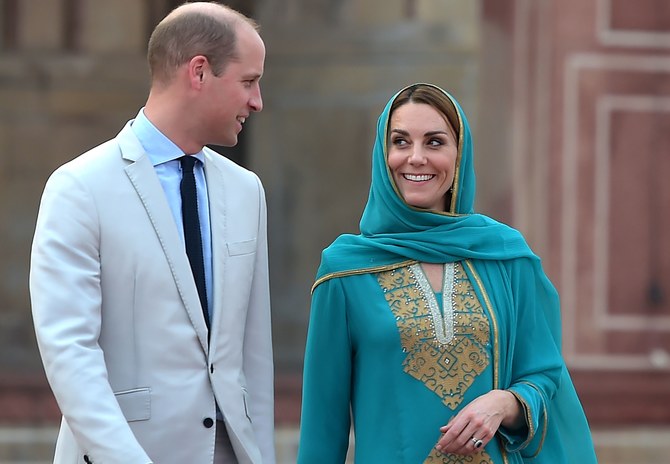
Britain's Prince William and his wife Britain's Catherine visit the historical Badshahi mosque in Lahore. (AFP)
Updated 17 October 2019
Follow

Storm forces William and Kate’s royal plane to abandon Islamabad landing

  • British Royal Air Force jet was caught in one of the thunderous storms that periodically rock the capital in October
  • “If I’m honest ... that was the most nervous I’ve ever felt in a plane,” added ITV royal correspondent Chris Ship

LAHORE: A fierce storm in Islamabad forced a plane carrying Britain’s Prince William and his wife Kate to abandon two landings before returning to Lahore late Thursday, reporters traveling with them said, in a dramatic end to a day of cracking cricket balls and touring the towering historic Badshahi Mosque.
The Voyager, a British Royal Air Force jet transporting the couple during their five-day tour of Pakistan, was caught in one of the thunderous storms that periodically rock the capital in October.
“The pilot circled for an hour but the lightening — and turbulence — was so bad we had to fly back,” tweeted the Daily Mail’s royal correspondent Rebecca English, who was on board the plane.
“Few of us have experienced turbulence as bad as that,” she added.
“If I’m honest ... that was the most nervous I’ve ever felt in a plane,” added ITV royal correspondent Chris Ship.
Daily Telegraph correspondent Ben Farmer said the pilot had tried to land twice, once at a military base in the garrison city of Rawalpindi adjacent to Islamabad, and once at Islamabad International before abandoning the attempt and returning to Lahore, some 270 kilometers (170 miles) flying distance away.
However all on board appeared to be safe, with English tweeting that Prince William — himself a pilot — had joked with the press pack that he had been flying.
English said it was unclear when they would be able to take off again. There was no immediate statement from Kensington Palace.


The mid-air flight drama came after the Duke and Duchess of Cambridge had spent the day exploring Lahore, Pakistan’s cultural capital.
The royal couple kicked off their fourth day in Pakistan with a visit to the SOS Children’s Village orphanage, where Kate gave a brief speech along with a short greeting in Urdu and celebrated children’s birthdays.
“Earlier this year I talked about the fact that it takes a village to raise a child. The village we’ve seen here today is the best representation of that ideal that I could have possibly imagined,” she said.
The Duke and Duchess later took to the crease at the National Cricket Academy, where they both hit a few runs as they played alongside a host of current and former cricket stars, including current bowling coach Waqar Younis.
After an outfit change, the duo headed to Lahore’s famous Badshahi Mosque — one of the world’s largest.
William sported a cream-colored linen suit and Kate donned a light green shalwar kameez, wrapping her hair in a matching headscarf and walking in stockinged feet to show her respect.
William’s mother, the late Princess Diana, caused a controversy at the same mosque in 1991 when she wore an above-the-knee dress, sparking a backlash from some Muslim leaders who argued she should have covered up.
The couple rounded off the trip with a visit to the Shaukat Khanum Memorial Cancer Hospital, founded by Prime Minister Imran Khan, where Diana is remembered fondly for helping raise money for the facility in the 1990s.
Kensington Palace has called the Cambridges’ five-day trip, which ends Friday, their “most complex” tour to date as the royals seek to boost ties between Britain and the second largest country in the Commonwealth.
The couple have spent much of the trip promoting various causes, from girls’ education to conservation and climate change awareness as they criss-crossed the country.
Security has improved dramatically since the army intensified a crackdown on militant groups in 2015, with several countries changing their travel warnings for Pakistan as a result, and Islamabad eager to promote both tourism and foreign investment.
There are promising signs, such as the British Airways return earlier this year after more than a decade, and the slow but steady revival of international cricket.


US and Mideast countries seek Kyiv's drone expertise as Russia-Ukraine talks put on ice

Updated 4 sec ago
Follow

US and Mideast countries seek Kyiv's drone expertise as Russia-Ukraine talks put on ice

KYIV, Ukraine: The United States and its allies in the Middle East are seeking Ukraine's expertise in countering Iran's Shahed drones, according to Ukrainian President Volodymyr Zelenskyy.

Various countries, including the United States, have approached Ukraine for help in defending against the Iranian drones, Zelenskyy said late Wednesday. He said he has spoken in recent days with the leaders of the United Arab Emirates, Qatar, Bahrain, Jordan and Kuwait about possible cooperation.

Russia has fired tens of thousands of Shaheds at Ukraine since it invaded its neighbor just over four years ago, launching a swarm of more than 800 drones and decoys in its biggest nighttime barrage. Iran has responded to joint U.S.-Israeli strikes by launching the same type of drones at countries in the Middle East.

Ukrainian assistance in countering Iranian drones will be provided only if it does not weaken Ukraine's own defenses, and if it adds leverage to Kyiv's diplomatic efforts to stop the Russian invasion, according to the Ukrainian leader.

"We help to defend from war those who help us, Ukraine, bring a just end to the war" with Russia, Zelenskyy said. Later Thursday, Zelenskyy said he had received a U.S. request for support to defend against the drones in the Middle East and had given the order for equipment to be provided along with Ukrainian experts without providing further details.

"Ukraine helps partners who help our security and the protection of our people's lives," he added in a social media post.

Trump, in an interview Thursday with Reuters, said, "Certainly I'll take, you know, any assistance from any country."

Ukraine has battle-tested drone defenses

Ukraine has pioneered the development of cut-price drone killers that cost as little as $1,000, rewriting the air defense rule book and making other countries take notice.

European countries got a wake-up call last September on the changed nature of air defense when Poland scrambled multimillion-dollar military assets, including F-35 and F-16 fighter jets and Black Hawk helicopters, in response to airspace violations by cheap drones.

Ukrainian manufacturers have developed low-cost interceptor drones specifically designed to hunt and destroy Shaheds, and its rapidly expanding drone industry is producing excess capacity.

Zelenskyy announced earlier this year that Ukraine would begin exporting the battle-tested systems.

The European Union's top diplomat, Kaja Kallas, said before chairing a meeting of EU and Gulf foreign ministers via video link Thursday that the talks would look at how Ukraine's experience can help countries counter Iranian drones.

Middle East war delays Russia-Ukraine talks

The Iran war, now in its sixth day, has drawn international attention away from Europe's biggest conflict since World War II, and forced the postponement of a new round of U. S-brokered talks between Russia and Ukraine planned for this week, Zelenskyy said.

Western governments and analysts say the Russia-Ukraine war has killed hundreds of thousands of people, while there is no sign that yearlong U.S.-led peace efforts will stop the fighting any time soon.

"Right now, because of the situation around Iran, there are not yet the necessary signals for a trilateral meeting," Zelenskyy said. "But as soon as the security situation and the overall political context allow us to resume that trilateral diplomatic work, it will be done."

Zelenskyy thanked the United States for the return from Russia on Thursday of 200 Ukrainian prisoners of war. Russia's Defense Ministry also said it received the same number of prisoners from Ukraine and thanked the U.S. and United Arab Emirates for mediating.

Prisoner swaps have been one of the few tangible results of the talks. Vladimir Medinsky, a Russian negotiator, said on social media that a total of 500 prisoners from each side would be exchanged between Thursday and Friday.

Oleksandr Merezhko, the head of Ukraine's parliamentary foreign affairs committee, said Russian President Vladimir Putin is trying to drag out the negotiations so that he can press on with Russia's invasion while escaping further U.S. sanctions.

He urged the U.S. administration to look at the Russia-Ukraine war and the war in the Middle East as linked.

"In reality, Russia and Iran are close allies that act in concert — Iran supplies weapons and Russia helps Iran develop its defense industry. These are interconnected conflicts," Merezhko told The Associated Press.

Ukraine's army has recently pushed back Russian forces at some points along the roughly 1,250-kilometer (750-mile) front line, according to the Institute for the Study of War.

Localized Ukrainian counterattacks liberated more territory than Ukrainian forces lost in the last two weeks of February, the Washington-based think tank said this week, estimating the recovered land at about 257 square kilometers (100 square miles) since Jan. 1.