



NEW YORK CITY: The UN is facing its worst liquidity shortfall in 74 years of operation with a deficit of $1.385 billion, which is making it difficult for the world body to pay staff and vendors or fund missions.
The crisis has forced Antonio Guterres, the UN secretary-general, to begin cutbacks in all operations.
Warning on Oct. 8 that the problems are at a “tipping point,” he called it “the worst cash crisis facing the UN in nearly a decade,” jeopardizing peacekeeping efforts in Yemen, Myanmar and the management of the UN’s New York headquarters, offices in Geneva, Vienna and Nairobi, and investigative commissions in Bangkok, Addis Ababa, Santiago and Beirut.
A UN budget review presented this week showed that the crisis is being driven by the lack of cash to pay staff and vendors or to fund critical programs, and outlined spending cuts that will begin immediately pending a resolution of the situation.
“The cash deficits occur earlier in the year, linger longer and run deeper,” said Catherine Pollard, UN under-secretary-general for management strategy, policy and compliance.
“For the second successive year, we have exhausted all regular budget liquidity reserves, despite several measures we had taken to reduce expenditures to align them with available liquidity.”
Chandramouli Ramanathan, UN's controller, detailed the debt in a presentation with Pollard on Oct. 11 that identified $1.385 billion in debts, more than half of the UN’s 2019 annual budget of $2.85 billion.
Ramanathan said that only $1.99 billion had been collected this year, including past year arrears.
“If the trend continues … you will pretty much see that at some point we are running out of liquidity so often — everything depends on the liquidity if the liquidity runs down, we have to prioritize the payment,” he said.
“It will come to the point where you will not have enough staff or not have enough to pay the vendors.”
Ramanathan said that 75 percent of the UN’s budget is for employee and building costs. The remainder includes air charters, fuel, rations, IT support and political missions, which he said are all in jeopardy.
This does not include the costs of peacekeeping missions, nearly $8 billion for 2019, but which are nearly $3.7 billion in arrears.
A slew of operating spending cuts at the UN began on Oct. 14, ranging from no new hirings or filling of vacant positions to switching off heating and airconditioning.
Ramanathan said that these were emergency steps but warned failure to address the “liquidity crisis” would result in other more serious cutbacks including funding of operations, missions and more.
UN OPERATING SPENDING CUTS
• No new hirings or filling of vacant positions
• Reducing operating hours of UN facilities including the New York City headquarters
• Suspending release of new documents, studies and translation of documents
• Curtailing travel of UN officials, meetings or publicly scheduled receptions
• Cutting back operations at the UN headquarters and its worldwide centers, including turning off the use of electricity for certain building operations such as escalators, and shutting down the UN’s fountains
• Heating and air conditioning to be turned off at 6 p.m. each day and not turned on until 8 a.m. at UN buildings
“We are trying to cut back on non-salaried costs, operating hours to meet obligations and to vendors,” he said.
Ramanathan said that the UN was prohibited by its charter from borrowing money. He acknowledged that traditionally member countries were late in paying, usually until the last half of the year or last quarter, but the late payments had become “later and later” each year.
“The US is the largest contributor and they have a large outstanding amount … the US has a large amount outstanding,” Ramanathan said, noting that the UN does single out and list specific debts or debtors.
“We are in active engagement with all the states that owe large amounts.”
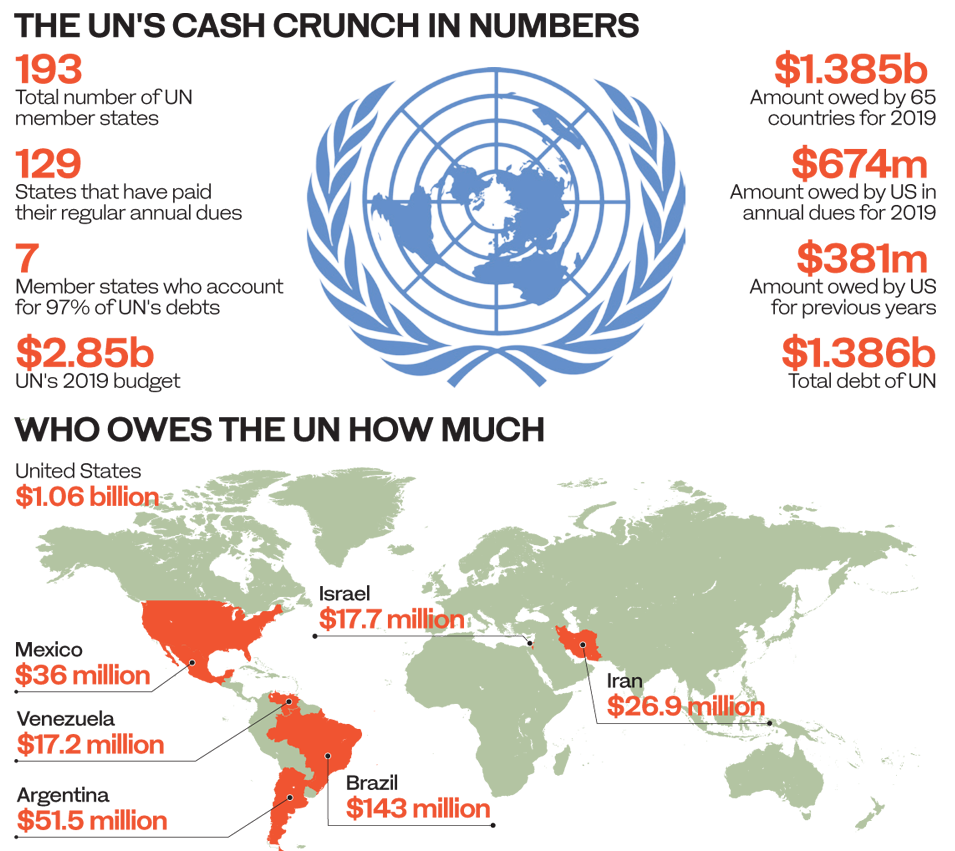
Ramanathan identified seven member nations that had failed to pay their memberships fully and accounted for 97 percent of the debt owed: the US ($1.06 billion), Brazil ($143 million), Argentina ($51.5 million), Mexico ($36 million), Iran ($26.9 million), Israel ($17.7 million) and Venezuela ($17.2 million).
He said that a total of 65 other countries were in arrears for their annual dues, based on country size and per capita income, but that represented less than 3 percent of the operating budget shortfall. Only 128 members were fully paid up for this year.
According to Ramanathan, the US owes its annual membership dues of $674 million for 2019, and $381 million for previous years.
UN officials declined to comment on reports that Guterres is seeking to address the unpaid US monies in a meeting with US President Donald Trump, who has repeatedly criticized the UN and the US financial obligations.
But an independent report by UN Dispatch, which is funded by the UN Foundation, reported on Dec. 6, 2016, that the UN’s headquarters generated $3.69 billion in benefits to New York City’s economy through jobs, commerce, hotels and retail spending by delegates and their staff.
One example of the costs includes accommodating the more than 1,500 journalists, delegates and support staff at the opening of the UN’s 74th General Assembly in New York City on Sept. 23.
The cash deficits occur earlier in the year, linger longer and run deeper.
Catherine Pollard, UN under-secretary-general for management strategy, policy and compliance
The UN erected a huge outdoor media tent in its grounds to accommodate journalists, providing access to the internet, electrical outlets, video and audio feeds, tables and work stations.
But these journalists, staff and delegates also brought with them revenue for the host city — filling hotels and restaurants, and generating profits for retailers, cabs and other businesses.
Despite the financial benefits New York City reaps from the UN headquarters presence, and the power the US wields at the UN, Trump brushed aside reports of the budget crisis or his nation’s failure to pay its share of the UN costs during his address on Sept. 24 to the UN General Assembly.
And a week later, Trump tweeted in response to UN officials’ budget concerns: “So make all Member Countries pay, not just the United States!”
The UN could suspend the voting of any nation that fails to pay its dues under Article 19 of the UN Charter, which states: “A Member of the United Nations which is in arrears in the payment of its financial contributions to the Organization shall have no vote in the General Assembly if the amount of its arrears equals or exceeds the amount of the contributions due from it for the preceding two full years. The General Assembly may, nevertheless, permit such a Member to vote if it is satisfied that the failure to pay is due to conditions beyond the control of the Member.” (Article 19 of the Charter of the United Nations)
A UN staff member said that it was unlikely that the UN would implement the rule against the US and that they fully expected the US “to pay at least part of what it owes” before the end of the year.
The UN was created in 1945 with the goal of ending human-rights abuses.
The power of the UN rests with the 15-member Security Council, which the US is a member of and controls through its veto to block any policies or resolutions it opposes.
The UN General Assembly includes 193 nations, serving as a platform for advocacy and action.


