

Automakers cut jobs and fear for investment as Brexit looms

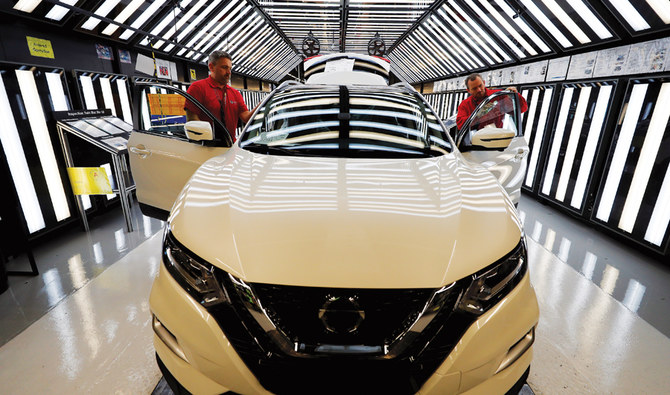
NIssan, which runs Britain’s biggest car factory in Sunderland, said tariffs would make its business unsustainable in Europe. (Reuters)
Updated 15 October 2019
Follow

Automakers cut jobs and fear for investment as Brexit looms

  • Automakers in Britain fear that World Trade Organization tariffs of 10 percent on vehicles alongside new customs checks

LONDON: One in three British automotive firms is cutting jobs as Brexit nears, up from one in eight just under a year ago, according to a survey conducted by a group representing the industry which risks being a big loser from Brexit.

Eighty percent of firms feared leaving the EU would hurt their future prospects and nearly two-thirds said they would be unable to invest in their British operations, the Society of Motor Manufacturers and Traders (SMMT) survey showed.

“Make no mistake, every day ‘no deal’ remains a possibility is another day of lost investment, another day that makes it harder to recover investor confidence in the UK,” SMMT Chief Executive Mike Hawes said.

“As yet, the damage is not irreversible. But we need a deal. A deal that, in the short term, enables a ‘business-as-usual’ transition for as long as it takes to negotiate and implement the future trading relationship.”

In the longer term, the industry needed frictionless trade with the EU, he said.

Prime Minister Boris Johnson has said he is prepared to take Britain out of the EU without an agreement on Oct. 31 if necessary, although lawmakers have passed legislation that they say will force him to seek a delay from Brussels.

The automobile sector, Britain’s biggest exporter of goods, is concerned that World Trade Organization tariffs of 10 percent on vehicles alongside new customs checks and border delays could halt production if there is a disorderly Brexit.

Last week, Nissan, which runs Britain’s biggest car factory, said such tariffs would make its business unsustainable in Europe.

The SMMT said its survey was based on responses from 158 member companies polled in September. 


Middle East war economic impact to depend on duration, damage, energy costs, IMF official says

Updated 05 March 2026
Follow

Middle East war economic impact to depend on duration, damage, energy costs, IMF official says

  • Katz: Prolonged increase in energy prices could unanchor inflation expectations
  • IMF: 2026 global GDP outlook was solid, too early to judge war’s impact on growth

WASHINGTON: The Middle East war’s impact on the global economy will depend on its duration and damage to infrastructure and industries in the region, particularly whether energy price increases are short-lived or persistent, the International Monetary Fund’s number two official said on Tuesday.

IMF First Deputy Managing Director Dan Katz told the Milken Institute Future of Finance conference in Washington that if there is prolonged uncertainty from the conflict and a prolonged impact on energy prices, “I would expect central banks to be cautious and ‌respond to the ‌situation as it materializes.”
He said the conflict could ​be “very ‌impactful ⁠on ​the global economy ⁠across a range of across a range of metrics, whether it’s inflation, growth and so on” but it was still early to have a firm conviction.
Prior to the US and Israeli air strikes on Iran and counterattacks across the region, the IMF had forecast solid global GDP growth of 3.3 percent in 2026, powering through tariff disruptions due in part to the continued AI investment boom and expectations of productivity gains.
Katz said ⁠that the economic impact from the Middle East conflict would ‌be influenced by its duration and further geopolitical ‌developments.
Earlier, the IMF said it was monitoring the ​conflict’s disruptions to trade and economic activity, ‌surging energy prices and increased financial market volatility.
“The situation remains highly fluid and ‌adds to an already uncertain global economic environment,” the Fund said in a statement issued from Washington. Katz said the IMF will look at the conflict’s direct impacts on the region, including damage to infrastructure, and disruptions to key sectors.
“Tourism is an important one. Air travel. Is ‌there physical damage to infrastructure, production facilities, and the big industry in particular that everyone will be focused on is, ⁠of course, the energy ⁠industry,” he said.
Oil rose further on Tuesday as Iran vowed to attack ships passing through the Strait of Hormuz. Brent crude oil , the global benchmark, surged to $83 per barrel, up 15 percent from its level on Friday.
Katz said he expected central banks to “look through” a temporary rise in energy prices, given their focus on core inflation. But central banks could respond if a more persistent energy shock results in “a destabilizing of inflation expectations.”
He said the post-COVID inflation spike of 2022 was influenced by energy impacts from Russia’s invasion of Ukraine, with more pass-through from headline inflation to core inflation.
“And so I’m sure central banks, as they are thinking about how the ​geopolitical situation is translating into ​energy markets, will be looking at the lessons of the pandemic and seeing if they can apply any of those lessons in setting monetary policy,” Katz said.