LONDON: Britain and the European Union on Wednesday agreed to hold last-ditch talks aimed at securing a Brexit deal with just days left to thrash out an agreement, as each side trades accusations of a failure to compromise.
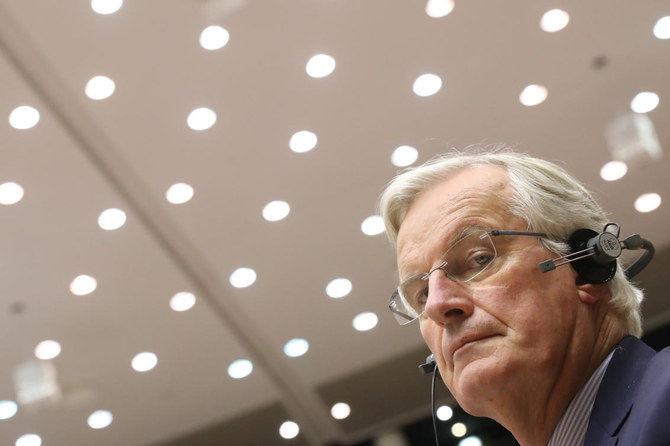
Brexit Secretary Steve Barclay will meet his EU counterpart Michel Barnier in Brussels on Thursday in an attempt to break the impasse before an October 17-18 summit.
After tempers frayed on both sides of the Channel on Tuesday, Barnier promised the bloc “will remain calm, respectful and constructive.”
“I think a deal is possible and very difficult but possible,” he told Sky News television.
Britain is due to leave the EU on October 31, more than three years after a landmark referendum that has dominated domestic politics and divided the nation.
British Prime Minister Boris Johnson has promised to take the country out of the bloc after nearly five decades of integration — with or without a withdrawal agreement.
But his proposals for a revised deal have not been well received in Brussels, and a new British law could force him to ask for more time.
On Tuesday, Downing Street sources broke diplomatic protocol by leaking details of a private conversation between Johnson and German Chancellor Angela Merkel.
Merkel was alleged to have said a deal was “overwhelmingly unlikely” without further UK compromise on its plans to keep open the border between EU member Ireland and the British province of Northern Ireland.
Berlin refused to comment but an irate European Council chief Donald Tusk accused Johnson of playing a “stupid blame game” and jeopardizing the future of both Britain and the EU.
Johnson is also expected to meet his Irish counterpart Leo Varadkar this week, with few signs Dublin is prepared to move on its position about border arrangements.
Finding a way to keep the frontier between north and south open without keeping Northern Ireland tied to EU trade rules has long been the main sticking point in talks.
The prospect of a hard border has raised fears that it could reignite unrest between pro-Irish republicans and unionists that killed thousands over three decades from the late 1960s.
Ireland on Tuesday announced it had set aside 1.2 billion euros in its 2020 budget as a contingency for no-deal, which has been seen as a sign of its pessimism about the talks.
Varadkar said it would be “very difficult to secure an agreement by next week.”
Anti-Brexit campaigners in Britain believe Johnson, who took over from Theresa May in July, is using the EU talks to play a political game to cement his credentials as a euroskeptic leader.
Speculation is rife that a snap general is on the cards, where he could exploit apparent EU intransigence over negotiations on the campaign trail.
Despite the law demanding he ask the EU to delay Brexit if he does not get a deal, he has previously said he would “rather die in a ditch.”
Amid speculation he could exploit a legal loophole to fulfil his pledge to “get Brexit done,” campaigners have gone to court to try to force him to obey the law.
But judges at Scotland’s highest civil court this week made two rulings stating that Johnson’s assurances to the court that he would comply were enough.
The law states that any Brexit delay must be requested by October 19 — the day after the summit — and the government has called for parliament to sit that day.
It will be the first Saturday sitting in 37 years and only the fifth since 1939.
The last weekend session was on April 3, 1982 after the Argentinian invasion of the Falkland Islands, a British overseas territory.
Other sittings were called for the outbreak of World War II and the Suez Crisis of 1956.


![]()

Britain and EU to hold last-ditch Brexit talks as deadline looms
Britain and EU to hold last-ditch Brexit talks as deadline looms
- Brexit Secretary Steve Barclay will meet his EU counterpart Michel Barnier in Brussels on Thursday
- Britain is due to leave the EU on October 31, more than three years after a landmark referendum


Latest updates


Recommended


© 2026 SAUDI RESEARCH & PUBLISHING COMPANY, All Rights Reserved And subject to Terms of Use Agreement.