

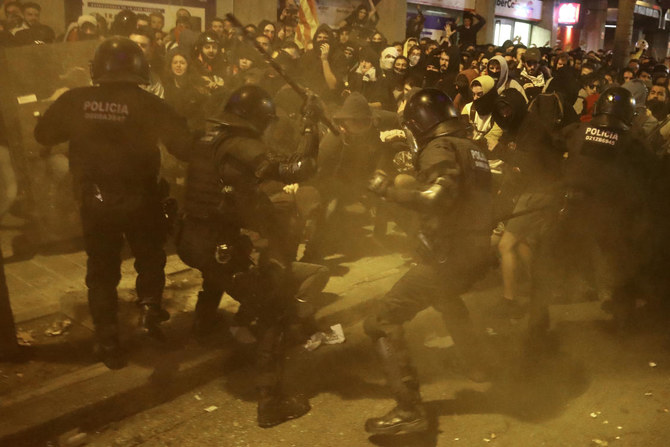
Clashes erupt in Barcelona as Catalans keep up pressure for split from Spain

Policemen in riot gear clash with protestors in Barcelona, Spain, Tuesday, Oct. 15, 2019. (AP)
Updated 15 October 2019
Follow

Clashes erupt in Barcelona as Catalans keep up pressure for split from Spain

  • Protests follow jailing of separatists on Monday
  • Pro-independence leaders vow to continue campaign

BARCELONA: Thousands of demonstrators took to the streets of Barcelona and some clashed with police on Tuesday in a second day of protests over the jailing of nine Catalan separatists by the supreme court for their role in a failed 2017 secession bid.
Pro-independence leaders have vowed to keep pushing for a new referendum on secession, saying Monday’s prison sentences strengthened the movement.
Some Barcelona protesters threw cans and flares at riot police, setting fire to cardboard and other trash in some places. They also tried to kick down security barriers set up around the Spanish government headquarters in the city center.
Police charged the demonstrators with batons, after removing protesters blocking motorways and a train station in the region.
Elsewhere, protesters lit candles and chanted “Freedom for political prisoners” in a rally organized by Omnium Cultural organization, whose chairman Jordi Cuixart was convicted on Monday.
Pro-independence labor union confederation IAC announced a general strike in Catalonia on Friday against labor laws which unions say infringe workers’ rights.
Oriol Junqueras was given the longest sentence, of 13 years, for his role in organizing the 2017 referendum, which was ruled illegal. He told Reuters in his first interview after the sentence that it would only galvanize the independence movement.
“We’re not going to stop thinking what we think, ideals can’t be derailed by (jail) sentences,” he said, saying that a new plebiscite was “inevitable.”
The head of the regional government, Quim Torra, defended the mass protests over sentencing he described as unacceptable.
“A new stage begins where we take the initiative and put the implementation of the right to self-determination back in the center” of our proposals, Torra said, urging Madrid to pay heed and start talks to that effect.
Demonstrators had blocked railways on Monday and thousands descended on Barcelona’s international airport, where some clashed with police. An airport spokesman said 110 flights were canceled on Monday and a 45 more were canceled on Tuesday.
All the defendants were acquitted of the gravest charge, rebellion, but the length of the prison terms — which Junqueras said they planned to appeal in a European court — prompted anger in Catalonia.
Two years after the debacle of the first plebiscite, Catalonia’s independence drive still dominates much of Spain’s fractured political debate, and will likely color a national election on Nov. 10, Spain’s fourth in four years.
Acting foreign minister Josep Borrell said of the issue: “Yesterday, today and tomorrow, it remains a political problem that has to be solved.” He called for dialogue within the framework of the constitution.

GREATER AUTONOMY?
But Borrell said the independence movement had ignored those in Catalonia who were not in favor of breaking away from Spain, saying: “This is a totalitarian attitude.” Separatists have repeatedly rejected such comments.
A dialogue could focus on greater autonomy for Catalonia, possibly within a more federal plurinational framework in Spain, said Santi Vila, one of three sentenced leaders who were not sent to prison.
A known critic of the secessionist agenda who had resigned as Catalan government business counselor just before the independence declaration, Vila called for a new election in the region, something regional government head Torra opposes.
“It looks reasonable that when two governments have such a communication problem ... it’s important to ask citizens if the way being taken is correct or not,” said Vila, 46. While he also supports a referendum, he says it should not be about full independence but self-government powers.
Spain’s main parties have consistently refused to hold an independence referendum in Catalonia, although the acting Socialist government says it is open to dialogue on other issues.
Diana Riba, wife of convicted leader Raul Romeva, told Reuters the independence drive would prevail over time.
“This is a very long process but we will see results as we did with the feminist movement, how they grew until becoming massive and achieving the rights that they were seeking,” she said, calling for “everyone to take to the streets.”


US to cut roughly 200 NATO positions, sources say

Updated 4 sec ago
Follow

US to cut roughly 200 NATO positions, sources say

  • Trump famously threatened to withdraw from NATO during ⁠his first presidential term and said on the campaign trail that he would encourage Russia to attack NATO members that did not pay their fair share on defense

WASHINGTON: The United States plans to reduce the number of personnel it has stationed within several key NATO command centers, a move that could intensify concerns ​in Europe about Washington’s commitment to the alliance, three sources familiar with the matter said this week.
As part of the move, which the Trump administration has communicated to some European capitals, the US will eliminate roughly 200 positions from the NATO entities that oversee and plan the alliance’s military and intelligence operations, said the sources, who requested anonymity to discuss private diplomatic conversations.
Among the bodies that will be affected, said the sources, are the UK-based NATO Intelligence Fusion Center and the Allied Special Operations Forces Command in Brussels. Portugal-based STRIKFORNATO, which oversees some maritime operations, will also be cut, as will several other similar NATO entities, the sources said.
The sources did not specify why the US had decided to cut the number of staff dedicated to the NATO roles, but the moves broadly align with the ‌Trump administration’s stated intention to ‌shift more resources toward the Western Hemisphere.
The Washington Post first reported the decision.

TRUMP ‌RE-POSTS ⁠MESSAGE ​IDENTIFYING NATO ‌AS THREAT
The changes are small relative to the size of the US military force stationed in Europe and do not necessarily signal a broader US shift away from the continent. Around 80,000 military personnel are stationed in Europe, almost half of them in Germany. But the moves are nonetheless likely to stoke European anxiety about the future of the alliance, which is already running high given US President Donald Trump’s stepped-up campaign to wrest Greenland away from Denmark, raising the unprecedented prospect of territorial aggression within NATO.
On Tuesday morning, the US president, who is scheduled to fly to the World Economic Forum in Switzerland in the evening, shared another user’s post on social media that identified NATO as a threat to the ⁠United States. The post described China and Russia as merely “boogeymen.”
Asked for comment, a NATO official said changes to US staffing are not unusual and that the US presence in ‌Europe is larger than it has been in years.
“NATO and US authorities are in ‍close contact about our overall posture – to ensure NATO retains our ‍robust capacity to deter and defend,” the NATO official said.
The White House and the Pentagon did not respond to requests for ‍comment.

MILITARY IMPACT UNCLEAR, SYMBOLIC IMPACT OBVIOUS
Reuters could not obtain a full list of NATO entities that will be affected by the new policy. About 400 US personnel are stationed within the entities that will see cuts, one of the sources said, meaning the total number of Americans at the affected NATO bodies will be reduced by roughly half.
Rather than recalling servicemembers from their current posts, the US will for the most part decline to ​backfill them as they move on from their positions, the sources said.
The drawdown comes as the alliance traverses one of the most diplomatically fraught moments in its 77-year history. Trump famously threatened to withdraw from NATO during ⁠his first presidential term and said on the campaign trail that he would encourage Russian President Vladimir Putin to attack NATO members that did not pay their fair share on defense. But he appeared to warm to NATO over the first half of 2025, effusively praising NATO Secretary-General Mark Rutte and other European leaders after they agreed to boost defense spending at a June summit.
In recent weeks, however, his administration has again provoked alarm across Europe. In early December, Pentagon officials told diplomats that the US wants Europe to take over the majority of NATO’s conventional defense capabilities, from intelligence to missiles, by 2027, a deadline that struck European officials as unrealistic. A key US national security document released shortly after called for the US to dedicate more of its military resources to the Western Hemisphere, calling into question whether Europe will continue to be a priority theater for the US
In the first weeks of 2026, Trump has revived his longstanding campaign to acquire Greenland, an overseas territory of Denmark, enraging officials in Copenhagen and throughout Europe, many of whom believe any territorial aggression within the alliance would mark the end of NATO. Over the weekend, ‌Trump said he would slap several NATO countries with tariffs starting February 1 due to their support for Denmark’s sovereignty over the island. That has caused European Union officials to mull retaliatory tariffs of their own.