BERLIN: German authorities on Tuesday appealed to Turkish and Kurdish communities to avoid echoing the Middle Eastern conflict, after clashes between the two groups over Ankara’s offensive in northeastern Syria.
Police said at least five people had been injured in fights between the two communities late on Monday.
“We have a responsibility to prevent the conflict in the region becoming a conflict in our society... in Germany,” integration commissioner Annette Widmann-Mauz told the Funke newspaper group.
“I expect all sides, especially migrant organizations and religious communities, to take responsibility and contribute to restraint.”
The commissioner advises the government on integration and serves as a point of contact for migrants and community organizations.
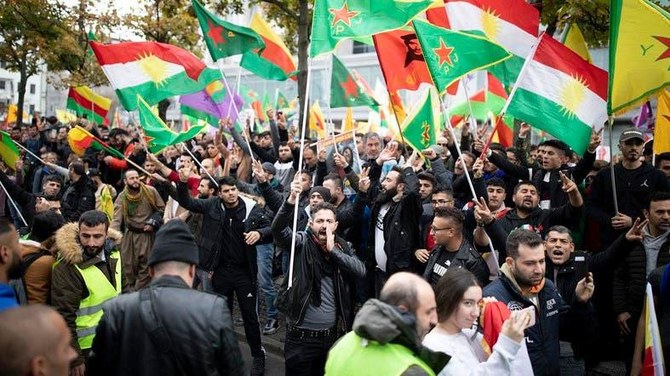
The clashes happened as around 350 people marched through the western city of Herne on Monday protesting Turkey’s offensive in Kurdish-controlled areas of Syria, police said in a statement.
They were “provoked with hand signals” by people drinking at a nearby kiosk, the statement added.
“Some of them stormed into the kiosk, attacked two people inside and injured them” and they also broke a window.
The demonstration continued and someone threw a bottle at the marchers from a Turkish-owned cafe as they passed.
“The reaction was very emotional and angry” as several participants again rushed into the cafe, breaking windows and furniture and injuring at least one person inside, as well as a police officer who intervened.
Nevertheless, “the police were able to calm the situation.”
Among the five people hurt was the organizer of the march. He, too, was attacked when he tried to stop the violence.
Of the roughly three million people with Turkish nationality or roots living in Germany, around one million are Kurds.
Politicians regularly warn of tensions between the two communities, which have been stoked by Turkey’s offensive against Kurdish fighters inside Syria.
“According to the 30-year-old Turkish citizen, the men had assaulted him because of the jacket he was wearing, which had a Turkish national flag on it,” a Berlin police statement said.
The leader of the Kurdish community in Germany, Ali Ertan Toprak, called Tuesday for calm.
“Our message is: do not let yourself be provoked. Do not react to provocations from the Turkish nationalist side,” he told Funke.
“If there are riots, it will harm our casue,” Toprak said. Kurds had “no interest in violence spreading on German streets.”
Turkish troops moved last Wednesday into the Syrian border zone controlled by Kurdish militias, which helped a Western-led coalition fight Islamic State (IS) jihadists but are accused of terrorism by Ankara.
Germany, along with European allies such as France, has condemned the offensive and halted arms exports to Turkey.


Germany urges ‘restraint’ after Turks and Kurds clash on streets
Germany urges ‘restraint’ after Turks and Kurds clash on streets

- The clashes happened as around 350 people marched through the western city of Herne on Monday protesting Turkey’s offensive in Kurdish-controlled areas of Syria
- Of the roughly three million people with Turkish nationality or roots living in Germany, around one million are Kurds


Indonesia’s new state mosque to hold first Eid prayers this year
- Mosque is located in Nusantara Capital City on Borneo island, a $32bn project set for 2045 completion
- Famous sculptor Nyoman Nuarta designed mosque, other government structures in new capital
JAKARTA: The state mosque in Indonesia’s planned new capital city, Nusantara, will hold its inaugural Eid Al-Fitr prayer this year, as the $62 million facility opens for its first run of Ramadan programs.
The Indonesian government has plans to relocate the capital to Borneo island to replace the overcrowded and sinking Jakarta on Java island, with the $32 billion megaproject scheduled for completion in 2045.
With a capacity of about 60,000 people, the mosque in East Kalimantan opened to the public last month, at the beginning of Ramadan.
“This mosque symbolizes that we are building the Nusantara Capital City with careful attention to spiritual, social and environmental aspects,” Troy Pantouw, spokesperson for the Nusantara Capital City Authority — the agency overseeing the new capital city — told Arab News on Saturday.
“We will hold Eid Al-Fitr prayers here and we are hoping that it would mark a historic momentum of unity here at Nusantara Capital City.”
Locally known as Masjid Negara, construction of the state mosque began in 2024. Its design was spearheaded by Balinese sculptor Nyoman Nuarta at the request of former President Joko Widodo.
Nuarta is one of Indonesia’s most famous visual artists and creator of the country’s tallest statue, Garuda Wisnu Kencana, located in Bali.
The 72-year-old is also the designer behind other main structures in Nusantara, including the new state palace.
This Ramadan marked many firsts for Masjid Negara, including its first taraweeh on Feb. 18, which was attended by thousands of worshippers in East Kalimantan.
In the same complex where the state mosque is located, the government has plans to build Christian churches, and Buddhist, Hindu and Confucian temples.
Indonesia, home to the world’s largest population of Muslims, officially recognizes Islam, Protestantism, Catholicism, Buddhism, Hinduism and Confucianism as religions.
“A church is now being built in the complex, and in the future there will also be houses of worship belonging to other religions. This reflects Nusantara’s values of harmony and respect,” Pantouw said.
“From the start, this area was designed to represent inter-religious harmony. We want the Nusantara Capital City to stand as a concrete example of how physical developments can be parallel to efforts to build tolerance in society.”