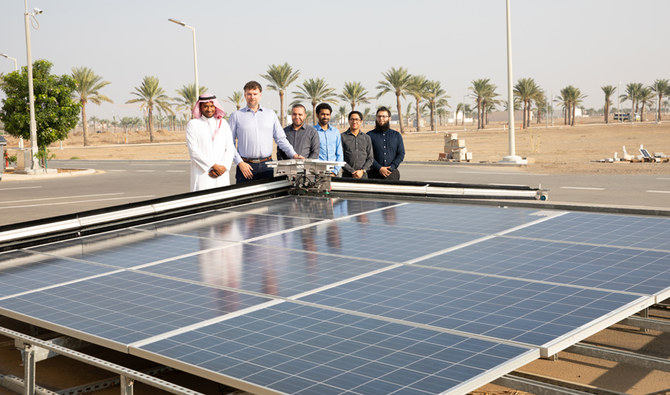
JEDDAH: NOMADD is a King Abdullah University of Science and Technology (KAUST) startup that aspires to contribute to the growing clean energy sector with its leading photovoltaics cleaning system based in Saudi Arabia.
According to Georg Eitelhuber, chief technical officer and cofounder of NOMADD, the company will enable more widespread use of solar photovoltaics in the country while conserving water resources and utilizing the full potential of solar energy.
NOMADD is a system designed, developed and tested in the Kingdom to suit local and regional conditions. “Wherever there is sun and wherever there is a desert, that is where NOMADD is and wills to be,” Eitelhuber told Arab News.
In desert climates, solar panels are often exposed to harsh weather conditions that may affect their function and require constant maintenance.
According to Eitelhuber, dust can prevent sunlight from reaching solar cells. Consequently, the panel may lose up to 60 percent of its capability to produce power during and after sandstorms.
Therefore, panels should be cleaned daily because if the dust is left for more than a day, dust particles from organics, dew, and sulfur adhere to the panels and damage them.
After extensive research, NOMADD founders concluded whatever they created to clean solar panels needed to be a waterless, automatic mechanical device. From those characteristics, they came up with the name NOMADD, which stands for: NO water, Mechanical Automated Dusting Device.
The name is also a tribute to nomadic peoples living in the desert. “In this part of the world, the very harsh environment makes moving through the desert constantly and regularly not easy, and the people who were able to do that for thousands of years are extremely tough. We believe that our product is part of that spirit of toughness in the desert,” said Eitelhuber.
The first idea of NOMADD goes back to 2010. “I was out in the field where they had a small solar area back then, and there was an official inauguration for this solar field … the panels were so dirty so we called the housekeeping department to come and clean them.”
Solar energy was still new in the region at that time. Eitelhuber found that no accurate solution had ever been thought about before. “I had the vision that there will be a large scale of solar panels in the Middle East, and it would be great to have a solution ready for it,” he said.
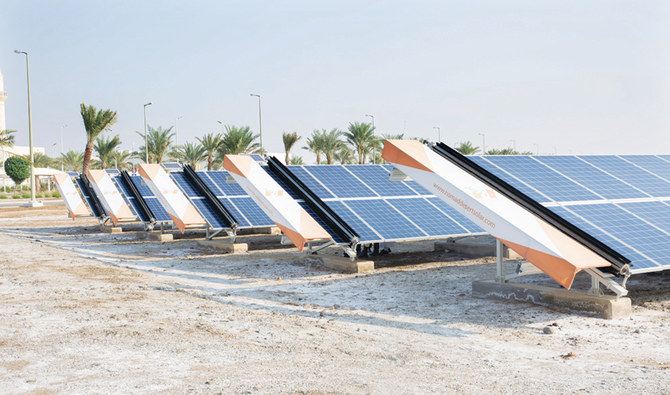
The NOMADD robots are equipped with specially designed brushes with drive motors and sophisticated control systems. The robots communicate wirelessly with a central hub that can be accessed from anywhere in the world, via any mobile device, which allows the client to monitor the robots and collect and analyze data.
NOMADD has six founders, and 15 people working full time for them worldwide, eight based at KAUST. The team is growing fast, and they hope to have 20 to 25 people by the end of the year.
Reliability of the product is everything for NOMADD’s team. Constant evaluation of the quality and expansion of the service is key to their success. Their biggest goal is to be recognized as the world’s leader in desert solar cleaning solutions.


![]()
![]()
![]()

Startup of the Week: NOMADD offers revolutionary solutions for the Saudi Arabia’s clean energy sector

Startup of the Week: NOMADD offers revolutionary solutions for the Saudi Arabia’s clean energy sector
- The NOMADD robots are equipped with specially designed brushes with drive motors and sophisticated control systems


Latest updates


Recommended


© 2026 SAUDI RESEARCH & PUBLISHING COMPANY, All Rights Reserved And subject to Terms of Use Agreement.