

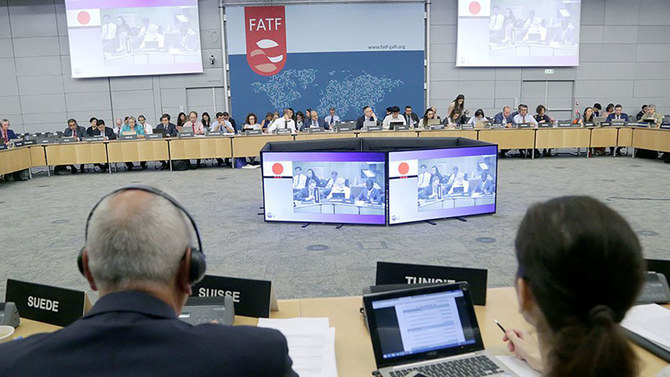

KARACHI: As a Pakistani delegation attends a crucial Financial Action Task Force (FATF) session in Paris, the government is confident it has taken sound measures against money laundering and terror financing and will be able to convince the international financial watchdog not to blacklist the country, officials and security analysts said here on Monday while talking to Arab News.
Headed by the economic affairs minister, Hammad Azhar, the country’s delegation arrived in Paris to attend the FATF meeting beginning on October 14. Among other things, the congregation will review progress made by Pakistan and issue its final statement on October 18.
Pakistan was put on the list of “jurisdictions with strategic deficiencies,” known as the grey list, for the structural deficiencies in its financial system related to anti-money laundering (AML) and combating the financing of terrorism (CFT). Ever since the country has taken a number of measures to comply with some 40 FATF recommendations.
“Pakistan has taken very positive measures against money laundering and terror financing in the federal budget (FY20) that were not announced earlier,” Dr. Abid Qaiyum Suleri, member of the Economic Advisory Council (EAC), told Arab News. “I don’t think that the country will be blacklisted since it has already complied with many of the recommendations. In the worst-case scenario, it will remain grey-listed for some time.”
Suleri believes that the formation of a dedicated unit in the Federal Board of Revenue (FBR) that is technologically equipped to curb terror financing is a step in the right direction.
He also counts the government’s efforts to document the economy and create reverification system for bank accounts to discourage money laundering very effective measures to convince the global financial watchdog of the country’s intent to plug any financial loopholes.
“Pakistan has also very effectively put in place a mechanism that has almost eliminated the possibility for proscribed organizations from resurfacing under different names,” he said, adding: “Basically when the economy is documented, it automatically reduces the money laundering chances. The same thing also leads to the elimination of terror financing. Pakistan has very effectively worked along these lines.”
The FATF’s Asia-Pacific Group on Money Laundering (APG) issued a report based on Pakistan’s performance until October 2018, showing that the country was fully “compliant” in one aspect relating to financial institutions secrecy laws. It was found “partially compliant” on 26 counts and “largely compliant” on nine others.
The APG’s 228-page report that was released this month showed that Pakistan had either fully, largely, or partially complied with 36 out of 40 parameters set by the FATF to exit the grey list.
“There is no charge of terror financing against Pakistan. The issue related to the non-transparent banking system which has now been improved to a large extent,” security analyst, Major General (r) Ijaz Awan, told Arab News.
“Pakistan had asked for evidence of terror financing, and they came up with a charge sheet against Hafiz Saeed. But they have not provided any evidence so far, and now he has been permitted by the United Nations to draw money from his account,” said Awan, adding that the country was likely to remain on the grey list, though not because of the compliance issues but “due to some foreign powers who want to put it under pressure.”
“Pakistan qualifies on merit to be white-listed. The country has taken stringent measures to strengthen its financial sector and bring it in compliance with FATF recommendations,” Samiullah Tariq, director research at Arif Habib Limited, told Arab News.
Pakistan previously remained on the FATF grey list in 2008 and 2012.


