DHAKA: A court in Bangladesh's capital on Sunday indicted eight suspected militants tied to a banned group over the 2015 killing of a man who published books on secularism and atheism.
Anti-Terrorism Special Tribunal Judge Majibur Rahman read out the charges to six of the suspects, who pleaded not guilty. Another two, including a sacked military official, remained fugitives, but the judge issued arrest warrants for them. Police say they belong to the banned domestic militant outfit Ansar al Islam.
In October 2015, suspected militants hacked Faisal Abedin Deepan of the Jagriti Prokashoni publishing house. On the same day, another publisher, Ahmed Rashid Tutul, survived an attack by suspected militants in Dhaka, Bangladesh's capital.
Both victims were publishers of Bangladeshi-American writer and blogger Avijit Roy, who was hacked to death in February 2015.
Several other atheists, bloggers and foreigners were killed by suspected militants in 2015. A bomb attack on Oct. 24 of that year in Dhaka aimed at Shia Muslims killed a teenager and injured more than 100 other people. Foreigners including Italian aid volunteer and a Japanese agricultural worker were also killed.
Authorities in Bangladesh say the network of the militant groups has been broken after a massive crackdown following a 2016 attack on a cafe in Dhaka in which 22 people, including 17 foreigners, were killed by five young men who belonged to the Jumatul Mujahedeen Bangladesh group, according to police.
Daesh claimed responsibility for the 2016 attack and other attacks, but Bangladesh's government said that domestic groups were behind them, and that IS has no existence in the country.

Bangladesh court indicts extremist militants for 2015 killing
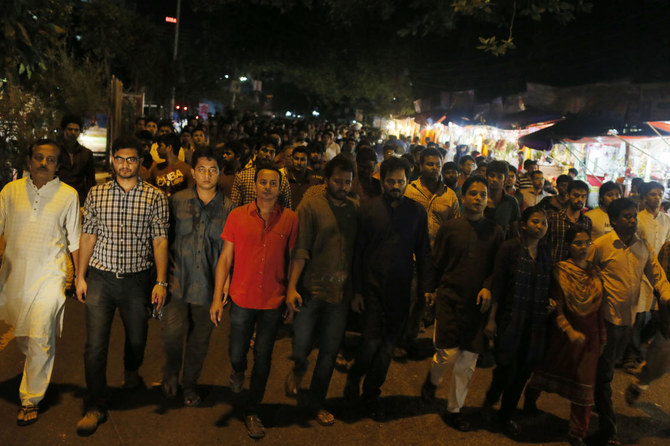
- In October 2015, suspected militants hacked Faisal Abedin Deepan of the Jagriti Prokashoni publishing house
- Both victims were publishers of Avijit Roy, who was hacked to death in February 2015
Venezuela parliament unanimously approves amnesty law
CARACAS: Venezuela’s National Assembly on Thursday unanimously approved a long-awaited amnesty law that could free hundreds of political prisoners jailed for being government detractors.
But the law excludes those who have been prosecuted or convicted of promoting military action against the country — which could include opposition leaders like Nobel Peace Prize winner Maria Corina Machado, who has been accused by the ruling party of calling for international intervention like the one that ousted former president Nicolas Maduro.
The bill now goes before interim president Delcy Rodriguez, who pushed for the legislation under pressure from Washington, after she rose to power following Maduro’s capture during a US military raid on January 3.
The law is meant to apply retroactively to 1999 — including the coup against previous leader Hugo Chavez, the 2002 oil strike, and the 2024 riots against Maduro’s disputed reelection — giving hope to families that loved ones will finally come home.
Some fear, however, the law could be used by the government to pardon its own and selectively deny freedom to real prisoners of conscience.
Article 9 of the bill lists those excluded from amnesty as “persons who are being prosecuted or may be convicted for promoting, instigating, soliciting, invoking, favoring, facilitating, financing or participating in armed actions or the use of force against the people, sovereignty, and territorial integrity” of Venezuela “by foreign states, corporations or individuals.”
Venezuela’s National Assembly had delayed several sittings meant to pass the amnesty bill.
“The scope of the law must be restricted to victims of human rights violations and expressly exclude those accused of serious human rights violations and crimes against humanity, including state, paramilitary and non-state actors,” UN human rights experts said in a statement from Geneva Thursday.
Hundreds, perhaps thousands, of Venezuelans have been jailed in recent years over plots, real or imagined, to overthrow the government of Rodriguez’s predecessor and former boss Maduro, who was in the end toppled in the deadly US military raid.
Family members have reported torture, maltreatment and untreated health problems among the inmates.
The NGO Foro Penal says about 450 prisoners have been released since Maduro’s ouster, but more than 600 others remain behind bars.
Family members have been clamoring for their release for weeks, holding vigils outside prisons.
One small group, in the capital Caracas, staged a nearly weeklong hunger strike which ended Thursday.
“The National Assembly has the opportunity to show whether there truly is a genuine will for national reconciliation,” Foro Penal director Gonzalo Himiob wrote on X Thursday ahead of the vote.
On Wednesday, the chief of the US military command responsible for strikes on alleged drug smuggling boats off South America held talks in Caracas with Rodriguez and top ministers Vladimir Padrino and Diosdado Cabello .
All three were staunch Maduro backers who for years echoed his “anti-imperialist” rhetoric.
Rodriguez’s interim government has been governing with US President Donald Trump’s consent, provided she grants access to Venezuela’s vast oil resources.


