

Toyota reveals revamped hydrogen sedan

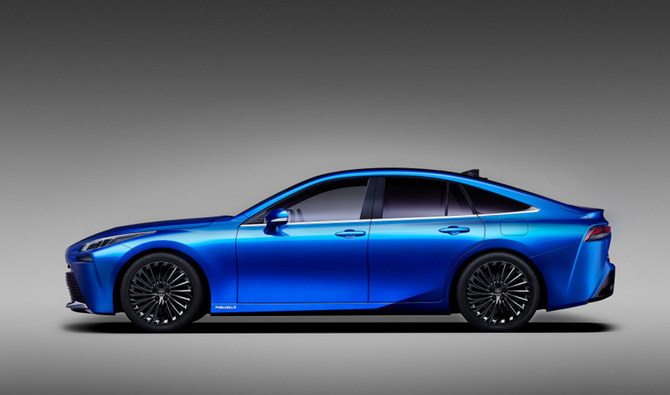
The new Toyota Mirai model boasts longer driving range than its predecessor and completely redesigned fuel cell stack and hydrogen tanks. (Toyota handout photo)
Updated 12 October 2019
Follow

Toyota reveals revamped hydrogen sedan

TOKYO: Toyota Motor Corp. unveiled a redesigned hydrogen-powered fuel cell sedan on Friday in its latest attempt to revive demand for the niche technology that it hopes will become mainstream.

Japan’s biggest automaker has been developing fuel-cell vehicles for more than two decades, but the technology has been eclipsed by the rapid rise of rival battery-powered electric vehicles promoted by the likes of Tesla Inc.

Ahead of the Tokyo Motor Show starting on Oct. 24, Toyota unveiled a prototype of the new hydrogen sedan built on the same platform as its luxury Lexus brand’s LS coupe. The new Mirai model boasts longer driving range than its predecessor and completely redesigned fuel cell stack and hydrogen tanks, the company said.

“We wanted to make a car that people really want to buy, not just because it’s an eco car,” Yoshikazu Tanaka, chief engineer of the new Mirai, said at the unveiling.

“We wanted something that’s fun to drive.”

The vehicle’s sporty redesign with longer wheelbase and lower-slung chassis is a marked departure from the first-generation Mirai, which looks like a bulked-up Prius hybrid.

The new car also has a 30 percent improvement in driving range over the previous iteration’s approximately 700 km (435 miles), according to the company.

Tanaka said the latest Mirai would cost less to make than its predecessor, because of a shift to mass production. The current model is mostly assembled by hand.

Costing consumers about 5 million yen ($46,500) after subsidies in Japan, the original Mirai is one of three fuel cell cars available to drivers. Hyundai Motor Co. sells the Nexo, while Honda Motor leases out the Clarity.

Toyota has sold fewer than 10,000 of the Mirai, a fuel cell sedan it touted as a game changer at its launch five years ago. By contrast, Tesla sold 25,000 of battery-powered Model S sedans in its first year and a half.

Toyota declined to disclose a price for the model and said it would be available from late next year in Japan, North America and Europe.


Saudi Aramco bolsters global oil market stability amid rising regional tensions

Updated 10 March 2026
Follow

Saudi Aramco bolsters global oil market stability amid rising regional tensions

RIYADH: Amid growing logistical challenges facing the energy sector, operational moves by Saudi Aramco are emerging as a stabilizing factor in global oil supply.

The company has offered additional crude shipments on the spot market, a step analysts see as aimed at absorbing supply shocks and ensuring the continued flow of oil through key energy corridors.

The move aligns with Saudi Arabia’s long-standing role as a leading global producer and is intended to limit price volatility and maintain balance between supply and demand at a time of heightened geopolitical uncertainty.

Reuters reported that Aramco has offered more than 4 million barrels of Saudi crude through rare spot tenders, as tensions between the US and Iran disrupt Middle Eastern exports.

Mohammad Al-Sabban, former senior adviser to the Saudi energy minister, said the current surge in oil prices does not necessarily reflect an immediate shortage of supply. Instead, it is largely driven by what energy markets call a “geopolitical risk premium.”

Speaking to Asharq Al-Awsat, Al-Sabban said prices remaining above $100 per barrel reflect global anxiety that the conflict could expand and threaten future supply security.

He noted that higher prices, while boosting short-term revenues and fiscal surpluses for oil-exporting countries, also bring hidden costs. These include increased spending on security measures to protect oil infrastructure — costs that rise in a volatile regional environment where Gulf states face mounting security pressures.

Al-Sabban also pointed out that spot market sales are currently generating greater returns than long-term futures contracts. The uncertainty surrounding the conflict has led buyers to pay premiums for immediate deliveries, making spot transactions more attractive during the current crisis.

Strategic chokepoint

Shipping through the Strait of Hormuz, which carries roughly 20 percent of global oil supply, remains central to the crisis.

Al-Sabban warned that even a temporary closure of the waterway would inevitably reduce available supplies, potentially triggering panic in markets and forcing countries to draw from strategic reserves.

He recalled historical precedents, noting that during the Iran-Iraq war, energy markets became a hub for speculation, with negative economic consequences emerging later.

Asked whether the conflict represents a short-term economic opportunity or a broader risk for regional economies, Al-Sabban said the reality is a mix of both. High prices may offer temporary gains as long as oil remains above $100 a barrel, but a prolonged conflict could ultimately impose heavier economic burdens through rising logistical and security costs.

Flexible response

Financial and economic adviser Hussein Al-Attas said Aramco’s decision to release additional cargoes on the spot market reflects significant flexibility in managing supply and responding quickly to market shifts amid rising demand and concerns about potential shortages.

He told Asharq Al-Awsat that the move sends an important signal to global markets that Saudi Arabia continues to play the role of a swing producer, capable of intervening to maintain market balance and ease fears about supply security.

Al-Attas added that the recent surge in oil prices is largely tied to geopolitical tensions in a region that represents the heart of global energy supply.

While Brent crude could remain above $100 in the short term if supply concerns persist, he noted that history shows price spikes driven by political tensions are often temporary unless they lead to a prolonged disruption in supply.

Higher oil prices naturally increase revenues for exporting countries, potentially strengthening fiscal balances and enabling governments to finance spending and development projects, Al-Attas remarked.

Gulf states, particularly Saudi Arabia and the United Arab Emirates, may therefore benefit financially in the short term.

However, he cautioned that such gains are usually temporary rather than structural. Prolonged high energy prices can slow global economic growth by fueling inflation, which may eventually reduce demand for oil. As a result, the current price surge may represent a temporary financial opportunity rather than a lasting shift in oil revenues.

Ultimately, Al-Attas said the crisis carries two opposing dynamics: Gulf countries may benefit financially in the short term, but any wider regional conflict could pose greater risks to economic and commercial stability.

For that reason, he added, the region’s strategic interest ultimately lies in stable energy markets and uninterrupted oil flows, which are essential for sustaining global demand and supporting long-term economic growth.
