

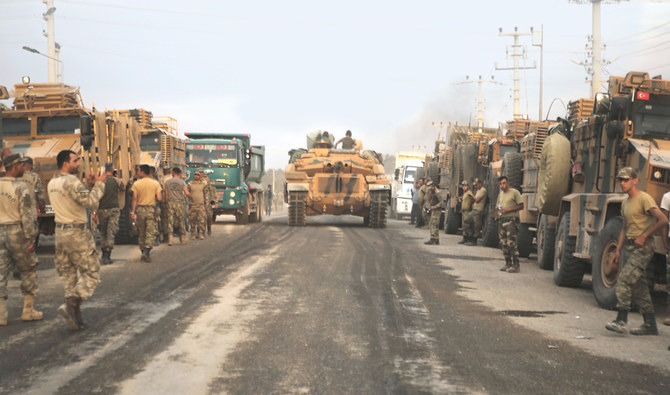

ANKARA: As the Turkish ground and air offensive in northeastern Syria continues, Turkish President Recep Tayyip Erdogan has threatened to send millions of Syrian refugees to Europe if the EU calls Turkey’s military offensive “an invasion.” “We will open the gates and send 3.6 million refugees your way,” he said on Thursday.
The statement is considered by some a move to “weaponize” the refugees who have been in Turkey since the beginning of Syrian civil war, and to use them as a leverage.
European institutions harshly criticized Turkey’s military operation into northeastern Syria against Kurdish-led Syrian Democratic Forces (SDF), which Turkey considers a terror group.
“Turkey must understand that our main concern is that their actions may lead to another humanitarian catastrophe, which would be unacceptable. Nor will we ever accept that refugees are weaponized and used to blackmail us. That is why I consider yesterday’s threats made by President Erdogan totally out of place,” Donald Tusk, president of the European Council, said on Oct. 11 after his meeting with President of Cyprus Nicos Anastasiades.
Under heavy artillery and airstrikes, more than 60,000 residents in Syrian towns have reportedly fled their homes since the beginning of the operation.
Ankara says it wants to create a “safe zone” along its border and to help the return of about 1 million Syrian refugees back to their country. However, the project is criticized by some as a move of “demographic re-engineering” that would forcibly settle families and change the social realities of the region.
In the framework of 2016 Turkey-EU refugee deal, the EU allocated about 97 percent of the €6 billion ($6.6 billion) of funding.
Russian President Vladimir Putin warned on Friday that Daesh captives could potentially escape from prisons in Syria over Turkey’s incursion amid the chaos.
“Not sure if Ankara can take control of the situation,” he said to the Sputnik news agency.
NUMBER
60,000 - residents — under heavy artillery and airstrikes — have reportedly fled their homes in Syrian towns since the beginning of the operation.
Western countries have expressed their disapproval of Turkey’s operation. France announced sanctions against Turkey will be “on the table” at next week’s European summit, while Norway and Finland decided on Thursday to suspend their arms exports to Turkey.
US President Donald Trump tweeted on late Thursday: “We have one of three choices: Send in thousands of troops and win militarily, hit Turkey very hard Financially and with Sanctions, or mediate a deal between Turkey and the Kurds!”
According to Kenneth Roth, executive director of Human Rights Watch, Erdogan’s statement equals treating Syrian refugees as pawns to be manipulated for political purposes.
Roth thinks that a stated reason for the operation is to force 1 million or more refugees to a zone along the border that Erdogan pretends will be “safe” but has no capacity to secure.
“Then, when others criticize this illegal scheme, he threatens to uproot refugees from the lives they have been building in Turkey and send them off to Europe,” he told Arab News.
Although experts say a threat of such a scale is not particularly credible, it will ring alarm bells in some European countries, especially Greece at the doorstep of the illegal migration route. Turkey hosts 4 million refugees, 3.6 million of them Syrians.


