

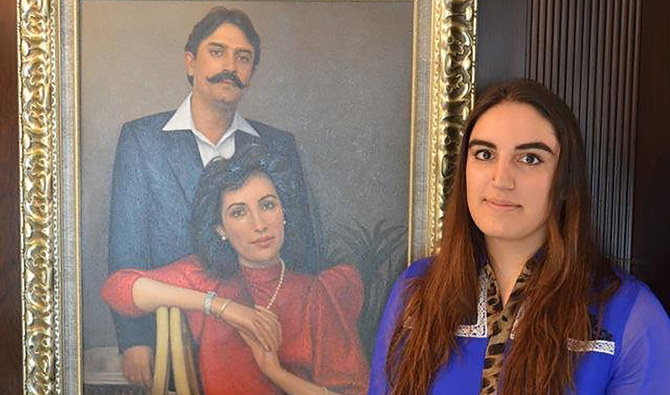

LAHORE: The history of Bakhtawar Bhutto-Zardari’s family is as torrid as Pakistan’s: her mother, twice prime minister, Benazir Bhutto was assassinated at an election campaign rally in 2007, her grandfather was hanged by a military dictator in 1979 and her uncle was gunned down in 1996 in the southern city of Karachi.
Now, Bakhtawar, 29, and her siblings Bilawal, 31, and Aseefa, 26, are faced with yet another ordeal: in June this year, their father former President Asif Ali Zardari was arrested in an investigation into fake bank accounts and money laundering in what is being seen as a major blow to one of Pakistan’s leading political dynasties and its once mighty political-machine, the Pakistan Peoples Party (PPP).
The Bhutto-Zardari family denies any wrongdoing and says the cases against Zardari are meant to pile pressure on the party. Khan’s other rival, ex-premier Nawaz Sharif, is also in jail on corruption charges.
“There is no doubt about the vindictiveness of this trial,” Bakhtawar told Arab News in response to emailed questions about her father’s incarceration, calling the Khan government’s anti-corruption crusade “nothing but hypocrisy and political victimization of the opposition.”
Zardari has been the subject of news media fascination since his marriage in 1987 to Bhutto. The accusations of corruption too, Bakhtawar said, were born out of an attempt to undermine her mother’s political career in the 1990s and have since followed her father each time he has taken bold steps as a politician, including in 2010 when his government introduced a set of constitutional reforms which saw the removal of crucial presidential powers introduced by military rulers in the past.
“Our father endured 11 years of incarceration before on fabricated charges, all of which he was acquitted of, but back then we were sheltered by our mother and the innocence of our youth … we were protected from the gruesome reality of the brutalities and torture he faced in prison,” Bakhtawar said. Now, however, the vacuum created by his absence was “suffocating,” she added.
Not being able to speak to Zardari regularly over the phone or see him other than at court hearings is not his children’s only concern; they also worry about his health and fear for his life. Bakhtawar said her father suffered from heart disease, high blood sugar and other ailments and the government was not allowing proper medical tests.
“He is being denied basic facilities entitled to him not only as a citizen but also a former president,” Bakhtawar said. In his jail cell, she said, “he is not even allowed a fridge to store his insulin.”
With Zardari in jail, his son Bilawal, an Oxford-educated firebrand who made his political debut in 2014, has vowed to resurrect the PPP party’s flagging fortunes.
The left-of-center PPP ruled Pakistan from 2008 to 2013, but became tarnished by a series of confrontations with the powerful Supreme Court over corruption scandals and was voted out in a landmark election in 2013 — the first time in Pakistan’s short but turbulent history that one elected civilian government replaced another.
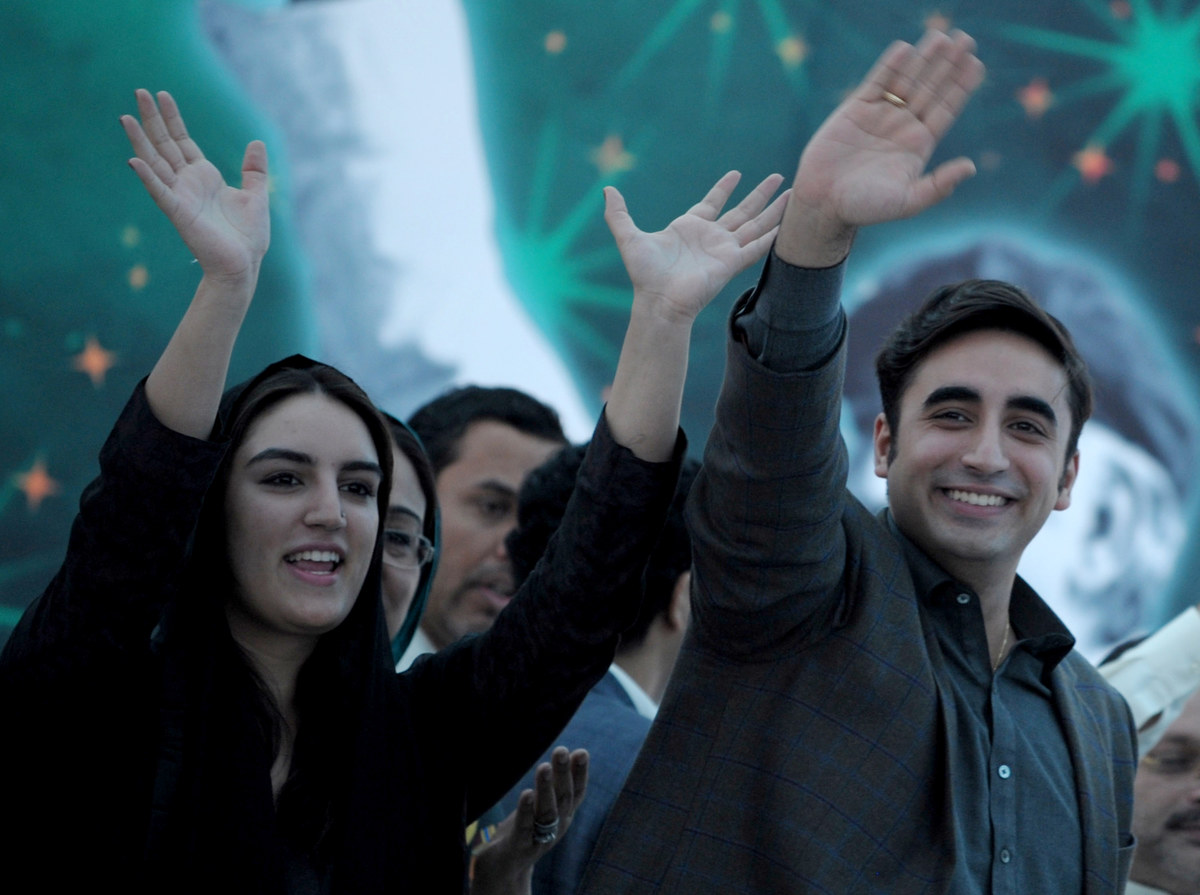
Chairman of Pakistan Peoples Party, Bilawal Bhutto Zardari, right, and his sister Bakhtawar wave to supporters at a rally in Karachi on Nov. 30, 2013. (AFP/File)
The party came third in the 2018 general elections, though Bilawal’s own fortunes have continued to rise since, as he has delivered fiery speeches in parliament and in his home province of Sindh accusing the government of deliberately targeting political opponents. But one of the major challenges for Bilawal remains the image of his father, a co-chairperson of the PPP and often contrasted with Imran Khan’s relentless anti-graft message.
“Bilawal has always remained consistent in his stance for parliamentary supremacy, protection of human rights and a pluralistic equal and democratic Pakistan,” Bakhtawar said in response to a question about whether her brother was a ‘misfit’ in Pakistan’s deeply polarized polity and society. “He is passionate, prescient and principled and serves the interest of the forthcoming generations. In that respect — he is the perfect fit.”
For her part, Bakhtawar, a graduate of the University of Edinburgh, says she has no immediate interest in politics and is happy serving as chairperson on the board of Shaheed Zulfikar Ali Bhutto Institute of Science and Technology (SZABIST) university, founded by her mother in 1995 and named after her grandfather. She also likes to rap in her free time and learn about new farming methods. The family owns huge tracts of farmland in their home province of Sindh. When her father is freed, Bakhtawar hopes they get to spend “more time together as a family.”
“I remain very vocal [about politics] especially on Twitter but I am not involved in matters of government,” she said. “We lost our grandparents, our uncles, our mother — I think enough blood of one family has been spilt in politics.”


