ISLAMABAD: China is paying close attention to the situation in Kashmir and wants a peaceful resolution of the dispute between the two South Asian nuclear-armed nations, said a Pakistan-China joint press statement on Wednesday while providing details of Prime Minister Imran Khan’s two-day visit to Beijing.
The Pakistani leader left for Islamabad after concluding his visit to China where he was invited by his counterpart Li Keqiang. During his stay in Beijing, the prime minister also met President Xi Jinping and interacted with Chinese business community.
According to the joint statement, leaders of the two countries agreed “that a peaceful, stable, cooperative and prosperous South Asia was in the common interest of all parties.”
“Parties need to settle disputes and issues in the region through dialogue on the basis of equality and mutual respect,” it added.
The Pakistani delegation also underscored that the China-Pakistan Economic Corridor (CPEC) was a transformational project. The two countries agreed that the second CPEC phase would promote industrial and socio-economic development in the South Asian state.
Pakistani officials told the Chinese authorities that the Gwadar Port had been given various facilities since the government wanted to make it the region’s trade and logistical hub.
The two sides also expressed determination to speedily execute CPEC projects to make the corridor a high-quality demonstration for China’s Belt and Road Initiative (BRI).
China and Pakistan also reviewed the “excellent” bilateral defense cooperation and agreed to strengthen it further “in the areas of military exercises, training cooperation, personnel exchanges, and equipment and technology cooperation.”
The two countries reaffirmed their commitment to fight terrorism in all its forms and manifestations, and called on all countries to strengthen international cooperation on counterterrorism.
China appreciated Pakistan’s efforts and sacrifices in countering terrorism, asking “the international community to objectively recognize Pakistan’s contributions to regional peace and security through its success in fight against terrorism.”
The two sides also underlined that educational links between them were becoming stronger.
“Prime Minister Imran Khan thanked Chinese leadership for providing opportunities to Pakistani students to study in China. He hoped that those students will play an important role in further deepening historic and deep-rooted ties between the two iron brothers,” the statement added.


![]()

Chinese authorities say Beijing paying close attention to Kashmir situation
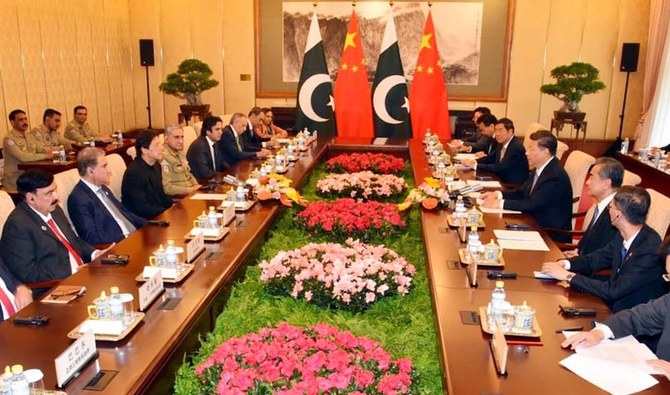
Chinese authorities say Beijing paying close attention to Kashmir situation
- As Prime Minister Khan concludes his visit, the two countries praise bilateral defense cooperation, agree to strengthen it further
- The second CPEC phase will promote industrial and socio-economic development in Pakistan, says joint statement
Latest updates



© 2026 SAUDI RESEARCH & PUBLISHING COMPANY, All Rights Reserved And subject to Terms of Use Agreement.