

UAE’s Masdar invests in British green technologies

1 / 8
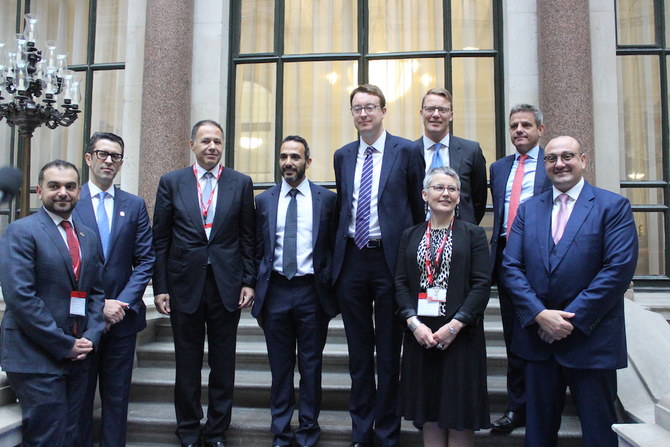
Infrastructure and Projects Authority's commercial finance specialist, Philippa Eddie and Zouk Capital's Managing Partner Samer Salty (R) with Masdar’s CEO Mohamed Al-Ramahi and British Exchequer Secretary to the Treasury Simon Clarke (R) at the the Charging Infrastructure Investment Fund (CIIF) conference in London. (AN Photo/Sarah Glubb)
2 / 8
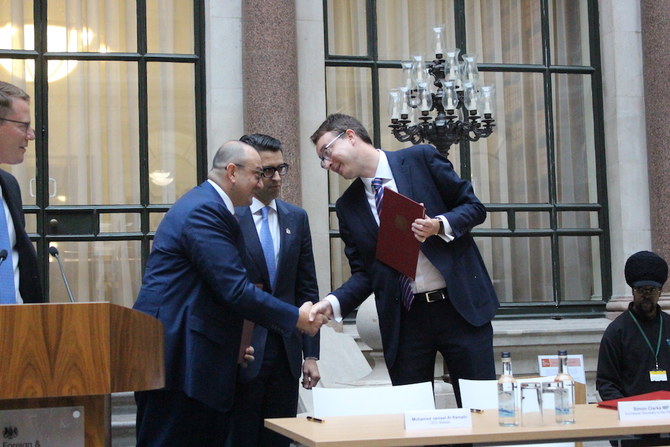
Masdar’s CEO Mohamed Al-Ramahi and British Exchequer Secretary to the Treasury Simon Clarke sign the Charging Infrastructure Investment Fund (CIIF) agreement in London. (AN Photo/Sarah Glubb)
3 / 8
The UK already has one of the largest electric vehicle charging networks in Europe, and this investment will help make it the fastest by installing state-of-the-art technology. (AN Photo/Sarah Glubb)
4 / 8
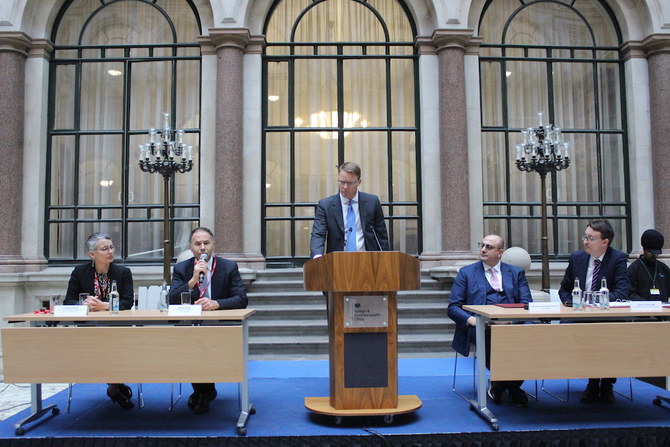
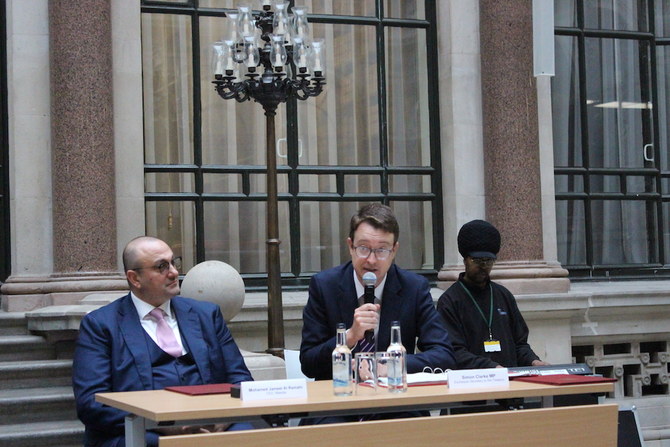
Masdar’s CEO Mohamed Al-Ramahi and British Exchequer Secretary to the Treasury Simon Clarke address the Charging Infrastructure Investment Fund (CIIF) conference in London. (AN Photo/Sarah Glubb)
5 / 8
Masdar’s CEO Mohamed Al-Ramahi and British Exchequer Secretary to the Treasury Simon Clarke sign the Charging Infrastructure Investment Fund (CIIF) agreement in London. (AN Photo/Sarah Glubb)
6 / 8
The UK already has one of the largest electric vehicle charging networks in Europe, and this investment will help make it the fastest by installing state-of-the-art technology. (AN Photo/Sarah Glubb)
7 / 8
Infrastructure and Projects Authority's commercial finance specialist, Philippa Eddie, addresses the Charging Infrastructure Investment Fund (CIIF) conference in London. (AN Photo/Sarah Glubb)
8 / 8
Khaled Al-Qubaisi, CEO of Aerospace, Renewables & ICT for Mubadala, addresses the Charging Infrastructure Investment Fund (CIIF) conference in London. (AN Photo/Sarah Glubb)
Updated 08 October 2019
Follow

UAE’s Masdar invests in British green technologies

  • Masdar has a long history of putting money into renewable energy and is a cornerstone investor in the CIIF
  • UK pioneer in tackling climate change by becoming first major economy to legislate for net zero emissions by 2050

LONDON: UAE renewable energy investor Masdar is pouring millions into a UK government fund to make Britain one of the world’s best-served countries for electric vehicles.
British ministers announced more than £500 million (SR2.29 billion) of new investments in green technologies, including a £400 million fund to bolster Britain’s electric vehicle charging infrastructure, with cooperation from private-sector investors.
“We were absolutely delighted that Masdar chose to invest 35 million in this fund, which the government topped up to 70 million for the installation of 3,000 rapid charges across the country,” British Exchequer Secretary to the Treasury Simon Clarke said during a conference held in London.
This more than doubles the number of rapid charges across the UK, producing a dense network of stopping points where cars can be charged in 20 minutes, compared to existing technology which can take 40 minutes.
The Masdar investment, in partnership with the UK Treasury and the Infrastructure and Projects Authority (IPA), is part of the UK’s commitment to reach net zero carbon emissions by 2050, making Britain the first major economy to do so, a law that was passed by former premier Theresa May in the last few weeks before she stepped down.
“I think today is such a good news day for both Britain and the UAE, but also our global environment in the long-term, which will allow us to start to transform our EV (electric vehicle) infrastructure, because, of course, we’ll only be able to persuade large numbers of people to switch to using EVs when we have the right infrastructure to make that possible,” Clarke told Arab News.
Masdar has invested more than £3 billion in the UK over the past 10 years, predominantly in offshore wind farms that produce enough clean energy to power more than 1 million households, which “shows Masdar’s continued participation in the UK’s clean energy commitment.”

Masdar’s CEO Mohamed Al-Ramahi told Arab News: “Decarbonization and electrification of mobility is a strategic target for us and we are very excited to be a cornerstone investor in this fund, alongside the UK and the Abu Dhabi government, and hopefully this will be replicated in other countries around the world as well.”
The Charging Infrastructure Investment Fund (CIIF) is managed by Zouk Capital, a London-based private equity and infrastructure fund manager that invests in clean and efficient economies and has also helped finance major projects throughout Europe, including Germany and Italy.
“The opportunity for the CIIF is actually huge and the EV market is on an ever-steepening growth curve with record numbers of EV vehicles being sold every month,” said Samer Salty, Zouk’s managing partner.
With climate issues on the rise, there is a heightened sensitivity to air pollution, and as a result, more European governments are seeking alternative energy methods, particularly in the EV market.
When asked if this initiative sets an example to other governments, IPA’s commercial finance specialist, Philippa Eddie, told Arab News: “I think this will make a big difference in terms of catalyzing private-sector investment into this very fast-growing electric vehicle charging sector… in terms of having public-sector money directly alongside private-sector money.”
It is part of a larger initiative that would ensure a cleaner and healthier Britain and increase sustainability to support the government’s commitment to tackling climate change.
A further £142.9 million was unveiled in green projects, including combating air and water pollution, removing greenhouse gases, cleaner food systems, reusing and recycling materials in innovative ways and sustainable management of marine resources.
Moreover, the UK committed to phasing out new petrol and diesel vehicles by 2040.
Khaled Al-Qubaisi, CEO of aerospace, renewables and ICT for Mubadala, said: “The UAE has made huge strides in recent decades to become a leader in energy production and green energy practices, but it is essential that we continue to partner and share our knowledge and learn from other countries. Our governments are tightly aligned on climate commitments.”
The UAE government has also set a target of achieving 50 percent clean energy by 2050 and is well on the way to achieving that even earlier.
“I hope that we continue to find strategic partnerships that work for both our countries, because together we’re showing that change is possible and providing leadership to governments and private companies around the world, showing that by working together we can affect real change,” Clarke said.


How lifestyle-led real estate is reshaping Saudi Arabia’s urban future

Updated 25 January 2026
Follow

How lifestyle-led real estate is reshaping Saudi Arabia’s urban future

  • Government spending, regulatory changes, and incentives for foreign investors are fueling development

RIYADH: Saudi Arabia’s real estate sector is entering a new phase, one defined by lifestyle, experience, and quality of life rather than sheer housing volume.

Driven by Vision 2030, lifestyle-focused developments are set to outperform traditional residential projects, reshaping how people live, work, and connect across the Kingdom.
Government spending, regulatory changes, and incentives for foreign investors are also fueling development. Rising demand across residential, commercial, and logistics sectors, along with the push for smart cities and sustainability, is reshaping the market.
Saudi Arabia’s real estate market was valued at $77.2 billion in 2025 and is projected to grow to $137.8 billion by 2034, with a compound annual growth rate of 6.7 percent from 2026 to 2034, according to IMARC Group.

Lifestyle-focused real estate market 
Saudi Arabia’s real estate landscape has evolved beyond conventional housing. Guided by Vision 2030, it now plays a key role in enhancing quality of life, boosting tourism, and driving economic diversification.
According to Sally Menassa, partner at Arthur D. Little, what stands out today is a clear shift from volume-driven residential supply to lifestyle-led, experience-based development.
“As a result, the lifestyle-focused segment is expected to outperform conventional residential real estate, growing at around 8 percent annually over the next five years. This growth is being driven by changing consumer expectations, population growth, rising incomes, and the scale of public investment shaping new urban environments,” Menassa said.
She added that demand in the Kingdom’s real estate is rising across four key segments: mixed-use districts near urban hubs such as King Salman Park; wellness-focused communities prioritizing walkability and services; coastal living along the Red Sea with branded residences; and heritage-driven districts like Diriyah and Al Balad that blend culture, hospitality, and long-term value.
“Overall, this marks a fundamental shift in the Kingdom. Real estate is no longer an end in itself and about delivering buildings; it is becoming a platform for place-making, economic diversification, and sustained value creation,” the ADL partner explained.
From another perspective, Houssem Jemili, senior partner at Bain and Co. Middle East said: “Saudi’s real estate market is forecast at roughly 7–8 percent CAGR to 2030; ‘lifestyle’ demand is being pulled most by amenity-led mixed-use communities plus higher-spec, greener and wellness-leaning homes.”
A report from PwC Middle East released in 2025 focused on the future of sustainable real estate in Saudi Arabia, and  showed that the sector is shifting toward livability-focused, high-quality urban developments. Giga-projects are driving demand for mixed-use, wellness-focused, and socially connected communities that enhance quality of life.
Imad Shahrouri, cities sector lead partner, consulting, in Riyadh at PwC Middle East said: “By placing livability and human experience at the foundation of its urban agenda, Saudi Arabia is shaping a market where lifestyle-led developments will play an increasingly influential role in driving demand and investment.”

Core lifestyle elements developers are prioritizing  
Saudi developers are shifting from the traditional “build and sell” model to creating integrated lifestyle communities focused on long-term value and everyday living.
Menassa from ADL highlighted that the shift centers on enhancing public spaces — with walkable areas, parks, and wellness facilities — to promote healthier, more social lifestyles, especially for a younger, health-focused population.
“Convenience is also playing a bigger role in shaping residential districts. Schools, childcare centers, clinics, co-working spaces and a wide range of food and beverage options are increasingly located within walking distance of homes, reducing commuting time and making everyday life more efficient and connected,” she said.
The partner added: “Equally important is the role of culture and social activity. Many developments now incorporate cultural venues, entertainment spaces and destination dining, ensuring that neighborhoods remain active throughout the day and week rather than becoming dormant outside working hours.”
Menassa went on to stress that real estate in Saudi Arabia is evolving into a strategic tool for quality of life, tourism, and talent attraction. Driven by Vision 2030, developments now integrate smart infrastructure and global lifestyle standards, while staying rooted in local culture to meet the needs of a young, urban population.

FASTFACT

Driven by Vision 2030, lifestyle-focused developments are set to outperform traditional residential projects, reshaping how people live, work, and connect across the Kingdom.

From Bain’s lens, Jemili said: “Developers are prioritizing livable neighborhoods. Walkability, parks and sport, culture and entertainment access, and everyday convenience, shaped by Vision 2030’s Quality of Life agenda and the 70 percent homeownership-by-2030 push.”
Shahrouri from PwC shed light on how developers in the Kingdom prioritizing livability, wellbeing, and inclusive, community-focused spaces are, aligning with Vision 2030’s push to enhance daily life and promote social integration while reflecting local identity.
“As a result, lifestyle-led elements such as walkable neighborhoods, activated public spaces and integrated community facilities are becoming central to new destinations, ensuring future developments foster more connected, resilient and experience-rich ways of living,” he said.

Regions, cities key hubs for experiential development 
Several Saudi cities are emerging as prominent centers for lifestyle-focused, experiential development, each defined by its unique urban and economic character.
From ADL’s perspective, Riyadh is leading this shift as it positions itself as a global capital. The city is seeing strong demand for integrated, mixed-use districts that support live-work-play lifestyles.
“Developments such as KAFD, Diriyah, and areas surrounding King Salman Park reflect a growing preference for urban living that combines employment, culture, green space, and entertainment in close proximity,” Menassa said.
“Jeddah’s appeal is different, but equally compelling. Its strength lies in its coastal character, historic fabric, and more relaxed urban rhythm. Waterfront regeneration and heritage-led districts, particularly around Al Balad, are driving interest in developments that blend walkability, culture, and sea-facing lifestyles — attracting residents, investors, and tourists alike,” she added.
The partner continued to underline that destination developments along the Red Sea coast focus on sustainable, low-density communities blending hospitality, nature, and residential living, promoting wellness and eco-tourism.
Menassa noted that secondary cities like Abha and AlUla are emerging as hubs for outdoor living, culture, and heritage, supported by government policies and investments. 
These lifestyle-driven districts appeal to residents for livability and job access, and to investors for scale and stability, offering resilience through everyday services and cultural experiences.
From Bain’s side, Jemili explained that Riyadh and Jeddah stand out as the main hubs because they combine jobs, population growth, liquidity and are where “integrated community” formats scale fastest.
“We’re seeing the same in Makkah and Madinah; the focus is shifting from delivering more units to delivering higher-quality development and standards,” he said.
From PwC’s perspective, Shahrouri noted that regions across Saudi Arabia are becoming hubs for lifestyle-driven development, with large-scale regeneration creating sustainable, well-designed environments that enhance urban living and attract global investment.
“Flagship projects are reshaping their surroundings by focusing on the character and feel of place, bringing together community elements, environmental responsibility, and integrated urban design.”

 Their growing appeal comes from the balance they strike between modern infrastructure and a human-centered approach to planning, creating destinations where daily life feels more seamless and connected,” he said.

Next phase of Saudi real estate evolution
The next phase of Saudi Arabia’s real estate evolution is likely to be defined by integration, intelligence, and regeneration.
From ADL’s lens, Menassa explained that  Riyadh is set to feature highly vertical, dense urban environments designed for land efficiency and sustainability, with fully integrated live-work-play ecosystems that reduce commuting, boost productivity, and enhance social cohesion.
“The real shift, however, is toward AI-enabled and data-driven communities, where energy, mobility, and services are actively managed rather than passively consumed. Real estate will increasingly be judged not by how much is sold, but by how well places perform — in terms of livability, productivity, and environmental outcomes,” she said.
The partner noted that Saudi Arabia is boosting private sector involvement, public-private partnerships, and institutional investments to develop public spaces and social infrastructure. The focus is shifting from just constructing cities to designing lifestyles, using real estate as a key driver for economic growth and social transformation.
Jemili from Bain said: “The next phase is more about operating districts like platforms, digital twins, and real-time data to optimize energy, maintenance, mobility, and resident experience, creating tighter live-work-play loops. Rather than ‘building more.’”
From PwC’s side, Saudi Arabia is building a strong foundation for future cities by focusing on resilient, resource-efficient developments and adaptable infrastructure, paving the way for smart, connected urban models like vertical districts and digital neighborhoods.
“These emerging environments are set to respond more naturally to the needs of their communities. As the quality and experience of urban life continue to rise, our cities are poised to become more intelligent, enriching and future ready, evolving with their residents and reflecting the ambition of a nation transforming at pace,” Shahrouri concluded.