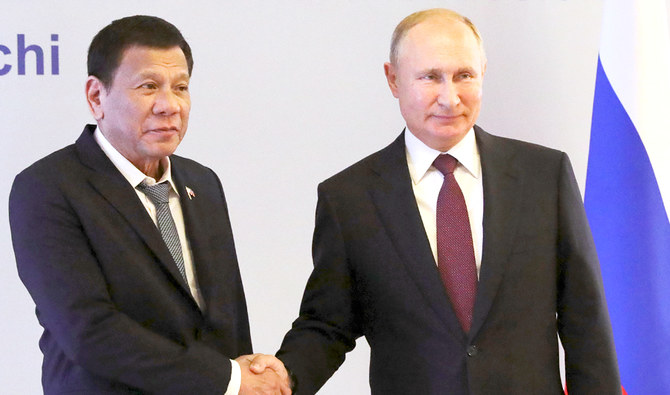

Russian President Vladimir Putin has pledged his country’s full support for the Philippines’ fight against terrorism.
Speaking during Filipino President Rodrigo Duterte’s current five-day official visit to Russia, Putin said: “On the bilateral level, I would like to point out that the Philippines is an important partner for Russia in Asia. Our bilateral cooperation is constructive and mutually beneficial.”
The Russian leader added that the two countries had developed a “truly friendly” relationship and recalled how Duterte had to cut short his first visit to Russia in May 2017 because of terrorist attacks by Daesh-inspired militants in Marawi City.
“I know that over the past two years you have managed to bring down the terrorist threat to a very low level and to greatly strengthen the capability of your security agencies.
“Mr. President, we are ready to continue to develop our partnership and to share our experience and achievements in the field of counterterrorism,” Putin said.
Citing the expansion of links between Russia and the Philippines, the president said it was largely due to Duterte’s personal contribution that political dialogue between the two countries had been revitalized, resulting in considerable achievements in trade and economic cooperation.
“Our trade has doubled, or more precisely, it increased by 102 percent to over $1.2 billion (SR4.5 billion) in 2018. Russian exports to your country have increased fourfold,” Putin added.
However, he believed the two countries could do much more, noting that Russia had major reserves in place and companies were ready to increase exports of energy, aircraft, motor transport and special equipment to the Philippines.
According to Putin, Russia also wanted to increase industrial cooperation with the Philippines, as well as improve collaboration on space exploration and the use of digital technologies.
He stressed the importance of establishing direct ties between entrepreneurs, citing the regular meetings of the Business Council, created in 2009.
In reply, Duterte said: “I am here today to reaffirm our strong commitment to build a robust and comprehensive partnership with the Russian Federation.”
He pointed to a dramatic increase in bilateral activities over the past two years and noted that both governments had made “historic firsts” in key strategic areas such as economic, defense, security, and military technical cooperation.
BACKGROUND
Filipino President Rodrigo Duterte defended his controversial war on drugs as he tried to convince world leaders he was ‘not a killer.’
On defense and security, Duterte highlighted the port call by the BRP Tarlac to Vladivostok in 2018, an unprecedented goodwill visit by a Philippine Navy vessel.
The two nations had also established high-level consultative mechanisms involving their foreign ministries, national security councils, and economic agencies.
The Filipino president cited the opening of defense attachés in both countries as an indication of their long-term commitment to enhance defense relations.
Meanwhile, at the Valdai discussion forum, Duterte defended his controversial war on drugs as he tried to convince world leaders he was “not a killer.”
He said he was having to fight corruption and the trafficking of drugs inside and outside of his government, and therefore a swift response was required, adding that he took full responsibility for all of the consequences of his drug war.
“I and I alone. If some day somebody has to be hanged, I will be happy. I will even put the noose on my neck and say, ‘go ahead.’”
Amid charges of extrajudicial killings in connection with his purge on narcotics, Duterte emphasized that it was not his government’s policy to execute all people involved in the illicit trade.
“I have no business. I have no universal right to destroy a fellow human being. I do not allow the military to shoot a person hog-tied or with his stretched hand in surrender. I told them that the only way that you can kill a criminal, the drug lords and the addicts, is when your life is in danger.”
However, during the forum, Duterte also said he “would be happy” if all the drug lords and addicts were killed.
He added: “I assure you I have a religion … I have my own God. I am not a killer. Some say (I’m) a killer. Of what? I have yet to kill one human being. When I say I will kill you, well, that’s a statement coming from the mouth of a president.”
In the past Duterte had reportedly claimed that he personally killed suspected criminals when he was mayor of his home city of Davao.