SYDNEY: One of the world’s rarest monkeys has been born at an Australian zoo.
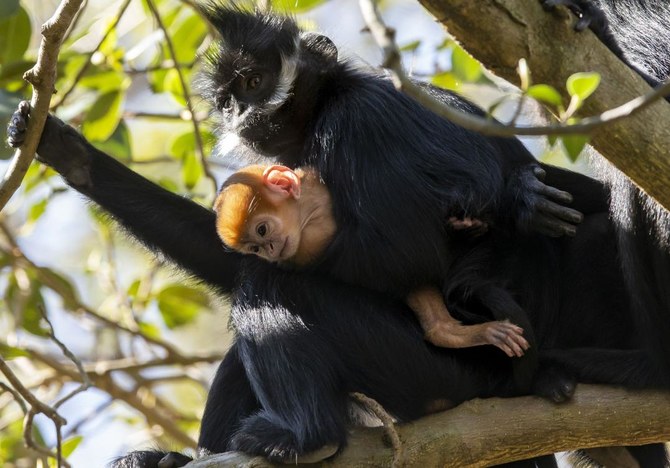
The male Francois’ Langur with its distinctive orange fur was born at Sydney’s Taronga zoo last week and has not yet been named.
Critically-endangered, the animal is only found in China and Vietnam where it is threatened by poachers and loss of habitat from encroaching development.
“Seeing Francois’ Langurs in the wild is incredibly rare, but seeing a baby is even more so,” said Senior Zoo Keeper Jane Marshall.
The baby’s bright orange hair lasts just a few weeks before it begins to darken to the color of its mother Noel’s hair.
The zoo estimates there are only about 3,000 of the species left in the wild.
“Not a lot of people know about Francois’ Langurs as a species, but these beautiful animals are very vibrant animals, who are incredibly agile and intelligent,” Marshall added.


‘Incredibly rare’ monkey born at Australian zoo
‘Incredibly rare’ monkey born at Australian zoo
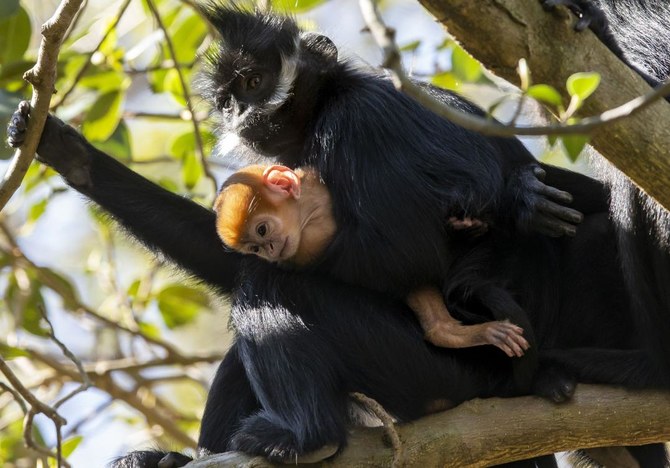
- The male Francois’ Langur with its distinctive orange fur was born at Sydney’s Taronga zoo last week
- Critically-endangered, the animal is only found in China and Vietnam where it is threatened by poachers


Egypt reclaims 3,400-year-old stolen statue of King Ramses II
- Egyptian authorities spotted the artefact when it was offered for sale in an exhibition in London in 2013
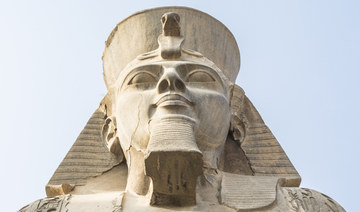
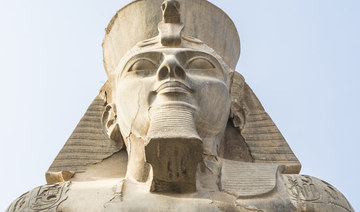
CAIRO: Egypt welcomed home a 3,400-year-old statue depicting the head of King Ramses II after it was stolen and smuggled out of the country more than three decades ago, the country’s antiquities ministry said on Sunday.
The statue is now in the Egyptian Museum in Cairo but not on display. The artefact will be restored, the ministry said in a statement.
The statue was stolen from the Ramses II temple in the ancient city of Abydos in Southern Egypt more than three decades ago. The exact date is not known, but Shaaban Abdel Gawad, who heads Egypt’s antiquities repatriation department, said the piece is estimated to have been stolen in the late 1980s or early 1990s.
Egyptian authorities spotted the artefact when it was offered for sale in an exhibition in London in 2013. It moved to several other countries before reaching Switzerland, according to the antiquities ministry.
“This head is part of a group of statues depicting King Ramses II seated alongside a number of Egyptian deities,” Abdel Gawad said.
Ramses II is one of ancient Egypt’s most powerful pharaohs. Also known as Ramses the Great, he was the third pharaoh of the Nineteenth Dynasty of Egypt and ruled from 1279 to 1213 B.C.
Egypt collaborated with Swiss authorities to establish its rightful ownership. Switzerland handed over the statue to the Egyptian embassy in Bern last year, but it was only recently that Egypt brought the artefact home.

A Nigerian chess champion is trying to break the world record for the longest chess marathon
- Tunde Onakoya, 29, is playing against Shawn Martinez, an American chess champion, in line with Guinness World Record
- Onakoya, who founded Chess in Slums Africa, hopes to raise $1 million for children’s education across Africa
NEW YORK: A Nigerian chess champion and child education advocate is attempting to play chess nonstop for 58 hours in New York City’s Times Square to break the global record for the longest chess marathon.
Tunde Onakoya, 29, hopes to raise $1 million for children’s education across Africa. He is playing against Shawn Martinez, an American chess champion, in line with Guinness World Record guidelines that any attempt to break the record must be made by two players who would play continuously for the entire duration.
Onakoya had played chess for 42 hours by 10:00 a.m. GMT on Friday. Support is growing online and at the scene, where a blend of African music is keeping onlookers and supporters entertained amid cheers and applause.
The current chess marathon record is 56 hours, 9 minutes and 37 seconds, achieved in 2018 by Hallvard Haug Flatebø and Sjur Ferkingstad, both from Norway.
The record attempt is “for the dreams of millions of children across Africa without access to education,” said Onakoya, who founded Chess in Slums Africa in 2018. The organization wants to support education of at least 1 million children in slums across the continent.
“My energy is at 100 percent right now because my people are here supporting me with music,” Onakoya said Thursday evening after the players crossed the 24-hour mark.
On Onakoya’s menu: Lots of water and jollof rice, one of West Africa’s best known dishes.
For every hour of game played, Onakoya and his opponent get only five minutes’ break. The breaks are sometimes grouped together, and Onakoya uses them to catch up with Nigerians and New Yorkers cheering him on. He even joins in with their dancing sometimes.
A total of $22,000 was raised within the first 20 hours of the attempt, said Taiwo Adeyemi, Onakoya’s manager.
“The support has been overwhelming from Nigerians in the US, global leaders, celebrities and hundreds of passersby,” he said.
Onakoya’s attempt is closely followed in Nigeria where he regularly organizes chess competitions for young people living on the streets to boost his cause. More than 10 million children are out of school in the West African country — one of the world’s highest rates.
Among those who have publicly supported him are celebrities and public office holders, including Nigeria’s former Vice President Yemi Osinbajo, who wrote to Onakoya on X, formerly Twitter: “Remember your own powerful words: ‘It is possible to do great things from a small place.’“
The Guinness World Record organization has yet to publicly comment about Onakoya’s attempt, which could reach 58 hours by midnight on Friday. It sometimes takes weeks for the organization to confirm any new record.


Used missiles for sale: Iranian weapons used against Israel are up for grabs on Jordan-based website
Used missiles for sale: Iranian weapons used against Israel are up for grabs on Jordan-based website
- Debris used in attack listed on OpenSooq online marketplace
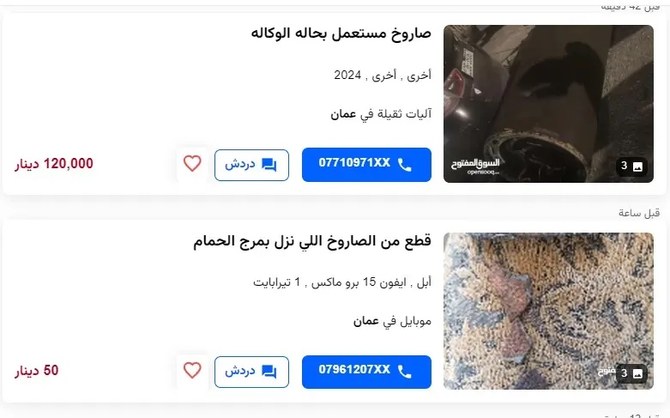
LONDON: Fragments of missiles launched by Iran during the recent attack on Israel have been discovered for sale on Jordan’s prominent OpenSooq website, which is known for trading goods, including vehicles and real estate.
Al Arabiya reported on Sunday that the shrapnel was being advertised, with pieces described as “Used Iranian ballistic missile in good condition for sale,” and “One-time use ballistic missile for sale at an attractive price.”
The sellers had provided specifications and images of the missiles, describing them as “excellent type,” and mentioned their involvement in an “accident” resulting in “severe damage to the body.”
Some listings even included installment payment options.
Iran launched drones and missiles toward Israel late on Saturday as it retaliated following a suspected Israeli strike on the consulate annex building adjacent to the Iranian Embassy in Damascus, Syria, earlier this month.
While most projectiles were intercepted by a joint response from Israel, the US, UK, France, and Jordan, the attack marked Iran’s first direct military assault on Israeli territory, escalating tension and uncertainty in the region.
Following the attack, individuals shared photographs online showing debris that had fallen on Jordanian territory in areas such as Al-Hasa, Marj Al-Hamam, and Karak Governorate.
The Jordanian government confirmed that it had intercepted some flying objects in its airspace, with no reported damage or injuries.
Debris from such incidents often holds economic value. Metal debris from the Iraq War has been used by Iran-backed groups to finance their activities.
Similar items are sold online as military memorabilia, and there has been a surge in demand for such artifacts, as seen in Australia last year, preceding the country’s ban on the sale of hate symbols.


Google Doodle celebrates Lebanese-American poet and artist Etel Adnan
- Etel Adnan rose to fame for her 1977 novel Sitt Marie Rose about the Lebanese civil war
DUBAI: Google released its latest Doodle on Monday honoring Etel Adnan, a Lebanese-American poet, essayist and visual artist, considered one of the most accomplished Arab-American authors of her era.
The poet, who rose to fame for her 1977 novel Sitt Marie Rose about the Lebanese civil war, was born in Lebanon in 1925 to a Greek mother and a Syrian father, and grew up in multiple cultures, languages, nationalities and religions. Sitt Marie Rose won the France-Pays Arabes award and become a classic of war literature, so much so that it is taught in American classrooms.
In 1949, Adnan went to Paris to study philosophy at the Sorbonne before going to America to study at Harvard and Berkeley.
From 1958 to 1972, she taught philosophy in California, during which time she also started painting and writing poetry. She developed her literary voice in English and said abstract painting was the entry point into her native Arabic.
Adnan returned to Beirut, where from 1972 to 1976 she worked as the arts editor for two newspapers. She returned to California in 1979, then spent her later years living between Paris and Beirut.
In 2003, Adnan was named “arguably the most celebrated and accomplished Arab American author writing today” by the academic journal MELUS: Multi-Ethnic Literature of the United States.
Adnan’s most recent honor was in 2020. Her poetry collection “Time,” which is a selection of her work — translated from French by Sarah Riggs — won the Griffin Poetry Prize.
The King Abdulaziz Center for World Culture, or Ithra, earlier this year opened an eponymous exhibition in her honor – “Etel Adnan: Between East and West” – showcasing 41 of her works. The space at Ithra’s gallery is the first solo exhibition of Adnan’s work in Saudi Arabia, running until June 30.
The works on display span from the beginning of Adnan’s artistic career in the late 1950s through to her final creations in 2021, shortly before her death that year aged 96.
Some of the works are on loan from significant international institutions such as the Sharjah Art Foundation, Sfier-Semler Gallery and Sursock Museum. Some are part of private collections.


‘HELP’ written in palm fronds lands rescue for Pacific castaways
- The trio became stranded on Pikelot Atoll, a tiny island in the remote Western Pacific, after their motor-powered skiff malfunctioned
- A US Navy aircraft saw the "help" sign and a ship came later to rescue the stranded trio, all experienced mariners in their 40s
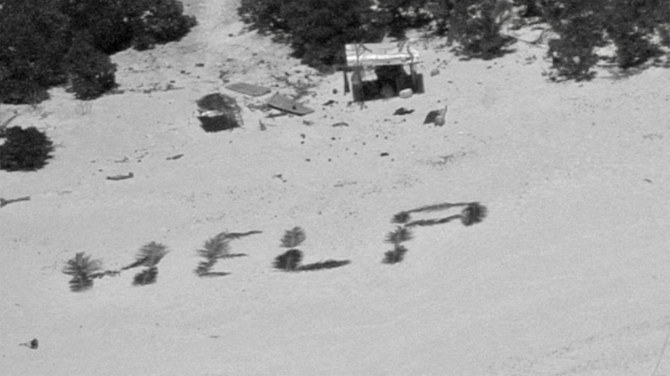
LOS ANGELES: Sometimes all you have to do is ask for “HELP“: That’s what three men stranded on a deserted Pacific island learned earlier this week, writing the message in palm fronds which were spotted by US rescuers.
The trio, all experienced mariners in their 40s, became stranded on a lonely island after setting off from Micronesia’s Polowat Atoll on March 31 in their motor-powered skiff which subsequently experienced damage.
They were reported missing last Saturday by a woman who told the US Coast Guard her three uncles never returned from Pikelot Atoll, a tiny island in the remote Western Pacific.
“In a remarkable testament to their will to be found, the mariners spelled out ‘HELP’ on the beach using palm leaves, a crucial factor in their discovery,” said search and rescue mission coordinator Lt. Chelsea Garcia.
She reported that the trio was discovered Sunday on Pikelot Atoll by a US Navy aircraft.
“This act of ingenuity was pivotal in guiding rescue efforts directly to their location,” she said.
The aircraft crew dropped survival packages, and rescuers one day later dropped a radio which the mariners used to communicate that they were in good health, had access to food and water, and that the motor on their 20-foot (six-meter) skiff was no longer working.
On Tuesday morning a ship rescued the trio and their equipment, returning them to Polowat Atoll, the Coast Guard said.
In August 2020, three Micronesian sailors also stranded on Pikelot were rescued after Australian and US warplanes spotted a giant “SOS” they had scrawled on the beach.