

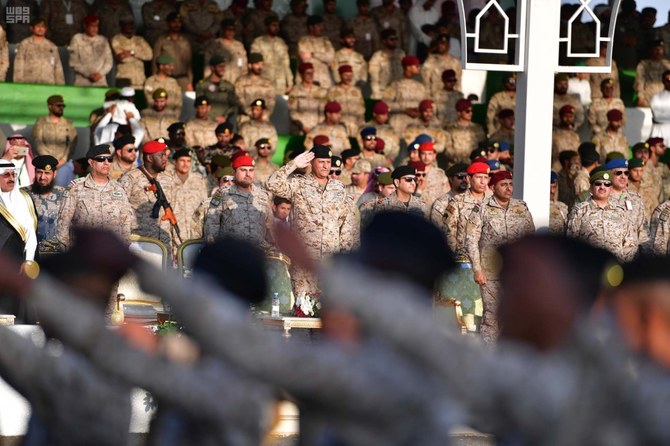
Saudi women invited to join the ranks of the armed forces

Saudi women can now join he Royal Saudi Land Forces, Royal Saudi Airforce, Royal Saudi Arabian Navy, Royal Saudi Air Defense Forces, Royal Saudi Strategic Missile Forces and Armed Forces Medical Services. (SPA)
Updated 03 October 2019
Follow

Saudi women invited to join the ranks of the armed forces

  • Women can now join as lance corporals, corporals, sergeants and staff sergeants
  • The initiative fulfills Saudi Vision 2030 and empowers women

DUBAI: Saudi women can now climb through the ranks of the armed forces the Kingdom’s Ministry of Defense has announced.

While women have been able to join the armed forces in Saudi Arabia, this is the first time they can be considered for more senior ranks, Arabic international daily Asharq Al-Awsat reported on Thursday.

“With these new laws supporting women’s capabilities and rights as citizens… naturally, they will enter new spheres of work, this is the reflection of a national belief in the equality between women and men,” Shura Council member Haya Al-Muni’i told Asharq Al-Awsat.

Under the scheme women can now join as lance corporals, corporals, sergeants and staff sergeants in the Royal Saudi Land Forces, Royal Saudi Airforce, Royal Saudi Arabian Navy, Royal Saudi Air Defense Forces, Royal Saudi Strategic Missile Forces and Armed Forces Medical Services.

The initiative is part of the Kingdom’s Vision 2030 to empower Saudi women and expand the role they play in society.

Saudi women have already been given the opportunity to climb the ranks in the front line of public security, including the General Directorate of Narcotics, General Directorate of Prisons, Criminal Evidence and Customs.


Ramadan spending lifts small Saudi businesses in Diriyah’s Samhaniya

Updated 7 sec ago
Follow

Ramadan spending lifts small Saudi businesses in Diriyah’s Samhaniya

  • Abayas, perfumes, heritage products in abundance
  • Proudly Saudi, operators and owners tell Arab News

RIYADH: In the Samhaniya neighborhood, a pocket of Diriyah, old mud-brick houses have been restored and repurposed into small shops and studios.

Throughout Ramadan, the neighborhood sees a familiar surge: longer nights, busier walkways, and more spending tied to hosting, gifting, and evening gatherings.

At Artisana, a Saudi brand specializing in handmade crafts, that shift is reflected in customer interest and purchasing.

Inside the shop, shelves and tables are arranged like a gift gallery, with handcrafted ceramics including cups, bowls and lidded containers.

Alongside are ready-to-carry items including subha or prayer beads, scarves, and handbags with traditional embellishments of different regions of the Kingdom.

Operator Ghalia Al‑Mutairi told Arab News: “Artisana is a leading Saudi brand in handmade crafts, known for transforming skilled craftsmanship into timeless gifts that carry cultural meaning and emotional value.”

The store’s focus is on presenting Saudi handcrafted products through pieces that celebrate heritage and inspire pride, she said.

The brand has developed four main product lines to cover a range of gifting needs, from simple souvenirs to luxury items, curated to highlight each product’s cultural and aesthetic value.

Ramadan brings a noticeable rise in demand, Al‑Mutairi said, driven by a mix of social habits and the month’s reflective atmosphere.

“Gift-giving culture increases in Ramadan, and Artisana’s heritage character makes it an ideal option that expresses authenticity and Saudi generosity.”

A few doors down, the same Ramadan rhythm plays out in scent.

“Ramadan is known as a season, and naturally sales are higher then,” Suleiman Al‑Durayhim, who co‑founded Oud AlDurayhim with his brother, told Arab News.

The month, he added, pushes brands to highlight what they have and stand out in the market.

Oud AlDurayhim’s setting matches its stock: textured mud walls, carved wooden display towers filled with oud chips, and gift boxes arranged beside small burners.

Glass decanters and mixing vessels sit behind the counter, holding amber-toned oils prepared for customers who want a specific profile.

“We’ve had strong demand, especially here in Diriyah, not only across the Kingdom but across the Gulf as well,” Al‑Durayhim said.

The brand began as a small venture and later took on the family name. Among the scents on the shelf, one is kept especially close: Saad, a perfume named after his late father, carrying family memory into something customers can wear and share.

Nearby is Suweik, a restored building that operates like an indoor strip of local labels, which has become another Ramadan stop for shoppers.

Nour Ahmed, a sales associate at Ghain Abaya, told Arab News that the brand built its online audience before opening its first brick-and-mortar shop in Diriyah.

“The brand has been on Instagram since 2017, and this is its first physical shop, where there’s been a great turnout.”

She added that prices range from SR170 ($45) to SR550.

This Ramadan has brought a much stronger flow of visitors. “Last year there weren’t that many people, but this period there’s a lot of turnout, especially from foreigners too,” she said.

“A lot of Europeans come because they want to see the abayas, and they even want the hijab, and they kind of feel a sense of spirituality with Muslims.”

Samhaniya itself has grown over the last few years, Ahmed said. “At first it was only cafes and the guesthouse, but now it’s extended to the end of the street. It’s all Saudi brands.”