Google Doodle celebrates Pakistani actor’s 81st birthday

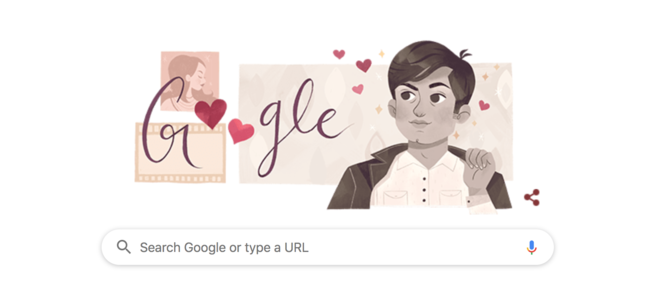
Google Doodle celebrates Pakistani actor, Waheed Murad's 81st birthday on 2nd October, with a customized homepage on the Google search engine. (Photo: screen-grab of Google homepage)
Updated 03 October 2019
Follow

Google Doodle celebrates Pakistani actor’s 81st birthday

  • Waheed Murad played a significant role in carving out the film industry
  • In 2011, 27 years after his death, Murad was posthumously awarded the Sitara-i-Imtiaz

Islamabad: Google Pakistan’s homepage celebrated Waheed Murad, one of the pioneers of Pakistan’s film industry, with a special doodle on his 81st birthday.
The day-long illustrations are often created to shine a light on major events, holidays, and to honor personalities who have contributed significantly to the cause of a specific country or the world at large.
A click on the doodle takes you to the search results of the individual or event being celebrated.
Thus far, the tech giant has displayed memorable doodles of several people from Pakistan, including Abdul Sattar Edhi, Nusrat Fateh Ali Khan, and Noor Jehan.
Born in Sialkot in 1938, Murad, also known as a “chocolate hero,” was an actor, producer and script writer who laid the ground work for the entertainment industry in the country. 
He first entered showbiz at the age of 21, after he completed his undergraduate and graduate studies, with a Masters in English from the University of Karachi.
Making a cameo in Saathi in 1959, he went on to star in 125 feature films (38 of which were in black and white) and took home 32 awards (for acting and producing) including for classics such as Armaan, Heera Aur Pathar, Doraha, Usey Dekha Usey Chaha, Dushman and Ishaara, which he also directed.
While a majority of his films were in Urdu, a few were in Punjabi and one in Pashto, too.
Murad was also the youngest film producer of his time and worked under his father’s banner, Film Art productions.
Murad was a beloved actor across the subcontinent winning fans in both Pakistan and neighboring India.
In his later years, Murad reportedly struggled with his declining status as a hero and had turned to substance abuse which may have contributed to his unexpected death in 1983 at the age of 45. He is survived by his wife Salma, daughter Aaliya, and son Adil.
In 2011, 27 years after his death, Murad was posthumously awarded the Sitara-i-Imtiaz by the then-president Asif Ali Zardari.
In addition to the Google Doodle, Google Arts and Culture has curated a page with the help of Pakistan’s “The Citizens Archive” to provide more information about Murad’s life and achievements, including photos of his work, family, and friends.


Pakistan’s Mahnoor Omer named among TIME’s ‘Women of the Year’ for 2026

Updated 01 March 2026
Follow

Pakistan’s Mahnoor Omer named among TIME’s ‘Women of the Year’ for 2026

  • Omer moved a Pakistani court against the so-called ‘period tax’ in Sept. 2025 which has since sparked a national debate
  • Taxes on sanitary pads in Pakistan can add up to 40 percent to retail price, UNICEF says only around 12 percent women use such products

ISLAMABAD: Pakistani women’s rights activist Mahnoor Omer, who fought against taxes on menstrual products, has been named among the TIME magazine’s ‘Women of the Year’ for 2026.

Omer’s efforts have been recognized alongside 16 activists, artists, athletes and businesswomen in the TIME’s Women of the Year 2026 list, including Olympic gold medalist Sydney McLaughlin-Levrone and Oscar-nominated filmmaker Chloe Zhao.

Dissatisfied with the efforts to educate Pakistani girls about sexual violence, Omer founded the Noor Foundation at the age of 14 and held her own workshops with village girls about everything from climate change to menstruation, according to the TIME magazine.

Two years later, a conversation with a domestic worker about the price of pads made her realize that not everyone could afford these essentials. She moved a court against the so-called “period tax” in Sept. 2025 and the case has sparked a national debate on the subject, considered a taboo by many in Pakistan, since its first hearing late last year.

“A decade and one law degree after her interest in activism was sparked, Omer, now 25, is putting her passion and expertise to work in the name of gender equity,” TIME wrote about Omer on its website.

Taxes imposed on sanitary products in Pakistan can add up to 40 percent to the retail price. UNICEF estimates just 12 percent of women in the country use commercially produced pads or tampons. The alternative, using cloth, risks health impacts including rashes and infections, and can make it impossible for girls to attend school while menstruating.

Omer’s suit, which awaits the government response, has sparked a national discussion. She says she spoke about menstruation to her father and male cousins, who thanked her for standing up for their daughters.
The 25-year-old, who is currently enrolled in a master’s degree in gender, peace, and security at the London School of Economics, sees this case as just the first of many.

“I’m not free until every woman is free,” she was quoted as saying by TIME. “I want to leave no stones unturned in terms of what I can do with the next few decades, as a lawyer for the women in my country and gender minorities in general.”