

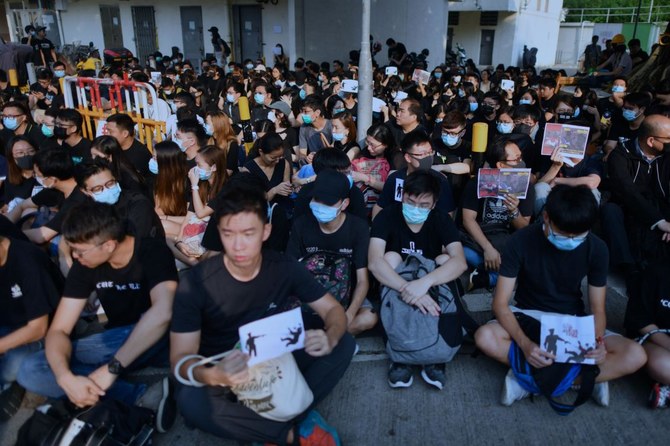
Sit-in at school of Hong Kong protester shot by police

Students and protesters gather in support of form five student Tsang Chi-kin, 18, who was shot in the chest by police during violent pro-democracy protests that coincided with China's October 1 National Day, during a protest at a school in Hong Kong on October 2, 2019. (File/AFP)
Updated 02 October 2019
Follow

Sit-in at school of Hong Kong protester shot by police

  • Running battles raged for hours across multiple locations as hardcore protesters hurled rocks and petrol bombs
  • The protest movement’s main demands are an independent inquiry into police actions, an amnesty for those arrested and universal suffrage

HONG KONG: Hundreds of Hong Kongers staged a sit-in Wednesday outside the school of a teenage protester who was shot by police on China’s National Day in a dramatic escalation of the violent unrest that has engulfed the territory for months.

The international finance hub has been left reeling from the shooting, the first time a demonstrator has been struck with a live round in nearly four months of increasingly violent pro-democracy protests.

Hong Kong was battered by the most sustained political clashes of the year on Tuesday as China celebrated 70 years of Communist Party rule with a massive military parade in Beijing.

The spiralling violence underscored seething public anger against Beijing’s rule and shifted the spotlight from China’s carefully choreographed birthday party, which was designed to showcase its status as a global superpower.

Running battles raged for hours across multiple locations as hardcore protesters hurled rocks and petrol bombs. Police responded for the most part with tear gas, rubber bullets and water cannon.

In Tsuen Wan district, a police officer fired his weapon at close range into the chest of Tsang Chi-kin, 18, as his unit was attacked by protesters armed with poles and umbrellas.

Police said the officer feared for his life on a day that saw his colleagues fire five warning shots from their pistols throughout the city.
“In this very short span of time, he made a decision and shot the assailant,” police chief Stephen Lo said.

But protest groups said the officer charged into the melee with his firearm drawn and condemned the increasing use of live rounds.
“HK (has) fallen into a de facto police state,” democracy activist Joshua Wong tweeted. “The paramilitary security forces completely took over this city.”

The shooting was captured on video that quickly went viral. Outside Tsang’s school on Wednesday students chanted slogans and held pictures of the incident, taken form videos posted on Facebook.

“No rioters, only tyranny,” they chanted, alongside other popular protest slogans. Tsang, who was filmed trying to strike the officer with a pole as he was shot, was taken to a nearby hospital in a critical condition but authorities said his condition had since improved.
“According to the latest information of the Hospital Authority, the current condition of the man is stable,” the government said in a statement.

A friend and classmate of Tsang, who gave his first name Marco, said the 18-year-old was a keen basketballer who was infuriated by sliding freedoms in Hong Kong and the police response to the protests.

“If he sees any problems or anything unjust, he would face it bravely, speak up against it, instead of bearing it silently,” Marco told AFP.
Police said 25 officers were injured in the National Day clashes, including some who suffered chemical burns from a corrosive liquid that was thrown at them by protesters. The liquid also wounded some journalists.

Hospital authorities said more than 70 people were admitted on Tuesday. Police made some 160 arrests throughout the day.
On Wednesday, 96 protesters arrested during clashes with police on Sunday appeared in court charged with rioting, according to court documents. Their ages ranged from 14 to 39.

The majority were students in their early twenties but other occupations listed included a waitress, a teacher, a doctor, an advertising executive and a cook.

Hong Kong’s protests were ignited by a now-scrapped plan to allow extraditions to the mainland. But after Beijing and local leaders took a hard-line they snowballed into a wider movement calling for democratic freedoms and police accountability.

With Hong Kong leader Carrie Lam seemingly unwilling or unable to find a political solution, police have been left to battle increasingly radicalized protesters.

Sentiment is hardening on all sides. Protesters and some local residents routinely shout “triads” at officers who often respond by calling demonstrators “cockroaches.”

The protest movement’s main demands are an independent inquiry into police actions, an amnesty for those arrested and universal suffrage.

But Beijing and Lam have said they are unwilling to meet those demands.


Troops guard Bangladesh depots as fuel crunch hits Asia

Updated 2 sec ago
Follow

Troops guard Bangladesh depots as fuel crunch hits Asia

  • The oil price spike caused by the war in the Middle East has sparked unrest in Bangladesh and exasperation at petrol pumps around Asia
DHAKA: The oil price spike caused by the war in the Middle East has sparked unrest in Bangladesh and exasperation at petrol pumps around Asia, where many economies are heavily dependent on fossil fuel imports.
Even as governments move to limit the impact on fuel prices, lines have formed at petrol stations in countries including Vietnam, Pakistan and the Philippines, although the situation remains stable elsewhere.
In Bangladesh — which imports 95 percent of its oil and gas needs — the military has been deployed at major oil depots, as police patrol in and around filling stations.
“We haven’t received supply from the depot, but the bike riders weren’t convinced and vandalized the station,” said petrol station worker Ashrafuzzaman Dulal told AFP, describing violence on Sunday.
On Tuesday his station Shahjahan Traders, one of the oldest in the capital Dhaka, had hung a banner apologizing because its stock had run out.
The South Asian nation of 170 million people has started fuel rationing, sent students home and scrapped celebratory light displays over the energy crunch.
One man was killed on Saturday night in the southern Bangladeshi district of Jhenaidah after an altercation over refueling with staff.
Following the 25-year-old’s death, angry crowds torched three buses and vandalized a filling station, police said.
- ‘So, so angry’ -
On Tuesday, queues stretched for 1.5 kilometers (nearly one mile) through Dhaka’s city center.
“My boss left the car here and took a rickshaw to reach his destination,” Kamrul Hasan, who was waiting in a vehicle almost at the end of the queue, told AFP.
Filling station worker Akhtar Hossain said he had not stopped for hours.
“Even during the Gulf War, we didn’t experience this sort of rush,” Hossain told AFP.
Oil prices fell Tuesday after US President Donald Trump said the US-Israel war on Iran could end “very soon.”
The previous day, the price of benchmark crude had rocketed past $100 a barrel — its highest level since Russia’s invasion of Ukraine in 2022.
The market instability came as Iran targeted the crude-rich Gulf with missile and drone barrages.
Maritime traffic in the Strait of Hormuz — a key Gulf waterway through which a fifth of global crude passes — has also all but halted since the war broke out.
Thousands of motorbike riders queued for fuel Tuesday in Vietnam, where prices for unleaded gasoline have surged more than 20 percent.
Vietnam has so far avoided mass shortages, with the government scraping duties on many imported petroleum products.
A 57-year-old who gave his name as Tuan told AFP at a Hanoi petrol station that he was “so, so angry.”
“I have been waiting in line for almost one hour. Then my turn came, and they said their system is down,” he said as dozens of drivers waited but others gave up.
- Myanmar price spike -
Vehicles also lined up in scorching heat at Philippine petrol stations this week, as officials warned against hoarding fuel, with similar scenes unfolding in Pakistan and Sri Lanka.
Enrico Guda, a gas station attendant in Metro Manila, said the station had double its usual daily workload as people rushed to fuel up before prices jumped.
In Myanmar, which imports 90 percent of its fuel oil and has long suffered from a fragile energy supply chain owing to the civil war consuming the country, traffic curbs are in place.
From Saturday, half of private vehicles have been ordered off the roads each day to preserve oil stocks.
“Some drivers depend on their vehicles for work and survival... the new system has made it harder for them to run their businesses,” said Hla Htay, 56, a car rental business owner.
In the Myanmar frontier town of Tachileik, an AFP reporter saw signs cross-border supplies from Thailand had been cut — with some petrol stations shut last week after an up-to threefold price spike the day before.
In several other Asian countries, from Japan to Indonesia, as well as China, India and Afghanistan, panic appears not yet to have hit, apart from a few sporadic queues for petrol.
“I used to fill up regularly once a week, but now I try to fill up whenever I find a cheaper gas station,” South Korean businessman Lee In-tae, 42, told AFP in Seoul.