

Philippine separatist leaders’ embrace hints at thaw in ties

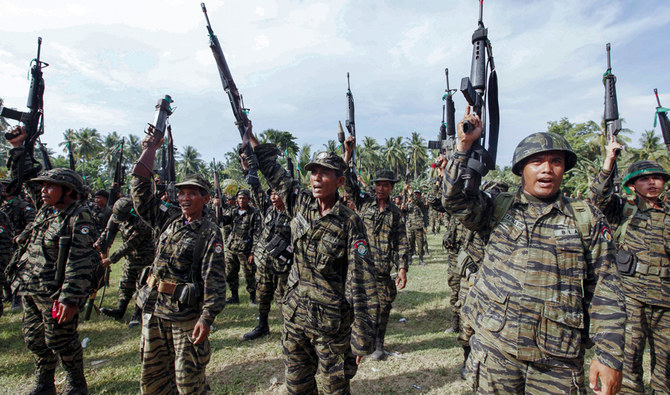
Moro Islamic Liberation Front (MILF) forces at their camp. (Shutterstock)
Updated 02 October 2019
Follow

Philippine separatist leaders’ embrace hints at thaw in ties

  • Philippines top Muslim separatist leaders, who have been at odds for decades, on Monday shook hands and embraced each other

MANILA: In another historic moment in the Philippines’ quest to bring lasting peace to Mindanao, the country’s top Muslim separatist leaders, who have been at odds for decades, on Monday shook hands and embraced each other.

The warm exchange between Moro National Liberation Front (MNLF) founding chair Nur Misuari and Moro Islamic Liberation Front (MILF) chair Murad Ibrahim, who is now interim chair of the Bangsamoro Autonomous Region of Muslim Mindanao, came as the two Muslim revolutionary leaders crossed paths at the culmination of the National Peace Month celebrations.

The event, broadcast live on social media, was hosted by the Office of the Presidential Adviser on the Peace Process, which was also celebrating its 26th anniversary. Also present were other former revolutionary leaders, active and retired military officials, members of the diplomatic corps, and peace advocates.

Minutes before the end of the event, special guests, including Misuari and Murad, were called to the stage for a group photo. When the two took to the stage, the surprising moment followed. Murad extended his hand to Misuari and they then shook hands and embraced each other, sparking hopes of possible reconciliation.

Misuari and Murad have not been under one roof in decades. The two Moro leaders distanced themselves from each other after the MILF broke away from the MNLF in 1977.

Aside from Murad, Misuari also exchanged warm greetings with former MNLF secretary general Muslimin Sema.

“The meeting was indeed historic. What we are seeing here is a reflection of the collective desire of all revolutionary leaders and the government to attain lasting peace in the country,” said Presidential Peace Adviser Carlito Galvez Jr.

“In line with the peace commitment of President Rodrigo Roa Duterte, we at the OPAPP will continue to do our best to bridge people, promote understanding and unity all in the name of peace,” he added.

“It’s a wonderful night that gave us the sign that it is now the time for our deep wounds from all conflicts to heal,” Galvez continued.

Misuari lauded Duterte’s strong political will and unwavering commitment to resolve the decades-long armed conflict in Mindanao.

“I look forward to the success of our peace process… The president knows how to totally achieve peace. I do believe this is a very opportune time for all of us to join hands to concretize what the president wants to happen very soon (in the peace process),” Misuari said.

It can be recalled that Malacanang announced last August the creation of a coordinating committee with the MNLF, as instructed by the president. While it is not clear “whether the committee will be used to thresh out a new agreement with the MNLF on a new territory for them,” Duterte’s spokesman Salvador Panelo said, “the committee would be a venue to seek the cooperation of the MNLF to achieve immediate peace in Sulu.”

Meanwhile, Murad extended a message of peace to the other Moro fronts in Mindanao — a gesture of goodwill that could invaluably contribute to achieving sustainable peace in the island region.

“We are open, our arms are open, we are inviting all groups. We also believe that the real success of the peace process is the collective effort of everybody. We cannot afford to isolate anybody. We need everybody,” Murad said, referring to the ongoing implementation of the Comprehensive Agreement on the Bangsamoro, which paved the way for the establishment of the BARMM.

Murad likewise said they still recognize Misuari as their leader, as he pointed out it was the MNLF chair who was the first to “unite the entire Bangsamoro.”

Murad also expressed his desire to mend the differences between him and Misuari so they can work together for a united Bangsamoro.

Sen. Juan Miguel Zubiri, who was instrumental in the passage and ratification of the Bangsamoro Organic Law, recognized the OPAPP’s key role in pushing forward the Bangsamoro peace process.

“OPAPP has been an invaluable instrument for peace in the nation. In particular, OPAPP has served and continues to serve a vital purpose in our journey toward genuine and lasting peace in Mindanao,” noted Zubiri, who was the event’s guest of honor.


Rohingya refugees hope new leaders can pave a path home

Updated 29 December 2025
Follow

Rohingya refugees hope new leaders can pave a path home

  • Some 1.7 million Rohingya Muslims displaced in Myanmar's military crackdown live in squalid camps in Cox’s Bazar, Bangladesh

COX’S BAZAR, Bangladesh: Rohingya refugees living in squalid camps in Bangladesh have elected a leadership council, hoping it can improve conditions and revive efforts to secure their return home to Myanmar.
Spread over 8,000 acres in Cox’s Bazar in Bangladesh, the camps are home to 1.7 million members of the stateless group, many of whom fled a 2017 military crackdown that is now subject to a genocide probe at the UN court.
In July, the refugees held their first elections since their influx began eight years ago, resulting in the formation of the United Council of Rohang (UCR).
“They are working to take us home,” said Khairul Islam, 37, who back home had a thriving timber business.
The new council has brought him a glimmer of hope amid an uncertain future.
“We can hardly breathe in these cramped camp rooms... all our family members live in a single room,” he said.
“It’s unbearably hot inside. Back in Myanmar, we didn’t even need a ceiling fan. In summer, we used to sit under tall trees,” Islam said, his eyes welling up.
More than 3,000 voters from across 33 refugee camps cast their ballots to elect an executive committee and five rotating presidents to focus on human rights, education and health.
Addressing a gathering at one of the camps, UCR president Mohammad Sayed Ullah urged refugees not to forget the violence that forced the mostly Muslim group to flee Myanmar’s Rakhine state.
“Never forget that we left our parents’ graves behind. Our women died on the way here. They were tortured and killed... and some drowned at sea,” said Sayed Ullah, dressed in a white full-sleeved shirt and lungi.
“We must prepare ourselves to return home,” he said, prompting members of the audience to nod in agreement.

A seat at the table 

“UCR wants to emerge as the voice of the Rohingyas on the negotiation table,” Sayed Ullah later told AFP.
“It’s about us, yet we were nowhere as stakeholders.”
The council is not the first attempt to organize Rohingya refugees.
Several groups emerged after 2017, including the Arakan Rohingya Society for Peace and Human Rights, once led by prominent activist Mohib Ullah.
But he was murdered in 2021.
And even before that, many organizations were shut down after a major 2019 rally, when the Rohingya said they would go home only with full rights and safety guarantees.
“Some newspapers misrepresented us, claiming we wanted to stay permanently in Bangladesh,” Sayed Ullah said.
“Many organizers were detained. The hardest blow was the assassination of Mohib Ullah.”
But trust is slowly building up again among the Rohingya crammed in the camps in Cox’s Bazar.
“Of course we will return home,” said 18-year-old Mosharraf, who fled the town of Buthidaung with his family.
“UCR will negotiate for better education. If we are better educated, we can build global consensus for our return,” he told AFP.

Security threats 

Many refugees have started approaching the body with complaints against local Rohingya leaders, reflecting a slow but noticeable shift in attitudes.
On a recent sunny morning, an AFP reporter saw more than a dozen Rohingya waiting outside the UCR office with complaints.
Some said they were tortured while others reported losing small amounts of gold they had carried while fleeing their homes.
Analysts say it remains unclear whether the new council can genuinely represent the Rohingya or if it ultimately serves the interests of Bangladeshi authorities.
“The UCR ‘elections’ appear to have been closely controlled by the authorities,” said Thomas Kean, senior consultant at the International Crisis Group.
Security threats also loom large, undermining efforts to forge political dialogue.
Armed groups like the Arakan Rohingya Salvation Army and Rohingya Solidarity Organization continue to operate in the camps.
A report by campaign group Fortify Rights said at least 65 Rohingyas were killed in 2024.
“Violence and killings in the Rohingya camps need to stop, and those responsible must be held to account,” the report quoted activist John Quinley as saying.