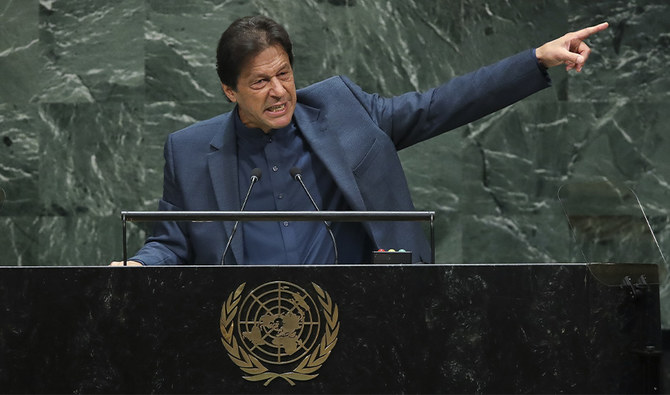
ISLAMABAD: Prime Minister Imran Khan on Friday warned the international community of an impending “bloodbath” in Kashmir after India lifted the curfew in the disputed region and its troops stamped out ensuing resistance in the valley.
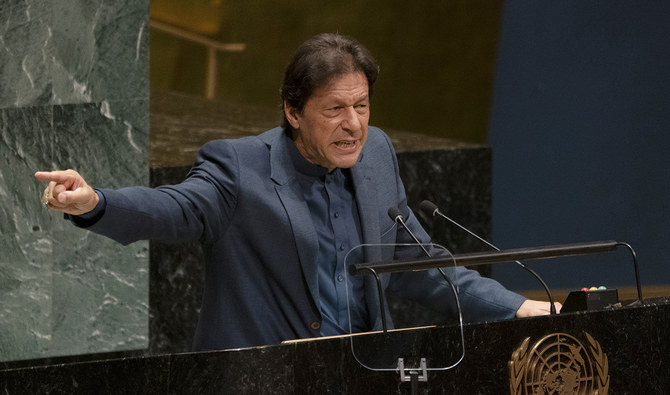
In his maiden speech to the United Nations General Assembly in New York, Khan said the people of Kashmir would come “out in the streets” once New Delhi ended the security lockdown of the Muslim-majority state, adding that 900,000 troops deployed in Indian-administered Kashmir would “shoot them” to muffle their voices.
Criticizing his Indian counterpart Narendra Modi, he said that India’s ruling party was following an agenda rooted in racial supremacy. “It is arrogance that has blinded Modi,” he continued.
Khan added that over a billion Muslims of the world were closely watching the situation in Kashmir and this could lead to their radicalization.
Kashmir remains a disputed territory between India and Pakistan since 1947 as each one of them controls part of it but claims it in full. Both the countries have also fought two wars over the territory but the issue continues to linger on.
Tensions between the two arch-rivals escalated after India unilaterally revoked the special constitutional status of its part of Kashmir on August 5 and imposed a security clampdown on the Himalayan territory to prevent protests.
Indian authorities have also detained thousands of Kashmiris and placed political leaders under house arrest.
Discussing the regional security situation in detail, the prime minister warned the UNGA of a possible nuclear showdown in South Asia, if the crisis in Kashmir was not averted and tensions continued to mount between India and Pakistan.
“If a conventional war starts [between Pakistan and India], anything can happen. And when a nuclear-armed country fights to the end, it will have the consequences beyond its border,” he noted.
Khan said that he was not threatening the world of a nuclear war, but it was a “fair worry.”
“It is a test of the United Nations because you are the one that promised Kashmiris the right to self-determination,” he added.
“This is not a time to appease [India] but a time to act … India must lift the curfew, free all political prisoners, and the world community must give Kashmiris the right to self-determination,” he continued.
The premier also rejected India’s claims of militant outfits operating in Pakistan. “I invite UN observers to visit Pakistan to see for themselves the steps we have taken to counter terrorism,” he said, adding that Pakistan reached out to India several times for dialogue but to no avail.
Talking about the prevalence of Islamophobia, he said that it started after September 11 bombings in the United States because some western leaders started equating Islam with terrorism.
“Islamophobia is creating divisions, hijab is becoming a weapon,” he said rebuffing the term ‘radical Islamic terrorism’ often used in the western countries.
“This radical Islamic terrorism used by leaders has caused Islamophobia and has caused pain to Muslims,” he said. “In European countries it is marginalizing Muslims, and this leads to radicalization.”
About the looming threat of climate change, the Pakistani leader said that his country was among the top ten states that were most affected by adverse impacts of the climate change.
“Our carbon emissions are minuscule, but we are facing the worst challenges,” he said. “We have a lot of good ideas [for adaptation and mitigation], but all of them are just hallucination without funding.”
The prime minister urged the UN to take initiative to deal with the challenge.
Speaking about money-laundering from developing countries, he said that ruling elites of the poor countries were siphoning off billions of dollars each year and stashing them in tax havens in the rich countries.
“The corrupt elites must not be allowed to park their money [abroad]. Why do we have these tax havens?” he questioned. “Why shouldn’t rich people pay taxes? Why are these secret accounts and tax havens legal?”
The prime minister urged the UN to take action against money-laundering from poor countries. “The IMF [International Monetary Fund] and ADB [Asian Development Bank] must find a way,” he added.


![]()
![]()

India planning ‘bloodbath’ in Kashmir, PM Khan tells UNGA
India planning ‘bloodbath’ in Kashmir, PM Khan tells UNGA
- Says Kashmir crisis could lead to a nuclear showdown
- Addresses other pressing issues like Islamophobia, climate change and money-laundering in his speech
Latest updates


© 2026 SAUDI RESEARCH & PUBLISHING COMPANY, All Rights Reserved And subject to Terms of Use Agreement.