

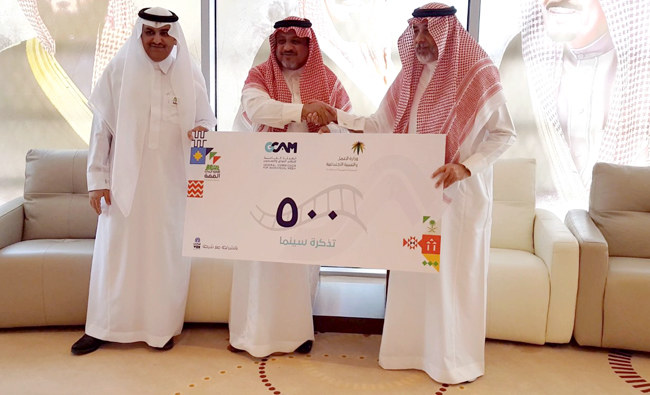
Saudi commission gives away 1,500 cinema tickets to those in need

The General Commission for Audiovisual Media (GCAM) organized an event as part of the Talahoum initiative. (SPA)
Updated 27 September 2019
Follow

Saudi commission gives away 1,500 cinema tickets to those in need

  • Government and private entities participated in the event

RIYADH: The General Commission for Audiovisual Media (GCAM) organized an event at which cinema tickets and other prizes were given to martyrs’ families, orphans and people with disabilities.

Government and private entities participated in the event, which was organized as part of the Talahoum initiative. 

The GCAM’s acting CEO Saud Al-Hazmi said the commission offered 1,500 cinema tickets in cooperation with VOX Cinemas. 

One-third of them were distributed by a representative of the Ministry of Labor and Social Development, he said.

He thanked the government and private sector for their efforts to make Talahoum a success.


Saudi Post issues commemorative stamp to mark Al-Faw’s UNESCO recognition

Updated 25 December 2025
Follow

Saudi Post issues commemorative stamp to mark Al-Faw’s UNESCO recognition

RIYADH: Saudi Post has issued a SR3 ($0.79) commemorative stamp to celebrate the registration of Al-Faw Archaeological Area on the list of UNESCO World Heritage Sites, making it the eighth Saudi site on this prestigious list.

Located south of Riyadh at the junction of a vast plain and the Tuwaiq mountain range, Al-Faw is strategically positioned along ancient trade routes connecting the southern Arabian Peninsula to its center and east.

The area in Wadi Ad-Dawasir, at the intersection of the Empty Quarter desert and the Tuwaiq mountain range, is home to almost 12,000 archaeological remains and has a history of human habitation stretching back more than 6,000 years.

The site features a landscape shaped over millennia by human interaction with the environment and which was abandoned in the 5th century AD owing to depleted water sources.

The commemorative stamps issued honor significant national and international events, highlighting key chapters of Saudi history making them collectible for philatelists, researchers, and heritage enthusiasts, the Saudi Press Agency reported.

UNESCO, while recognizing the site last year, has said the site was a strategic point on the ancient trade routes of the Arabian Peninsula, but was abruptly abandoned around the fifth century.

Archaeological remains uncovered at the site range from prehistoric times to the late pre-Islamic era, testifying to successive occupations by three different populations.

Features include paleolithic and neolithic tools, tapered structures, cairns and circular constructions, the sacred mountain of Khashm Qaryah, rock carvings, funeral cairns, an ancient water management system, and remains of the city of Qaryat Al-Faw.

Other Saudi sites on the UNESCO Heritage List are Al-Hijr (2008), At-Turaif in Diriyah (2010), Historic Jeddah (2014), rock art in the Hail Region (2015), Al-Ahsa Oasis (2018), Hima Cultural Area (2021), and Uruq Bani Maarid protected area (2023).