Blockchain digitizing Saudi shipping industry

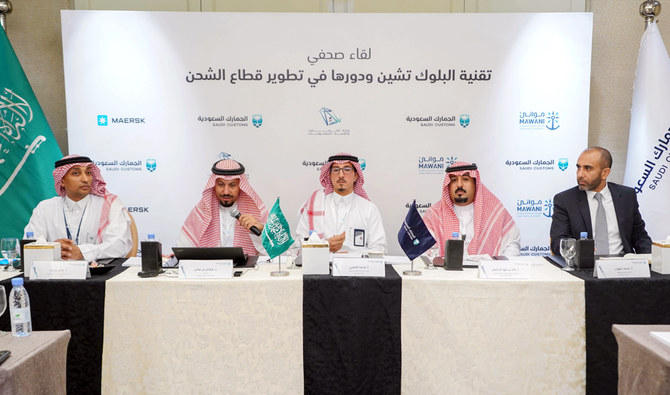
Officials from Saudi Customs, MCIT, the General Authority of Ports, and Maersk held a press conference to highlight the importance of blockchain technology in the shipping industry.
Updated 25 September 2019
Follow

Blockchain digitizing Saudi shipping industry

Saudi Customs, in partnership with the Ministry of Communications and Information Technology (MCIT), the General Authority of Ports, and integrated logistics company Maersk, held a press conference to highlight the importance of blockchain technology in the shipping industry. 

General Manager of Marketing and Customer Service at Saudi Customs Adel Baraja said the role of Saudi Customs is in line with Vision 2030. “Saudi Customs is considered to be one of the most cross-functional organizations across both the government and private sectors, placing Saudi Customs at the heart of government entities essential to achieving the goals of the Kingdom’s Vision 2030,” he said. 

Dr. Hisham bin Abbas, adviser for modern technologies and blockchain at the MCIT, said the ministry’s aim is to develop new technologies to ultimately enhance the Kingdom’s position and make it one of the most important centers of the world. “Within the ICT sector, the ministry focuses on enabling and disseminating blockchain technology as one of the most prominent modern technologies through an implementation plan to build an integrated ecosystem,” he said.

Mohammed Al-Otaibi, general manager of information technology at the General Customs Authority, reviewed the use of blockchain technology in customs and the steps taken by the authority toward digital transformation.

He said the first shipment that was launched using blockchain technology was from the King Abdul Aziz Port in Dammam to the port of Rotterdam on May 12 last year.

Al-Otaibi pointed out that the adoption of blockchain technology by Saudi Customs is the first in the region. “This step reflects the strategy of Saudi Customs to facilitate cross-border trade, especially through sea ports, which account for roughly 80 percent of trade in the Kingdom,” he said.

Al-Otaibi explained that blockchain technology supports the business development of major importers and traders by reducing time and cost and enhancing the security of supply chains. At the global level, he said the technology offers a digital reference documenting all the phases of the shipping procedures and allowing the relevant parties to access them simultaneously, without the intervention of any external party, thereby promoting international cooperation to ensure safety of trade and the reliability of global supply chains.

Regional Director of Maersk Mohamad Chehab said the company aims to become a global logistics company for container shipping and to achieve this goal, Maersk developed various products and services to facilitate shipments including trade finance, remote container management (RCM), and Maersk Spot, which allows the customer to book the shipment directly through the Maersk website. 

“As a result, the company’s investment in the development of digital solutions has become a pillar for its transformation,” Chehab said.

Maersk and IBM have built the TradeLens platform, a common platform for users from airlines, ports, terminals, customs authorities and customers, to automatically and reliably deliver their shipment data via blockchain technology.


ITC Infotech accelerates Vision 2030 through digital hub in Riyadh

Updated 37 sec ago
Follow

ITC Infotech accelerates Vision 2030 through digital hub in Riyadh

ITC Infotech’s commitment to delivering real digital change in the Middle East is reinforced by strengthening collaboration and working more closely with customers on the ground. The establishment of its Digital and AI Engineering Hub in Riyadh brings superior digital engineering and AI skills closer to businesses, allowing for speedier collaboration, localized innovation, and solutions targeted to regional needs. This strategic expansion aligns with Saudi Arabia’s Vision 2030 and underscores ITC Infotech’s long-standing emphasis on partnership-led growth and customer-centric innovation.

The hub was officially inaugurated on Jan. 15 by Sanjiv Puri, chairman and managing director of ITC Ltd. This facility is designed to help enterprises leverage advanced technologies and convert digital ambitions into measurable business outcomes. This move aligns closely with Saudi Arabia’s efforts to build a knowledge-driven economy powered by innovation and technology.

Saudi Arabia’s digital leap

Vision 2030 is more than just economic diversification; it is a clear blueprint for creating a technologically advanced society. This vision is centered on the integration of artificial intelligence and digital engineering, which are transforming industries and enabling long-term, sustainable growth. The strategic importance of AI is clear, with the Saudi Data and AI Authority estimating that it may add $135 billion to the Kingdom’s GDP by 2030. This commitment is supported by significant investments, including $14.9 billion announced at LEAP 2025 to advance digital infrastructure, talent, and next-generation technologies, as well as historic projects like the $2.7 billion Hexagon Data Center in Riyadh. Together, these efforts are laying the foundation for a secure, resilient, and future-ready digital ecosystem that can support AI adoption, data-driven governance, and smart city development at scale.

What the hub offers

ITC Infotech’s Riyadh hub is designed to fuel this momentum by focusing on three core areas:

  • AI-powered platforms: Delivering predictive analytics, intelligent automation, and data-driven insights to help businesses transition from reactive operations to proactive strategies.
  • Digital engineering solutions: Leveraging Industry 4.0-driven smart manufacturing capabilities, integrating AI-led modeling, connected systems, and advanced analytics to optimize production performance, improve asset utilization, and proactively reduce operational and quality risks across the engineering lifecycle.
  • Cloud-native architectures: Building agile, secure, and resilient ecosystems that enable faster innovation and seamless integration across enterprise systems.

These capabilities are designed to enable organizations to innovate, scale, and compete in a rapidly evolving digital economy. Beyond technology, the hub is fundamentally anchored in building a team of the region, from the region, for the region and for global impact. Through structured skill-building programs, deep partnerships with academia, systematic knowledge transfer, and immersive, hands-on delivery models, the hub is creating a future-ready Saudi workforce fully aligned with Vision 2030 and capable of serving both national and international priorities.

Driving enterprise transformation 

The ITC Infotech hub aims to enable transformation rather than simply deploy technology. By driving AI adoption, accelerating digital engineering, and building cloud-native ecosystems, ITC Infotech seeks to help businesses:

  • develop new business models to meet evolving market needs.
  • improve operational efficiency through predictive insights and automation.
  • support sustainability goals by optimizing resources and reducing risks.
  • build a skilled local workforce capable of leading future innovations.

These outcomes support enterprises as they transition to more resilient, data-driven, and digitally mature operating models.

The road ahead

ITC Infotech is a wholly owned subsidiary of ITC Limited, one of India’s largest conglomerates, with over 25 years of experience as a trusted technology services partner to enterprises globally. The company focuses on next-generation enterprise transformation, delivering services across infrastructure and application modernization, cloud, cybersecurity, digital engineering, and AI-led innovation.

As Saudi Arabia continues its digital journey, ITC Infotech’s combination of global expertise, strong local presence, and collaborative delivery model positions it as a long-term partner in advancing Vision 2030. ITC Infotech’s hub in Riyadh reflects this commitment, bringing advanced capabilities closer to customers, investing in local talent, and enabling enterprises to adopt AI at scale as they compete in an increasingly digital world.