
UNITED NATIONS: The United States on Wednesday announced sanctions on Chinese companies for buying Iranian oil, stepping up pressure despite European attempts to arrange talks between Washington and Tehran.
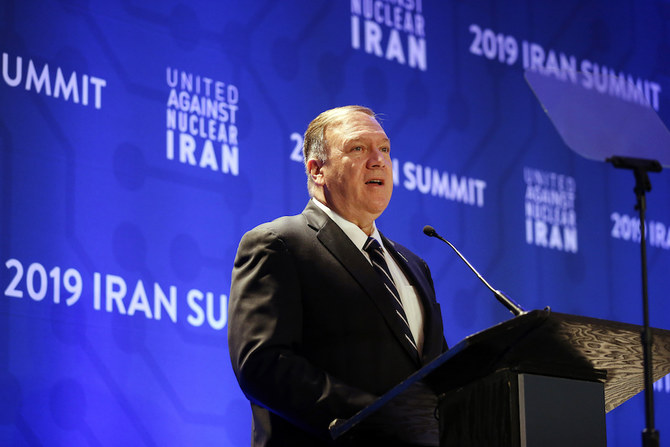
Speaking to a pressure group opposed to the Iranian regime on the sidelines of the United Nations, Pompeo said the actions were in response to violations of unilateral US sanctions.
The US Treasury Department announced that it placing sanctions on five Chinese nationals and six entities, including two Cosco Shipping Corporation subsidiaries.
“We’re telling China, and all nations — know that we will sanction every violation of sanctions of all activity,” Pompeo told United Against a Nuclear Iran.
He said that sanctions were being placed both on the companies and on their chief executives.
Pompeo said that the United States was also aiming to split the elite Revolutionary Guards from the rest of the Iranian company.
The unit, known formally as the Islamic Revolutionary Guard Corps (IRGC), is in charge of protecting the regime and has vast business holdings.
Attacks on Sept. 14 on the oil facilities of Saudi Arabia, widely blamed on Iran, have rattled the Middle East and raised concerns about a broader war. Iran denies involvement.
“The more Iran lashes out the greater our pressure will and should be,” Pompeo said. “That path forward begins now with two new actions.”
“The United States will intensify our efforts to educate countries and companies on the risk of doing business with IRGC entities, and we will punish them if they persist in defiance of our warnings,” Pompeo said.
The actions come as France leads last-minute efforts to arrange a meeting at the United Nations between US President Donald Trump and his Iranian counterpart Hassan Rouhani to defuse tensions.
In a speech to the annual gathering of world leaders on Tuesday, US President Donald Trump promised to keep trying to squeeze Iran’s economy with sanctions until Tehran agrees to give up what Washington says is a pursuit of nuclear weapons.
Iran has said its nuclear program has always been for peaceful purposes only.
Last year Trump withdrew from a 2015 international accord with Iran which had put limits on Tehran’s nuclear program in exchange for sanctions relief.
(With AFP and Reuters)