ISLAMABAD: The UAE envoy to Pakistan was the first to cast his vote on Sunday at the UAE embassy, as balloting began for the country’s citizens residing or working abroad to elect a political candidate to represent them in the Federal National Council (FNC), a parliamentary body for the seven emirates that make up the UAE.
According to UAE officials, more than 200 of the country’s citizens live in Pakistan including over 60 residing in the capital, Islamabad.
“This is the fourth election for the Federal (National) Council in UAE, and we are really proud of this democracy process in UAE,” Hamad Obaid Ibrahim Salem Al-Zaabi, UAE Ambassador to Pakistan said while speaking to Arab News during the balloting session at the embassy in Islamabad.
The UAE has more than 118 diplomatic missions around the world which have set up polling booths for citizens to cast their votes, Al-Zaabi said.
“The (polling for the FNC) election in Pakistan will be held in Islamabad and at the consulate in Karachi on September 22 and 23. The big election in UAE will be held between October 2 to 4, followed by results... announced on October 5,” the UAE Ambassador said.
FNC, as per the provision of the UAE Constitution, was established in 1971 and comprises of 40 members representing the Arab peninsula’s seven Emirates; with Abu Dhabi and Dubai having the most number of seats followed by Sharjah and Ras Al Khaimah, and less populated Fujairah, Ajman, and Umm al Quwain with the least.
In the past, all members were appointed by the emirates’ respective rulers, but in 2006 the method was revised to introduce a partial form of democracy that allows the people of UAE to elect 20 FNC members through an electoral process.
“We started in 2006 and now we are in 2019 and this year it is totally different because half of this council will be women. UAE and its leadership support women empowerment and encourages females to be part of the country’s legislative decisions,” Al-Zaabi said.
The Ambassador, widely known for his philanthropic activities in Pakistan and his continued efforts to strengthen fraternal ties between the two countries said: “We have reached our goals to support democracy and encourage the people in UAE to be part of this democratic process.”


UAE citizens in Pakistan cast votes as balloting begins for Federal National Council

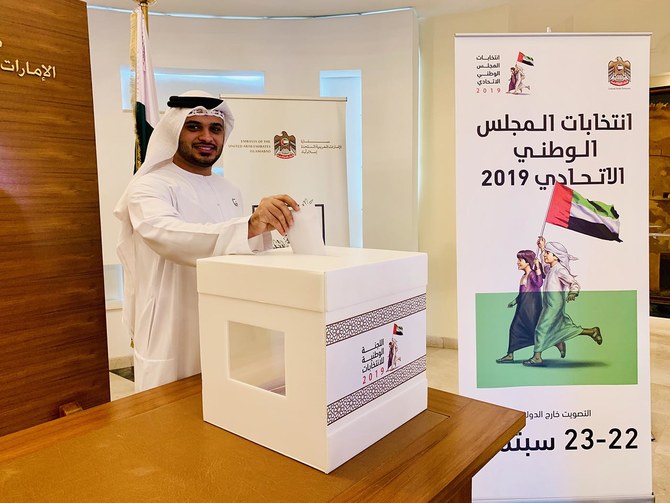
UAE citizens in Pakistan cast votes as balloting begins for Federal National Council

- More than 200 UAE citizens in Pakistan are expected to cast their vote
- Half of the council this year is expected to be women: UAE envoy

Pakistan face arch-rivals India today in blockbuster T20 World Cup clash in Colombo
- Cricket contest takes place amid surging political tensions between India and Pakistan after their May 2025 clash
- Indian skipper Suryakumar Yadav says team will decide whether or not to shake hands with Pakistani cricketers
ISLAMABAD: Pakistan take on defending champions and arch-rivals India today, Sunday, in Colombo in a highly anticipated T20 World Cup 2026 clash between the two sides.
The Group A fixture between the two sides will not just be important for the on-field cricket action but also because of the political tensions between the neighbors. India and Pakistan engaged in a brief military confrontation in May 2025 which came to a halt after Washington brokered a ceasefire.
However, political tensions spilled over onto the cricket field when Indian skipper Suryakumar Yadav opted out of shaking hands with his Pakistani counterpart before the toss at their Asia Cup encounter last year in September. The Indian team refused to shake hands with their Pakistani counterparts in all three matches of the tournament, triggering a strong protest from Pakistan.
Tensions surged again after Pakistan’s government announced earlier this month it would not allow its team to play against India in the World Cup in solidarity with Bangladesh. The South Asian country was replaced with Scotland after it refused to play its matches in India due to security reasons. Pakistan criticized the move and announced boycotting the Feb. 15 match against India. However, Islamabad later took back its decision to boycott the match after negotiations with the International Cricket Council.
“The game should be played in real spirit, the way it has been played since it started,” Pakistan captain Salman Ali Agha said at the pre-match press conference on Saturday. “The rest is up to them (India), what they want to do.”
Indian skipper Suryakumar Yadav did not commit whether his team will shake hands with Pakistan or not on Sunday.
“Why are you highlighting that?” Yadav asked reporters. “We are here to play cricket. We will play good cricket. We will take all those calls tomorrow. We will see tomorrow.”
Political and military tensions have meant the two teams have not played a bilateral series for years.
India has not traveled to Pakistan since 2008 and Pakistan visited India for the 50-over World Cup in 2023 but has since played ICC tournaments at neutral venues.
India has defeated Pakistan 12 times in the 16 T20 games they have played. They also have an impressive 6-1 record in the eight T20 World Cup matches since the first edition in 2007, with one being tied.
“We don’t have a good record against them in World Cups,” Agha admitted. “But whenever you come to play a new match, it’s a new day and you have to play good cricket to win.
“You can’t change history. You can learn from it. We learned from it and we’ll try to do a good performance tomorrow and win the match.”
Both sides have won their two fixtures so far, with India beating the USA and Namibia while Pakistan have defeated the Netherlands and the USA as well.
The top two teams from each group will qualify for the Super Eight stage of the World Cup.
The match is scheduled to begin at 6:30 p.m. Pakistan Standard Time.