ISLAMABAD: A Malaysian motorcycle club, Santana Riderz, has decided to raise awareness and funds for pediatric cancer by planning a biking expedition to Pakistan in which its members will ride through a number of countries, said the association’s top official on Friday.
The 17 riders belong to the Sikh community and hope to conclude their journey in Pakistan’s eastern town of Nankana Sahib, the birthplace of the founder of their religion, Guru Nanak, whose 550th birth anniversary will be celebrated in November this year.
Pakistan’s Punjab province holds tremendous historic significance for Sikhism. Not only does it have the community’s holiest religious shrine but was also part of its empire in the early half of the 19th century and was governed by one of its most illustrious rulers, Maharaja Ranjit Singh.
The Sikh riders have embarked on their venture in collaboration with the National Cancer Society of Malaysia (NSCM) and will cruise the roads of Thailand, Myanmar and India before finishing their trip in Pakistan.
According to details, six of them will kick off the run from Malaysia while others will ride into formation as the journey continues. The group will cover 16,000 kilometers in almost 40 days, and each rider will spend about Rs350,000 to meet their fuel, food and accommodation expenses.
46-year-old Jaspal Singh, who serves as president of the motorcycle club, maintains it is the largest bike ride of its kind since it aims to raise funds for children fighting cancer.
“Santana Riderz Malaysia Club is an organization that reaches out to help anyone in their means,” he told Arab News. “We are united by a common goal: To save and improve lives, especially young ones.”
“In Malaysia, the NCSM has always kept its door open to people who want to do voluntary work,” he added. “Children shouldn’t feel sick or lose their hair. They shouldn’t have to face long term effects like hearing loss or the ability to ever walk. These are some of the driving factors that compelled us to connect with the NCSM.”
Under the theme “Sarbat Da Bhala” – or “blessings for everyone” – funds raised through the ride will go to children and their families, regardless of race or creed. According to Singh, this was also one reason why the NCSM chose the club’s charitable ride.
Established in 1979, Santana Riderz has 46 members. The non-profit has been an active philanthropic force in Malaysia since it has previously organized a number of initiatives to help communities across that country by raising money on wheels.
On coming to Pakistan, Singh said a few of his group members had traveled to the country before, but “a journey to a place of such significance” was always worth repeating.
“Just like anyone who has faith in God, going to a place of sanctuary is most satisfying to the soul and mind. This sanctuary is a sacred place for us, set apart from the profane, ordinary world,” he added. “This kind of phenomenon is beyond emotional and indescribable. We have gratitude and feel most connected to God.”

Malaysian Sikh bikers ride to Pakistan for cancer awareness
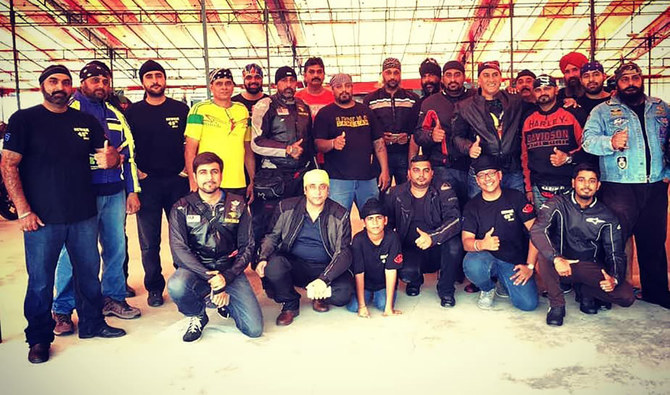
- The ride coincides with the 550th birth anniversary of the founder of Sikhism and ends in his birthplace, Nankana Sahib, in Pakistan
- Santana Riderz want to raise awareness about pediatric cancer, generate funds to combat the disease
In Peshawar, 76-year-old artist struggles to keep near-extinct Mughal wax art alive
- Craft involves intricate process using heated wax, oil, pigments, limestone to create textured, miniature artworks
- Riaz Ahmad, who has trained his son in wax art, says he hopes to train more people to preserve traditional craft
PESHAWAR: Riaz Ahmad, 76, stirs wax in a small plastic can with a long chopstick, takes it out on the palm of his left hand and adds natural color before drawing designs on a piece of cloth.
Surrounded by several such pieces of black cloth with unique art, Ahmad strives every passing day to keep the 500-year-old, Mughal-era wax art alive at his home near the Lahori Gate in the northwestern Pakistani city of Peshawar.
Ahmad comes from a well-known family of wax artists who were based in Shillong and Darjeeling in present-day India and had migrated to Peshawar during the 1947 partition of the sub-continent.
His work remains rooted in tradition, faithfully repeating patterns passed down through generations and winning Ahmad several awards both at home and abroad in recognition of his dedication.
“I have been making the same Mughal era designs that my forefathers used to make,” he told Arab News last week.
“I went to India in 2004, where I received the UNESCO Seal of Excellence [for Handicrafts] award... On 23 March, 2012, the Government of Pakistan awarded me the Tamgha-i-Imtiaz.”
The near-extinct traditional craft, which is believed to have originated in Central Asia and refined under the Mughal patronage, particularly in Peshawar, involves an intricate process using heated wax, linseed oil, powdered pigments, and limestone to create detailed, textured and often colorful miniature artworks by hand.
Ahmad learnt wax art from his father, Miran Bakhsh, nearly six decades ago.
“My parents used to do this work in Shillong and Darjeeling [in present-day India]. They had a shop there, and after the Partition, they migrated to Peshawar, Pakistan,” he said. “When they came here, they started doing the same work.”
A basic piece of his work costs around Rs3,000 ($10.7). A larger piece made on order can fetch between Rs5,000 and Rs15,000 ($17-$53), but such orders are rare.
“Wax and colors have become expensive. When I sell a piece for Rs3,000, around Rs1,000 goes into expenses, and Rs2,000 is my daily wage,” Ahmad said.
But the 76-year-old worries more about the future of the art form, which he insists cannot be learned quickly and requires “love and dedication.”
“Some people say they want to come, some from Karachi and some from Lahore, but it becomes difficult for me to go there or for them to come here,” he said.
Most wax artists in Peshawar have abandoned the art due to a lack of institutional support, according to Ahmad, who relies primarily on exhibitions to earn a living.
“The reason [for the decline of this art form] is that the government does not pay attention. They are caught in their own conflicts, and the culture is suffering,” Ahmad said.
“Other artists have left this art. Some are selling rice and some are driving rickshaws,” he added. “I have been doing this work inside my house. If there is any event, we go there and sell our art.”
Saad Bin Awais, a spokesperson for the Khyber Pakhtunkhwa Culture and Tourism Authority (KPCTA), said the government has engaged artisans in several projects. He said some of these projects have come to an end while others are ongoing.
“Riaz Ahmad is the only wax artist in Khyber Pakhtunkhwa and the authority is serious about facilitating him,” he said, adding that the KPCTA facilitates Ahmad’s participation in exhibitions across the country to showcase his art.
“We have also been collecting data of artists in Khyber Pakhtunkhwa for an upcoming project to facilitate them in any way possible.”
Ahmad has trained his son, Fayyaz, in wax art who now practices it in Islamabad. The septuagenarian says he wishes to train more people to preserve the dying art form.
“I cannot leave this work,” he said. “I will continue this art even though my hands shake.”