GENEVA: A Sudanese man was shot and killed Thursday as he and other migrants returned to shore by the Libyan Coast Guard tried to resist being sent back to detention, the UN said.
The International Organization for Migration strongly condemned the incident and demanded that Libyan authorities investigate and bring those responsible to justice.
“This was tragedy waiting to happen,” IOM spokesman Leonard Doyle said in a statement.
“The use of live bullets against unarmed vulnerable civilians, men, women and children alike, is unacceptable under any circumstances and raises alarms over the safety of migrants and humanitarian staff,” he added.
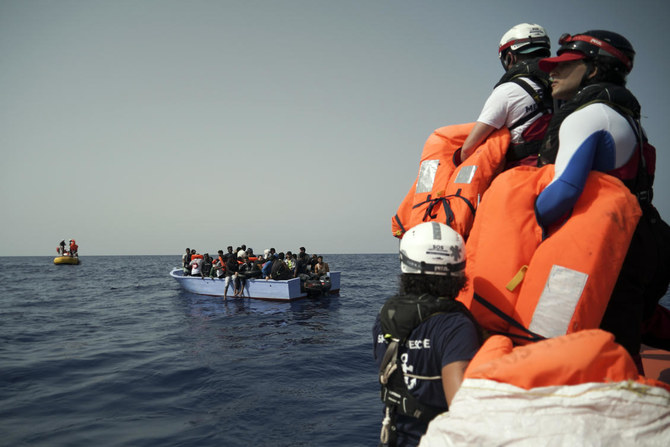
The UN agency said its staff had been on site at the Abusitta Disembarkation point in Tripoli when as many as 103 migrants returned to shore resisted being sent back to Libyan detention centers.
When several migrants tried to run away from the guards, “armed men began shooting into the air,” and one migrant was hit by a bullet in the stomach, according to the IOM staff accounts.
“Despite immediately receiving medical aid on the spot by an IOM doctor and then being transferred to a nearby clinic, he died two hours after admission,” the agency said.
The man’s death, it said, stood as “a stark reminder of the grim conditions faced by migrants picked up by the Coast Guard after paying smugglers to take them to Europe.”
The UN and aid groups have warned that rescued migrants returned to Libya face rampant human rights abuses in both official and illegal centers in the war-ravaged country.
According to the UN, some 5,000 migrant women, children and men remain detained in inhumane conditions in Libya — more than 3,000 of them in areas of active conflict.
In June, an airstrike on the Tajoura detention center killed 53 migrants, including six children.
“That facility remains operational to this day, despite persistent calls to end the arbitrary detention of migrants,” IOM said.
“Alternatives to detention must be found,” it said, stressing that the “increasing reports of abuse and human trafficking from detention centers are truly alarming.”
IOM demanded “immediate action ... to put an end to the suffering of civilians in Libya, especially detained migrants.”

Migrant killed during Libya disembarkation: UN
- ‘This was tragedy waiting to happen’: International Organization for Migrationspokesman Leonard Doyle
- IOM demands ‘immediate action ... to put an end to the suffering of civilians in Libya, especially detained migrants’
Israel says it launched pre-emptive attacks against Iran
- An Israeli defense official said the operation had been planned for months in coordination with Washington
Israel said it launched a pre-emptive attack against Iran on Saturday, pushing the Middle East into a renewed military confrontation and further dimming hopes for a diplomatic solution to Tehran’s long-running nuclear dispute with the West.
The New York Times, citing a US official, reported that US strikes on Iran were underway. A source said that Iran’s supreme leader, Ayatollah Ali Khamenei, was not in Tehran and had been transferred to a secure location.
An apparent strike in Iran’s capital Saturday happened near the offices of Khamenei. State television acknowledged an explosion in the area of the offices.
Israeli media reported attempts to assassinate Iranian President Masoud Pezeshkian during the attacks, and have not ruled out Khamenei being targeted.
Several missiles have struck University Street and the Jomhouri area in Tehran, while explosion likely occurred in the northern Seyyed Khandan area of Tehran, state media reported. Thick smoke was also rising from the vicinity of Pasteur Street in downtown Tehran, ISNA said.
The attack, coming after Israel and Iran engaged in a 12-day air war in June, follows repeated US-Israeli warnings that they would strike again if Iran pressed ahead with its nuclear and ballistic missile programs.
“The State of Israel launched a pre-emptive attack against Iran to remove threats to the State of Israel,” Defense Minister Israel Katz said.
An Israeli defense official said the operation had been planned for months in coordination with Washington, and that the launch date was decided weeks ago.
The US military declined to immediately comment on the attack.
Explosions were heard in Tehran on Saturday, Iranian media reported, and sirens sounded across Israel around 08:15 local time in what the military said was a proactive alert to prepare the public for the possibility of an incoming missile strike.
The Israeli military announced the closure of schools and workplaces, with exceptions for essential sectors, and a ban on public airspace. Israel closed its airspace to civilian flights, and the airports authority asked the public not to go to any of the country’s airports.
The country’s airspace will reopen and flights to and from Israel to resume ‘as soon as the security situation allows,’ the airport authority said.
Iran’s airspace has been closed, Tasnim news agency reported.
The US and Iran renewed negotiations in February in a bid to resolve the decades-long dispute through diplomacy and avert the threat of a military confrontation that could destabilize the region.
Israel, however, insisted that any US deal with Iran must include the dismantling of Tehran’s nuclear infrastructure, not just stopping the enrichment process, and lobbied Washington to include restrictions on Iran’s missile program in the talks.
Iran said it was prepared to discuss curbs on its nuclear program in exchange for lifting sanctions but ruled out linking the issue to missiles.
Tehran also said it would defend itself against any attack.
It warned neighboring countries hosting US troops that it would retaliate against American bases if Washington struck Iran.
In June, the US joined an Israeli military campaign against Iranian nuclear installations, in the most direct American military action ever against the Islamic Republic.
Tehran retaliated then by launching missiles toward the US Al Udeid air base in Qatar, the largest in the Middle East.
Western powers have warned that Iran’s ballistic missile project threatens regional stability and could deliver nuclear weapons if developed. Tehran denies seeking atomic bombs.


