

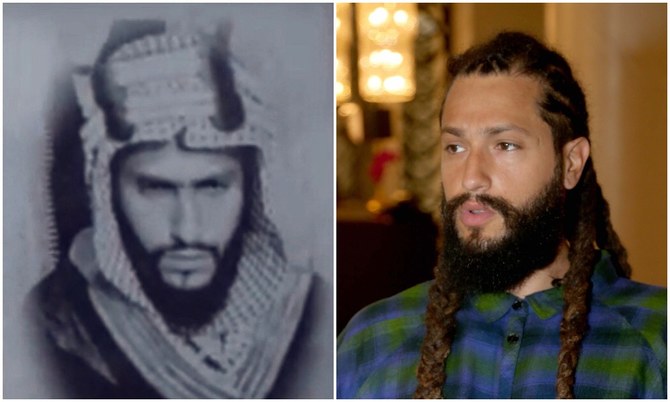
King Abdul Aziz lookalike to star in new Saudi Movie ‘Born a King’

1 / 4
Rakan Abdulwahid is the 32-year-old Saudi actor who plays King Abdul Aziz in “Born a King.” (Supplied and AN Photo by Saad Al-Dosary)
2 / 4
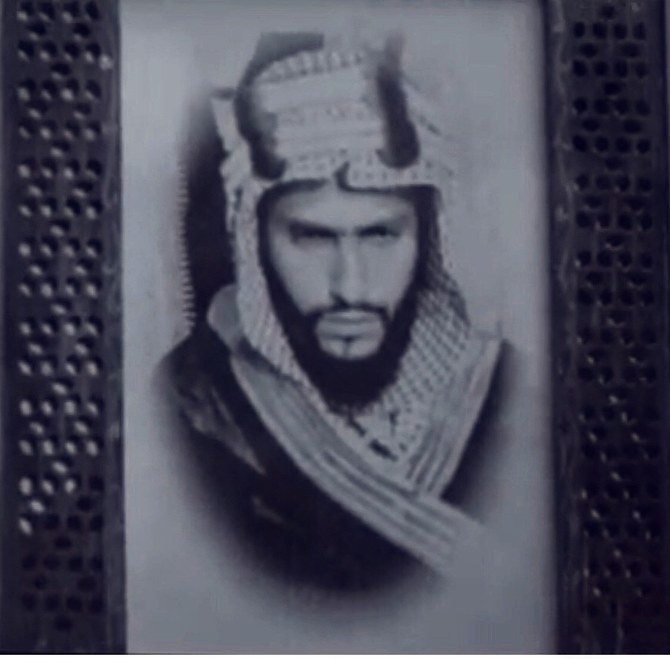
Abdulwahid said his great grandfather fought alongside King Abdul Aziz. (Supplied)
3 / 4
Abdulwahid said his great grandfather fought alongside King Abdul Aziz. (Supplied)
4 / 4
The Saudi actor Rakan Abdulwahid felt a connection to the founder of the Kingdom (AN Photo by Saad Al-Dosary)
Updated 21 September 2019
Follow

King Abdul Aziz lookalike to star in new Saudi Movie ‘Born a King’

  • Rakan Abdulwahid is the 32-year-old Saudi actor who plays King Abdul Aziz
  • The rapper, singer, designer, model and now actor considers himself a 'Saudi ambassador of arts to the US' 

RIYADH: With his long dreadlocked hair, handsome Arabian looks and a quiet disposition, Rakan Abdulwahid is the 32-year-old Saudi actor who plays King Abdul Aziz in “Born a King.”

His family history runs deep with the Al-Saud family. “My great grandfather fought alongside King Abdul Aziz,” Rakan told Arab News.  


His family’s lineage goes back to the days of King Abdulaziz as they are considered the official “Al-Arda” dance performers. They have been performing the pre-war and celebratory dance for over a century, before the founding of Kingdom of Saudi Arabia.

His uncle, Salah Abdulwahid, is featured in the movie, as the main Al-Arda performer.

The Saudi actor felt a connection to the founder of the Kingdom, not only physically resembling the king, but also embodying his charisma.

Before the shooting of the movie, he began reading up on anything he could get his hands on to learn more about the founder’s personality, to try and pefect his character and do him justice on the big screen.

Born in the US and raised in the Kingdom, and an avid athlete in his youth, he was a soccer player until he broke his hip in a tournament.


The multitalented actor not only shines through on the big screen, but is a rapper, singer, model and designer. As a lover of the arts in all forms, he believes that culture can build bridges across the world.

He has vowed to represent his country in a positive manner while breaking stereotypes about Saudi Arabia. He also speaks French, English and Spanish fluently.

The actor obtained four degrees in just 7 years, having majored in industrial engineering with a minor in business and math from Northeastern University.

He later continued his education and received his master’s in engineering project management and an MBA certificate in global supply chain management. However, that didn’t stop him from taking law classes at Harvard for a semester.

As a child he would write 300-page stories, cooked passionately and danced with abandonment.

He returned to his homeland to play one of the most influential people in the Kingdom’s history: Its founder King Abdul Aziz.


Hafez Galley’s exhibition pays tribute to two Egyptian artists who shaped a visual era

Both artists emerged in an era when newspapers and magazines played a central role in shaping Egypt’s visual culture. (Supplied)
Updated 6 sec ago
Follow

Hafez Galley’s exhibition pays tribute to two Egyptian artists who shaped a visual era

  • Artworks by Attyat Sayed and El Dessouki Fahmi will be on display until Feb. 28

JEDDAH: Hafez Gallery in Jeddah has opened an exhibition showcasing the works of influential Egyptian artists Attyat Sayed and El Dessouki Fahmi. The exhibition runs until Feb. 28.

Kenza Zouari, international art fairs manager at the gallery, said the exhibition offers important context for Saudi audiences who are becoming increasingly engaged with Arab art histories.

Artworks by Attyat Sayed and El Dessouki Fahmi will be on display at Hafez Gallery until Feb. 28. (Supplied)

“Attyat Sayed and El Dessouki Fahmi’s decades-long practice in Cairo established foundational models for how artists across the region approach archives, press, and ultimately collective memory,” Zouari told Arab News. 

Both artists emerged in an era when newspapers and magazines played a central role in shaping Egypt’s visual culture. Their early work in press illustration “demanded speed, clarity, the ability to distill complex realities into a single, charged image,” the gallery’s website states.

Seeing the works of both artists side-by-side is breathtaking. It’s fascinating to witness how press illustration shaped such profound and lasting artistic voices.

Lina Al-Mutairi, Local art enthusias

Heba El-Moaz, director of artist liaison at Hafez Gallery, said that this is the second time that the exhibition — a posthumous tribute to the artists —has been shown, following its debut in Cairo.

“By placing their works side by side, it highlights how press illustration, often considered ephemeral, became a formative ground for artistic depth, narrative power, and lasting influence, while revealing two distinct yet deeply interconnected artistic paths within modern Egyptian visual culture,” she told Arab News. 

Artworks by Attyat Sayed and El Dessouki Fahmi will be on display at Hafez Gallery until Feb. 28. (Supplied)

Sayed’s work evolved from black-and-white illustration into “layered, dynamic compositions that translate lived emotion into physical gesture, echoing an ongoing negotiation between the inner world and its outward form,” the website states. Viewed together, the works of Sayed and Fahmi “reveal two distinct yet deeply interconnected artistic paths that contributed significantly to modern Egyptian visual culture.”

The exhibition “invites visitors into a compelling dialogue between instinct and intellect, emotion and structure, spontaneity and reflection; highlighting how artistic rigor, cultural memory, and sustained creative exploration were transformed into enduring visual languages that continue to resonate beyond their time,” the gallery states.

Lina Al-Mutairi, a Jeddah-based art enthusiast, said: “Seeing the works of both artists side-by-side is breathtaking. It’s fascinating to witness how press illustration shaped such profound and lasting artistic voices. The exhibition really brings their vision and influence to life.”