KARACHI: Pakistan’s Minister for Maritime Affairs Syed Ali Haider Zaidi told Arab News on Thursday that the government was working on a ferry service that would connect Middle Eastern seaports with Karachi and Gwadar.
The country has long cherished the dream of initiating the service that will link Pakistani ports with Dubai, Oman and Bandar Abbas to facilitate people who want to travel among these destinations by providing them alternate routes.
Pakistan has also encouraged its private sector to invest in this mode of transportation.
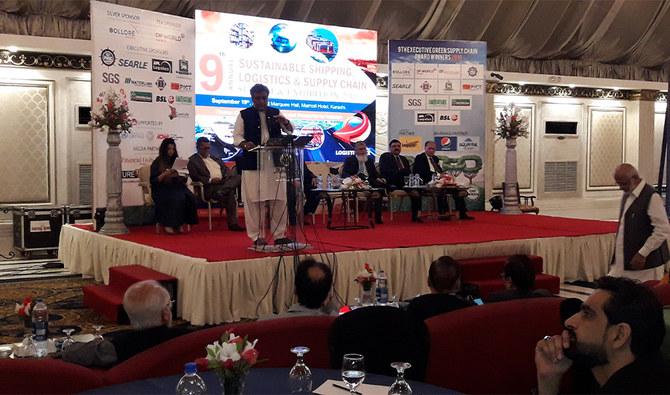
“I am trying to start ferry services from Karachi to Gwadar and to Bandar Abbas and Dubai. The work on the ferry service is in process,” Zaidi said while responding to an Arab News query on the sidelines of the 9th Sustainable Shipping, Logistics and Supply Chain Summit and Exhibition.
“We have opened the shipping sector for all, and many foreign investors, including those from the Middle East, have expressed their interest,” Zaidi added.
Pakistan revised and announced its shipping policy on Wednesday, giving incentive to private sector organizations to avail complete tax holidays until 2030 by joining the sector.
“Pakistani flag carriers [owned and registered in Pakistan] will be exempted from customs duty, income, and sales tax until 2030,” Zaidi said while speaking at the summit. “They will enjoy the first berthing rights which otherwise may cost them thousands of dollar as demurrage charges.”
Faced with an enduring balance-of-payments crisis, the government is taking measures to reduce dollar-dominated payments on freight being charged by foreign shipping companies they exert pressure on the country fragile forex reserves.
“Under the renewed shipping policy there is one condition that you will charge freight in Pak rupees since that will help reduce the burden on the country’s foreign exchange reserves. It will be a major achievement if we even reduce $1 billion from $5 billion on account of freight bill we paid last year,” Zaid said.
The minister informed that under the new policy, local companies would even get better incentives than the Pakistan National Shipping Corporation (PNSC), the country’s only shipping company.
“The PNSC would continue to be charged one dollar per gross register tonnage (GRT) and new companies would have to pay $0.75,” he noted.
Zaidi also appreciated the role of the national flag carrier in transporting crude from the Middle East, mainly from Saudi Arabia, since other foreign carriers were reluctant due to the ongoing security concerns in the region.
He clarified that hydrocarbon cargoes imported by government organizations and state-controlled enterprises would still be transported by PNSC vessels.


![]()

Work on Ferry service to link Pakistan with UAE in process, Maritime Minister
Work on Ferry service to link Pakistan with UAE in process, Maritime Minister
- PNSC continues to transport crude from middle east, mainly Saudi Arabia, amid reluctance among foreign carriers
- Tax incentives offered to local shipping companies until 2030, Minister says
Latest updates


© 2026 SAUDI RESEARCH & PUBLISHING COMPANY, All Rights Reserved And subject to Terms of Use Agreement.