

Saudi aid agency signs 16 deals to combat blindness worldwide

1 / 2
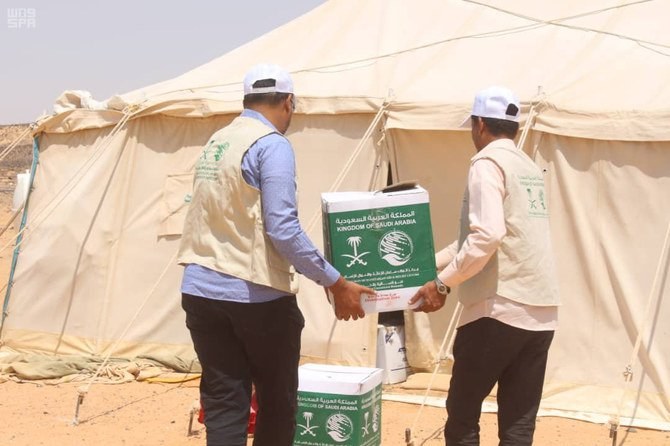
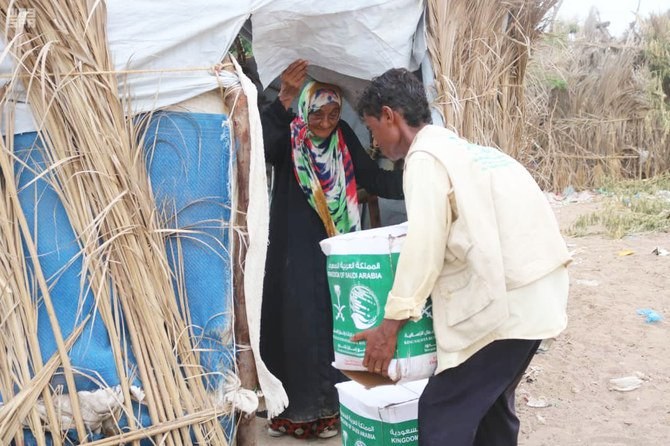
In Aside from providing food, clothing and other basic goods to refugees, KSRelief also sends specialists to perform medical surgeries for various illnesses in communities that usually have no access to doctors. (SPA)
2 / 2
Aside from providing food, clothing and other basic goods to refugees, KSRelief also sends specialists to perform medical surgeries for various illnesses in communities that usually have no access to doctors. (SPA)
Updated 19 September 2019
Follow

Saudi aid agency signs 16 deals to combat blindness worldwide

DAMMAM: Saudi Arabia has signed a raft of deals with an international health charity aimed at combating blindness in seven countries around the world, the Saudi Press Agency reported.

The King Salman Humanitarian Aid and Relief Center (KSRelief) inked 16 agreements with Al-Basar International Foundation to implement medical programs in Bangladesh, Yemen, Cameroon, Nigeria, Morocco, Eritrea and Pakistan.

Dr. Aqeel bin Jamaan Al-Ghamdi, KSRelief’s assistant general supervisor of planning and development affairs, signed the accord with the foundation’s secretary-general, Dr. Adel bin Abdul Aziz Al-Rashoud.

Al-Ghamdi said the campaigns to prevent blindness and diseases would involve medical checks on 100,000 cases, 10,000 vision-related operations, and the distribution of 20,000 medical glasses by the end of this year.

Saudi Arabia has spent $87 billion (SR326 billion) on humanitarian aid to 81 countries over two decades. According to a KSRelief report, more than 1,011 humanitarian aid programs worth $3.5 billion have benefitted 44 countries, primarily Yemen, Palestine, Syria, Somalia, Pakistan, Indonesia and Iraq, since 2014.

Recently, UN aid chief Mark Lowcock announced that Saudi Arabia would be contributing $500 million to the world body next week to help fund its humanitarian response in Yemen. Lowcock said the Kingdom planned to pay on Sept. 25 and that the UAE had also recently made a payment of $200 million.

HIGHLIGHT

The campaigns to prevent blindness and diseases would involve medical checks on 100,000 cases, 10,000 vision-related operations, and the distribution of 20,000 medical glasses by the end of this year.

Meanwhile, the center is carrying out several humanitarian projects in Syria and Yemen, which includes provision of food, health care, vocational training and education.

KSRelief allocated 132 cartons containing food baskets to the needy in Socotra, the Yemen archipelago, benefiting 116 families, in addition to 80 food baskets for 400 people in Saada governorate’s Al-Atif.

A total of 1,432 food baskets were also handed out in the Al-Wafa, Al-Baidar, Al-Rajab, Al-Zaalanah, Al-Taliya, Al-Fardan, Sabiroun, and Benin camps in Syria and many other informal settlements in Saraqib, Sarmin, Maarat Misrin and Salqin, benefiting 8,730 people.

In addition, the center distributed 367 cartons of food baskets in Marib governorate, Yemen, in coordination with the Benevolence Coalition for Humanitarian Relief, helping 900 displaced people.

This comes within the framework of the food projects provided by the Kingdom and represented by the centers for the Yemeni and Syrian peoples during the current humanitarian crisis.


Pakistan says defense pact with Saudi Arabia elevated brotherly ties to ‘new heights’

Updated 6 sec ago
Follow

Pakistan says defense pact with Saudi Arabia elevated brotherly ties to ‘new heights’

  • Pakistan, Saudi Arabia signed strategic defense pact last year pledging aggression against one will be treated as attack on both
  • Deputy PM Ishaq Dar says enduring bonds with Islamic and Arab nations form vital pillar of Pakistan’s foreign policy 

ISLAMABAD: Deputy Prime Minister Ishaq Dar said on Wednesday that Pakistan’s defense pact with Saudi Arabia elevated its brotherly ties with the Kingdom to “new heights,” stressing that close ties with Arab and Islamic nations form a key pillar of Islamabad’s foreign policy. 

Pakistan and Saudi Arabia signed a Strategic Mutual Defense Agreement on Sept. 17 last year, pledging that aggression against one country would be treated as an attack on both, enhancing joint deterrence and formalizing decades of military and security cooperation.

Both nations agreed in October 2025 to launch an economic cooperation framework to strengthen trade and investment ties. 

“In the Middle East, our landmark Strategic Mutual Defense Agreement with Saudi Arabia has elevated our brotherly ties to new heights,” Dar said while speaking at the Pakistan Governance Forum 2026 event in Islamabad. 

The Pakistani deputy prime minister was speaking on the topic “Navigating International Relations Amidst Changing Geo-Politics.”

Dar noted that Pakistan has reinforced partnerships with other Middle Eastern nations such as the UAE, Qatar, Jordan, Oman, Egypt and Bahrain. He said these partnerships have yielded “concrete agreements” in investment, agriculture, infrastructure, and energy sectors. 

“Our enduring bonds with Islamic and Arab nations form a vital pillar of our foreign policy, and we will continue to expand our partnerships across Asia, Latin America, and Africa,” he said. 

Dar pointed out that the presidents of Kazakhstan, Uzbekistan and Kyrgyzstan have undertaken visits to Pakistan in recent months, reflecting Central Asian nations’ desire to boost cooperation with Islamabad.

On South Asia, the Pakistani deputy PM said Pakistan has successfully transformed its fraternal ties with Bangladesh into “a substantive partnership.”

“Similarly, the trilateral mechanism involving China, Pakistan, and Bangladesh has been launched with a view to expanding and deepening regional cooperation and synergy,” the Pakistani minister said. 

He said Islamabad has strengthened its “all-weather” partnership with China via the second phase of the multi-billion-dollar China-Pakistan Economic Corridor agreement and “unwavering support” from both sides for each other’s core interests. 

Dar said Pakistan had also reinvigorated its partnership with the US, advancing cooperation in trade, technology, investment, and regional stability. 

“This calibrated approach has enhanced our ability to navigate complexity with skill and confidence, ensuring that our national interests are served without compromising our core foreign policy principles,” he said.
