Japanese officials cautious on prospects for US trade deal

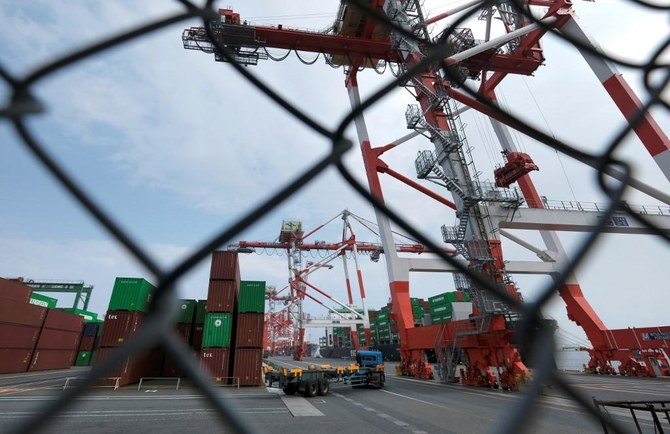
A long-sought trade pact with Japan was scrapped when Donald Trump withdrew the US from a pan-Pacific trade agreement shortly after taking office in 2017. (AFP)
Updated 17 September 2019
Follow

Japanese officials cautious on prospects for US trade deal

  • A long-sought trade pact with Japan was scrapped when Donald Trump withdrew the US from a pan-Pacific trade agreement shortly after taking office in 2017
  • Trump said he preferred that Washington and Tokyo strike a bilateral deal

TOKYO: Officials in Japan appeared wary over the prospects for a trade deal with the US after President Donald Trump said he was prepared to sign a pact soon.
Japan’s chief government spokesman, Yoshihide Suga, said Tuesday that the two sides are still finalizing details after reaching a basic agreement in late August on trade in farm products, digital trade and other industries.
Suga said Trump and Prime Minister Shinzo Abe are considering signing a deal in late September when they attend the UN General Assembly in New York.
“We are accelerating the work that still remains,” he said. “But I decline to comment further because we have not reached a formal agreement.”
Trump’s notice to Congress, released by the White House on Monday, did not mention tariffs on autos and parts, long a sticking point between the two countries.
It said his administration was looking forward to collaborating with lawmakers on a deal that would result in “more fair and reciprocal trade” between the two countries.
Toshimitsu Motegi, who became foreign minister last week after negotiating the deal as economy minister, said Japan must watch carefully to prevent Washington from forcing any last-minute changes, Kyodo News agency reported.
The agricultural minister, Taku Eto, cautioned against letting down Tokyo’s guard until the final agreement is reached, it said.
A long-sought trade agreement with Japan was scrapped when Trump withdrew the US from a pan-Pacific trade agreement shortly after taking office in 2017.
Japan and the other 10 remaining members of the trade pact, the Trans-Pacific Partnership, then renegotiated their own deal without the US
Trump said he preferred that Washington and Tokyo strike a bilateral deal.
That resurrected the longtime issue of tariffs on Japanese car and auto parts exports to the US and of stiffer duties on US exports of farm and other products to Japan.


Saudi banking sector outlook stable on higher non-oil growth: Moody’s 

Updated 4 sec ago
Follow

Saudi banking sector outlook stable on higher non-oil growth: Moody’s 

RIYADH: Saudi Arabia’s banking sector outlook remains stable as stronger non-oil economic growth and solid capital buffers support lending and profitability, Moody’s Ratings said, forecasting continued expansion despite liquidity constraints. 

In its latest report, credit rating agency Moody’s said the Kingdom’s non-oil gross domestic product is projected to expand by 4.2 percent this year, up from 3.7 percent recorded in 2025. 

In January, S&P Global echoed a similar view, saying banks operating in Saudi Arabia are expected to sustain strong lending growth in 2026, driven by financing demand tied to Vision 2030 projects. 

Fitch Ratings also underscored the healthy state of Saudi Arabia’s banking system last month, stating that credit growth and high net interest margins are supporting bank profitability in the Kingdom. 

Commenting on the latest report, Ashraf Madani, vice president and senior credit officer at Moody’s Ratings, said: “We expect credit demand to remain robust, but tight liquidity conditions will continue to limit the sector’s lending capacity.” 

Madani added that operating conditions in Saudi Arabia will continue to support banks’ strong asset quality and profitability. 

“The operating environment for banks remains buoyant, underpinned by a forecast increase in non-oil GDP growth, robust solvency and continued progress toward the government’s economic diversification goals,” he added.  

Moody’s said authorities in the Kingdom are introducing business-friendly reforms to bolster investment and private sector activity, while implementing key development projects and preparing for major global events. 

Saudi Arabia continues to advance reforms including full foreign ownership rights, simplified capital market registration procedures and improved investor protections, which could accelerate credit growth to 8 percent this year. 

Problem loans are expected to remain near historical lows at around 1.3 percent of total loans, supported by ongoing credit growth, favorable operating conditions and lower interest rates, which collectively strengthen borrowers’ repayment capacity. 

Retail credit risk remains controlled in Saudi Arabia because most borrowers are government employees with stable income streams. 

“Concentration of single borrowers and specific sectors remains high although the growing proportion of consumer loans — now nearing 50 percent of overall sector lending — continues to reduce aggregate concentration risk,” added Moody’s.  

The report said profitability is expected to remain solid among Saudi banks, supported by sustained loan growth and fee income. 

Margins are expected to remain stable despite lower asset yields as banks take advantage of credit demand to widen loan spreads on existing and new lending. 

Moody’s expects net income to tangible assets to remain stable at 1.8 percent to 1.9 percent this year. 

The report added that Saudi banks benefit from a very high likelihood of government support in the event of any failures. 

“We assume a very high likelihood of government support in the event of a bank failure. This is based on the government’s track record of timely intervention,” Moody’s said.  

It added that Saudi Arabia remains the only G-20 country that has not adopted a banking resolution framework. However, it is the only Gulf Cooperation Council member to have introduced a law for systemically important financial institutions.