TOKYO: Officials in Japan appeared wary over the prospects for a trade deal with the US after President Donald Trump said he was prepared to sign a pact soon.
Japan’s chief government spokesman, Yoshihide Suga, said Tuesday that the two sides are still finalizing details after reaching a basic agreement in late August on trade in farm products, digital trade and other industries.
Suga said Trump and Prime Minister Shinzo Abe are considering signing a deal in late September when they attend the UN General Assembly in New York.
“We are accelerating the work that still remains,” he said. “But I decline to comment further because we have not reached a formal agreement.”
Trump’s notice to Congress, released by the White House on Monday, did not mention tariffs on autos and parts, long a sticking point between the two countries.
It said his administration was looking forward to collaborating with lawmakers on a deal that would result in “more fair and reciprocal trade” between the two countries.
Toshimitsu Motegi, who became foreign minister last week after negotiating the deal as economy minister, said Japan must watch carefully to prevent Washington from forcing any last-minute changes, Kyodo News agency reported.
The agricultural minister, Taku Eto, cautioned against letting down Tokyo’s guard until the final agreement is reached, it said.
A long-sought trade agreement with Japan was scrapped when Trump withdrew the US from a pan-Pacific trade agreement shortly after taking office in 2017.
Japan and the other 10 remaining members of the trade pact, the Trans-Pacific Partnership, then renegotiated their own deal without the US
Trump said he preferred that Washington and Tokyo strike a bilateral deal.
That resurrected the longtime issue of tariffs on Japanese car and auto parts exports to the US and of stiffer duties on US exports of farm and other products to Japan.

Japanese officials cautious on prospects for US trade deal
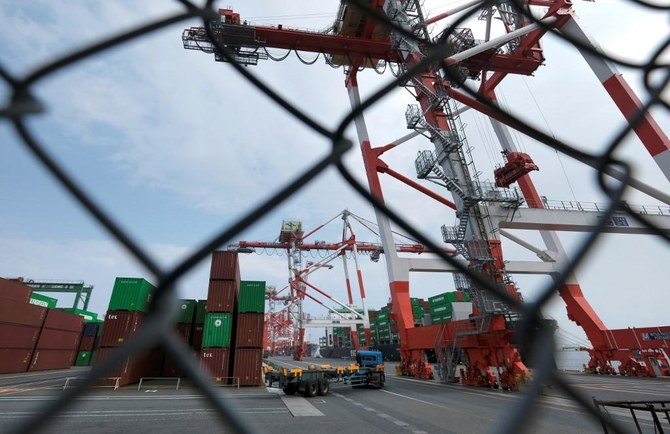
- A long-sought trade pact with Japan was scrapped when Donald Trump withdrew the US from a pan-Pacific trade agreement shortly after taking office in 2017
- Trump said he preferred that Washington and Tokyo strike a bilateral deal
First EU–Saudi roundtable on critical raw materials reflects shared policy commitment
RIYADH: The EU–Saudi Arabia Business and Investment Dialogue on Advancing Critical Raw Materials Value Chains, held in Riyadh as part of the Future Minerals Forum, brought together senior policymakers, industry leaders, and investors to advance strategic cooperation across critical raw materials value chains.
Organized under a Team Europe approach by the EU–GCC Cooperation on Green Transition Project, in coordination with the EU Delegation to Saudi Arabia, the European Chamber of Commerce in the Kingdom and in close cooperation with FMF, the dialogue provided a high-level platform to explore European actions under the EU Critical Raw Materials Act and ResourceEU alongside the Kingdom’s aspirations for minerals, industrial, and investment priorities.
This is in line with Saudi Vision 2030 and broader regional ambitions across the GCC, MENA, and Africa.
ResourceEU is the EU’s new strategic action plan, launched in late 2025, to secure a reliable supply of critical raw materials like lithium, rare earths, and cobalt, reducing dependency on single suppliers, such as China, by boosting domestic extraction, processing, recycling, stockpiling, and strategic partnerships with resource-rich nations.
The first ever EU–Saudi roundtable on critical raw materials was opened by the bloc’s Ambassador to the Kingdom, Christophe Farnaud, together with Saudi Deputy Minister for Mining Development Turki Al-Babtain, turning policy alignment into concrete cooperation.
Farnaud underlined the central role of international cooperation in the implementation of the EU’s critical raw materials policy framework.
“As the European Union advances the implementation of its Critical Raw Materials policy, international cooperation is indispensable to building secure, diversified, and sustainable value chains. Saudi Arabia is a key partner in this effort. This dialogue reflects our shared commitment to translate policy alignment into concrete business and investment cooperation that supports the green and digital transitions,” said the ambassador.
Discussions focused on strengthening resilient, diversified, and responsible CRM supply chains that are essential to the green and digital transitions.
Participants explored concrete opportunities for EU–Saudi cooperation across the full value chain, including exploration, mining, and processing and refining, as well as recycling, downstream manufacturing, and the mobilization of private investment and sustainable finance, underpinned by high environmental, social, and governance standards.
From the Saudi side, the dialogue was framed as a key contribution to the Kingdom’s industrial transformation and long-term economic diversification agenda under Vision 2030, with a strong focus on responsible resource development and global market integration.
“Developing globally competitive mineral hubs and sustainable value chains is a central pillar of Saudi Vision 2030 and the Kingdom’s industrial transformation. Our engagement with the European Union through this dialogue to strengthen upstream and downstream integration, attract high-quality investment, and advance responsible mining and processing. Enhanced cooperation with the EU, capitalizing on the demand dynamics of the EU Critical Raw Materials Act, will be key to delivering long-term value for both sides,” said Al-Babtain.
Valere Moutarlier, deputy director-general for European industry decarbonization, and directorate-general for the internal market, industry, entrepreneurship and SMEs at European Commission, said the EU Critical Raw Materials Act and ResourceEU provided a clear framework to strengthen Europe’s resilience while deepening its cooperation with international partners.
“Cooperation with Saudi Arabia is essential to advancing secure, sustainable, and diversified critical raw materials value chains. Dialogues such as this play a key role in translating policy ambitions into concrete industrial and investment cooperation,” she added.


