PM Khan phones Saudi crown prince, condemns attack on oil facilities

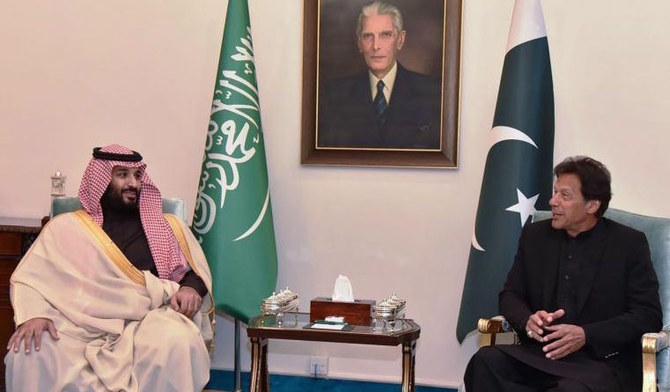
Pakistan's Prime Minister Imran Khan (right) speaks with Crown Prince Mohammed bin Salman at the Prime Minister House upon his arrival in Islamabad on Feb 17, 2019. (File/AFP)
Updated 18 September 2019
Follow

PM Khan phones Saudi crown prince, condemns attack on oil facilities

  • US envoy to UN says emerging information point at Iran's involvement
  • The attack on Saudi Aramco cut the kingdom's oil production by more than half adversely impacting the global economy.

ISLAMABAD – Prime Minister Imran Khan spoke with Saudi Crown Prince Mohammed bin Salman over the phone Monday night to condemn the attack on the kingdom’s oil facilities, according to the Saudi Press Agency (SPA).
"During the telephone conversation, the Pakistani Prime Minister expressed Pakistan’s full support and stand for the Kingdom with all its capabilities to confront these sabotage activities which threaten the global economy and the Kingdom’s security,” the SPA reported.  
The Pakistani premier reiterated his country’s support to Saudi Arabia against any terror attack and vowed to stand by Saudi Arabia in case of any threat to the sanctity and security of the two holy mosques.
Khan also expressed full support and solidarity with the brotherly nation against any threat to its security and territorial integrity. The Saudi crown prince said that Saudi Arabia has capability to fight against terrorists, the local media reported on Tuesday.
The rebel Houthi group in Yemen claimed responsibility for the horrific Saturday attack, which damaged the world’s biggest crude oil processing plant cutting the Kingdom’s oil production by more than half.
On Monday, the Saudi-led coalition said that the attack on Saudi oil facilities was carried out with Iranian weapons, an allegation that Tehran denied.
However, US President Donald Trump, said that Washington was “locked and loaded” to hit back while US Secretary of Energy Rick Perry termed the incident “an attack on global economy.”
The US Ambassador to the UN Security council, Kelly Craft, also maintained that emerging information on the attacks “indicates that responsibility lies with Iran” and that there is no evidence the attack came from Yemen.


Pakistan sets expectations for Trump-backed Gaza Board of Peace at UN

Updated 4 sec ago
Follow

Pakistan sets expectations for Trump-backed Gaza Board of Peace at UN

  • The country calls for ceasefire enforcement and reconstruction of the war-ravaged territory
  • Pakistani diplomat warns Gaza recovery must proceed without annexation or forced displacement

ISLAMABAD: Pakistan on Wednesday highlighted its expectations of US President Donald Trump’s Board of Peace (BoP) in Gaza, saying it joined the United Nations-backed body alongside other Muslim nations since it expected concrete steps toward a permanent ceasefire, reconstruction of Gaza and a lasting and just peace grounded in the Palestinian right to statehood.

Prime Minister Shehbaz Sharif signed the Gaza Board of Peace charter earlier this week along with other world leaders on the sidelines of the 56th Annual Meeting of the World Economic Forum in Davos.

Pakistan’s Permanent Representative to the UN, Ambassador Asim Iftikhar Ahmad, told an open Security Council debate on the Middle East that the decision was driven by the need to address the “unresolved Palestinian question,” which he described as “the core of the instability” in the region.

“We hope that the BoP under the framework of resolution 2803 will lead to concrete steps toward the implementation of a permanent ceasefire, further scaling up of humanitarian aid, reconstruction of Gaza, and realization of the right to self-determination of the people of

Palestine through a credible, time-bound political process, consistent with international legitimacy and relevant UN resolutions resulting in an independent, sovereign and contiguous state of Palestine based on pre-1967 borders with Al-Quds Al-Sharif as its capital,” Ahmad said while addressing the council.

“That is the ultimate goal supported by the international community,” he added. “Palestinian-led governance and institutional strengthening, with a central role of the Palestinian Authority, are indispensable in this regard.”

Ahmad maintained Pakistan was deeply concerned about the fragile situation in Gaza, pointing to Israel’s continued ceasefire violations that he said were putting civilian lives at risk. He stressed that the ceasefire must be fully respected with a view to a permanent cessation of hostilities.

The Pakistani diplomat said recovery and reconstruction should begin without delay and must proceed without annexation, forced displacement or any alteration of the territorial unity of the Occupied Palestinian Territory.

“The contiguity of Gaza and the West Bank is indispensable for the viability of the Palestinian state,” he said.

Ahmad also called for a credible, irreversible and time-bound political process culminating in the realization of Palestinian statehood in accordance with international legitimacy.

“The international community, particularly this council, bears the responsibility to translate renewed engagement into measurable change on the ground for the betterment of the Palestinian people,” he said, adding that Pakistan was ready to work with “members of the council, regional and international partners, and the United States to advance a just and lasting solution to the Palestinian question, and comprehensive peace in the Middle East.”