World must transform food production, scientists say

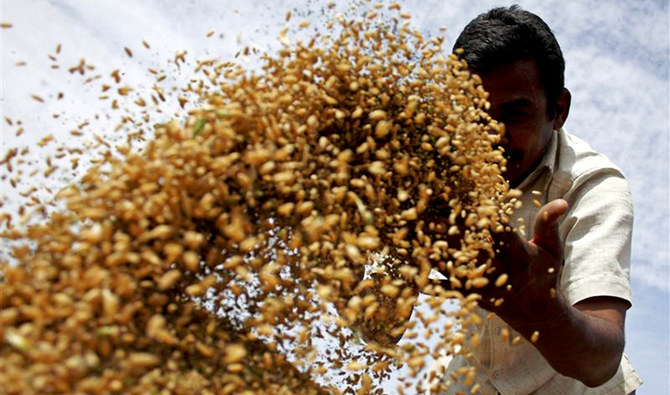
The study says the reforms can free up 1.2 billion hectares of agricultural land for restoration. (Reuters)
Updated 17 September 2019
Follow

World must transform food production, scientists say

  • Global over-dependence on a relatively small number of staple foods leaves populations vulnerable to crop failures

LONDON: The world must diversify its food production and consumption, or face damaging supply disruptions that could lead to suffering and social unrest, scientists warned on Monday.

A new global study found the health and environmental benefits of transforming the way we farm would heavily outweigh the cost of doing so, with the authors urging governments to do more to support sustainable agriculture.

“A small disruption in supply really can do a lot of damage and leads to huge price increases,” said Per Pharo of the Food and Land Use Coalition, the global alliance of economists and scientists behind the study.

“That creates suffering and social unrest. And it will highly likely also lead to hunger and instability,” he told the Thomson Reuters Foundation.

Global over-dependence on a relatively small number of staple foods leaves populations vulnerable to crop failures, with climate change adding to the strain, the report said.

“Four different crops provide 60 percent of our calories — wheat, rice, maize and potatoes. That increases our vulnerability,” said Pharo. The panel said the report was the first of its kind to assess the benefits of transforming global food systems as well as the cost of inaction.

The damage the modern food industry does to human health, development and the environment costs the world $12 trillion a year — equivalent to China’s GDP — the study found.

It proposes a series of solutions, from encouraging more diverse diets to improve health and reduce dependency on specific crops, to giving more support to the types of farming that can restore forests, a key tool in fighting climate change.

In Costa Rica, for example, the government has reversed deforestation by eliminating cattle subsidies and introducing payments to farmers who manage their land sustainably.

As a result, the amount of forest cover has risen from a quarter of the country’s land in 1983 to more than half today, the report said.

And it will highly likely also lead to hunger and instability

The study said the reforms could also free up 1.2 billion hectares of agricultural land for restoration.

That is more than twice the size of the Amazon rainforest, which spans seven nations.

“What we’re saying is realistic if the reform agenda is implemented,” said Pharo, adding that under the proposed changes, consumers would actually get “slightly more affordable food.”

“The excuse that we cannot prioritize environment at the same time because we’ve got to focus on development, on human welfare, is simply false. We can deliver both.”



Saudi Arabia reports surge in patent filings amid innovation drive

Updated 55 min 4 sec ago
Follow

Saudi Arabia reports surge in patent filings amid innovation drive

RIYADH: Saudi Arabia recorded a significant increase in the number of patent applications filed by individuals and national institutions during 2025, reflecting a growing awareness among innovators and national entities of the importance of protecting innovations and maximizing the value of intangible assets.

The Saudi Authority for Intellectual Property explained that patent applications filed by individuals witnessed substantial growth, rising from 2,007 submissions in 2024 to 3,942 in 2025, representing a growth rate of 96 percent. This indicates a broadening base of innovators and entrepreneurs, and a rising awareness of the importance of registering intellectual property rights, according to the Saudi Press Agency. 

The authority also indicated that the number of patent applications filed by national institutions increased from 408 in 2024 to 734 in 2025, representing an 80 percent growth. This reflects the increasing interest of national entities in protecting their innovations and transforming them into valuable economic assets.

The entity further noted that this growth contributed to raising the total number of patent applications filed in 2025 to 10,300, compared to 8,029 in 2024. It affirmed its continued efforts to develop the intellectual property system, streamline registration procedures, and support innovation, in line with the objectives of the Kingdom’s Vision 2030.

Saudi Arabia has made notable progress in the 2025 Global Intellectual Property Index, with its score rising by 17.5 percent, placing it among the fastest-improving economies out of the 55 countries evaluated.

According to the 13th edition of the index, published by the US Chamber of Commerce in April, the Kingdom now ranks 40th globally, a reflection of the substantial reforms driven by its Vision 2030 strategy. These reforms aim to enhance intellectual property protection, foster innovation, and support the growth of a knowledge-based economy.

Since 2019, Saudi Arabia’s overall score has increased from 36.6 percent to 53.7 percent in 2025, marking a cumulative improvement of over 40 percent in just six years. This progress stems from a comprehensive transformation of the nation’s IP ecosystem, including the strengthening of legal frameworks and enforcement mechanisms.

These developments highlight Saudi Arabia’s growing institutional capacity and ongoing regulatory modernization, led by the SAIP.