KARACHI: Pakistan would take a $1.2 billion hit on every $5 per barrel increase in the global oil prices, experts told Arab News after two Saudi oil facilities were droned on Saturday, adding that such a scenario could lead to “unimaginable” economic consequences for the South Asian country.
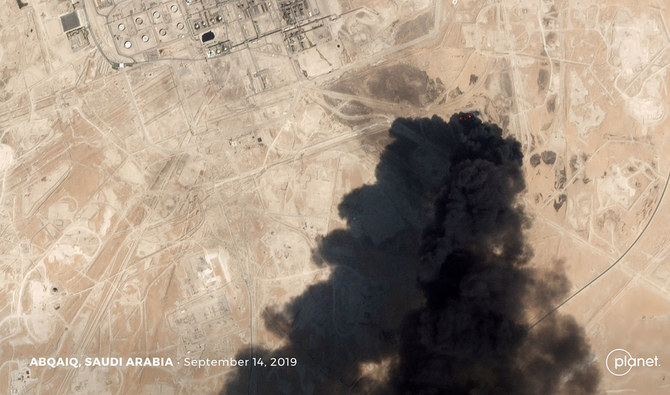
The Houthi militia attacked the Kingdom’s major oil facilities in the Eastern Province on Saturday, causing a disruption of 5.7 million barrels a day and removed 5 percent of global oil supply that resulted in a 15 percent increase in the global oil price at the beginning of the Asian trade on Monday.
The Brent crude for November futures traded at $65.41 per barrel by midday after posting an 8.6 percent gain in the Asian trade.
The attack that the US State Secretary, Mike Pompeo, blamed on Iran resulted in the single biggest oil supply disruption since the Iranian Revolution of 1979 when 5.6 million barrels a day went out of the global supply.
With all eyes riveted on Saudi Arabia and how quickly it manages to restore its full oil production, Pakistani experts say it will have a devastating impact on the country’s economy as Pakistan’s enhanced oil import bill will undermine all the measures to bring down the current account deficit.
Oil imports constituted 26 percent of the country’s total import bill of $54.8 billion during the fiscal year FY19 and 24 percent during the fiscal year FY18, according to the Pakistan Bureau of Statistics.
“Every $5 per barrel surge in oil prices weakens Pakistan’s balance of payments by $1.2bn on an annual basis, assuming that the prices remain high throughout the year,” Samiullah Tariq, Director Research at the Arif Habib Limited, a brokerage firm, told Arab News on Monday.
“Higher oil prices will lead to higher inflation and negative balance of payments. If the global uncertainty persists it will also negatively affect us since such circumstances usually impede financial inflows. It would also make things difficult for Eurobond and Sukuk issuance,” he added.
Economists say that such attacks can thwart Pakistan’s efforts to reduce its import bill, adding to its current account deficit once again.
“The price spike that is expected to stay at around $70 per barrel will increase our import bill and trade deficit that recently declined. This will once again begin to erode our foreign reserves,” Dr. Ayub Mehar, a senior economist, told Arab News.
“The government must take remedial measures from now on,” he added.
“The increasing crude prices will exert pressure on an already indebted nation,” GA Sabri, former secretary petroleum, told Arab News. “We are facing a financial crisis and this attack can further deepen our losses. The losses can be unmanageable because we mainly import oil from Saudi Arabia. The recent developments are very serious and disturbing and can have a trickle down impact on the overall economy.”
Experts suggest exploration of domestic energy resources. They also implore the government to find new oil import destinations to mitigate risks to Pakistan’s energy security.
“This attack on the Aramco installations show that in future such facilities would be subjected to war targets in the regional flare up. This will impact your strategic facilities,” Dr. Maria Sultan, Director General of South Asian Strategic Stability Institute University, told Arab News.
“I am constantly calling for exploration of domestic oil and gas and other minerals because the country is full of these natural energy resources,” Sabri suggested. “We must also honor our commitments and start long term TAPI [Turkmenistan-Afghanistan-Pakistan-India] gas pipeline project,” he added.


Pakistan looking at 'unmanageable' economic catastrophe post Aramco attacks – experts
Pakistan looking at 'unmanageable' economic catastrophe post Aramco attacks – experts

- Every $5 per barrel price increase would jack up Pakistan’s import bill by $1.2 billion, analysts warn
- Houthis attack on oil facilities removes 5.7 mbd from global supply, trigger price spike

Pakistan urges pilgrims to complete Saudi biometrics as Hajj preparations gain pace
- Government warns pilgrims biometric verification is required for Hajj visas
- Step follows tighter oversight after last year’s Hajj travel disruptions
ISLAMABAD: Pakistan’s government on Friday urged aspiring pilgrims to complete mandatory Saudi biometric verification for Hajj visas, as preparations for the 2026 pilgrimage gather pace following stricter oversight of the Hajj process.
The announcement comes only a day after Pakistan’s Religious Affairs Minister Sardar Muhammad Yousuf said regulations for private Hajj operators had been tightened, reducing their quota following widespread complaints last year, when tens of thousands of pilgrims were unable to travel under the private Hajj scheme.
“Saudi biometric verification is mandatory for the issuance of Hajj visas,” the Ministry of Religious Affairs said in a statement, urging pilgrims to complete the process promptly to avoid delays.
“Hajj pilgrims should complete their biometric verification at home using the ‘Saudi Visa Bio’ app as soon as possible,” it added.
The statement said the pilgrims who were unable to complete biometric verification through the mobile application should visit designated Saudi Tasheer centers before Feb. 8, adding that details of the centers were available on Pakistan’s official Hajj mobile application.
Pakistan has been steadily implementing digital and procedural requirements for pilgrims ahead of Hajj 2026, including mandatory training sessions, biometric checks and greater use of mobile applications, as part of efforts to reduce mismanagement.
Saudi Arabia has allocated Pakistan a quota of 179,210 pilgrims for Hajj 2026, with the majority of seats reserved under the government scheme and the remainder allocated to private tour operators.


